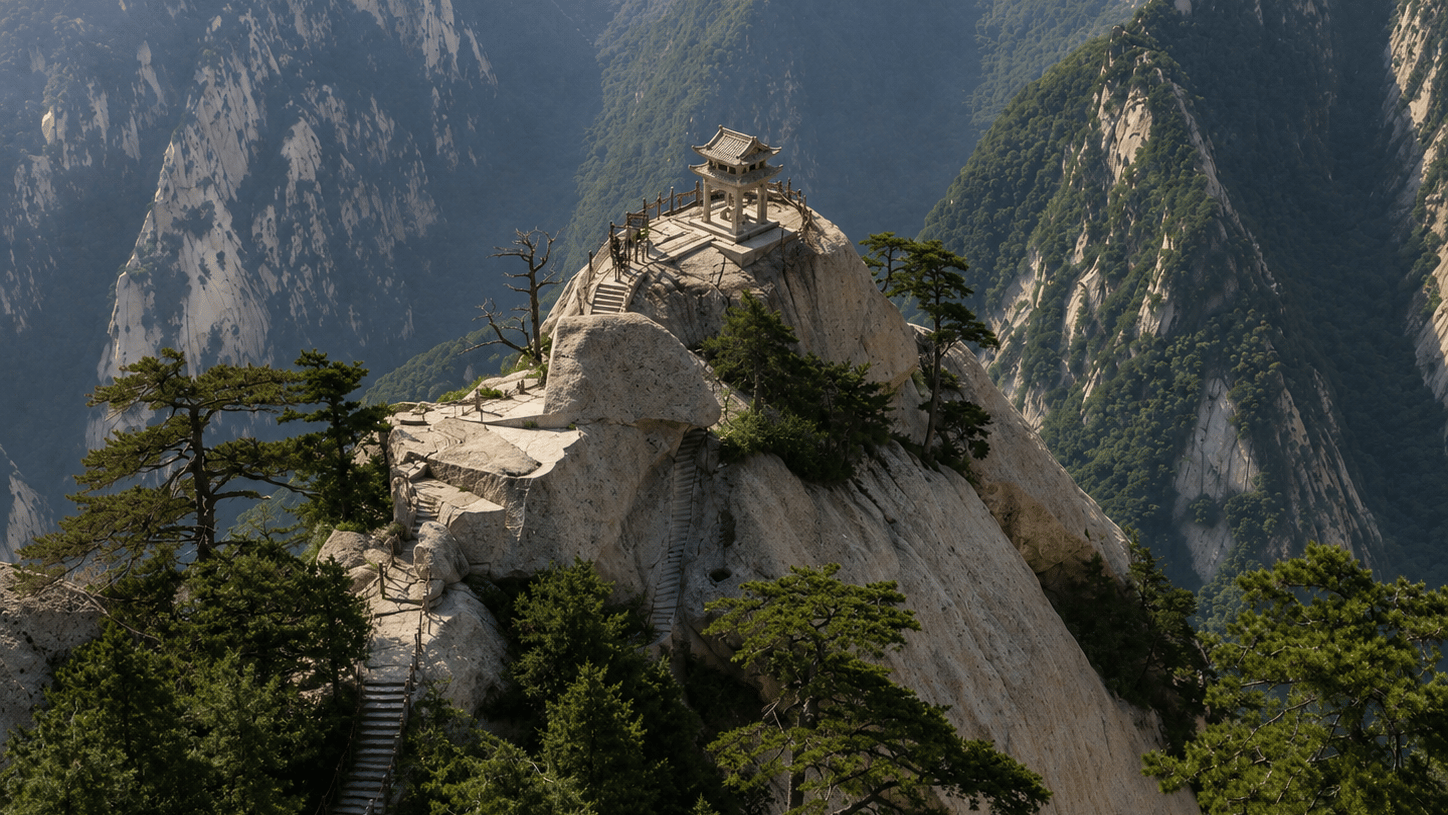
East Asia · Elevated Stronghold
Mount Huashan
China
Mount Huashan is strongest on Population Capacity 8/10 — The official West Peak hotel alone advertises food and lodging for more than 60 people, with additional accommodation and facilities elsewhere on the mountain. This comfortably exceeds the twenty-person reference while sanitation and logistics constrain larger durable communities.. Its clearest scored constraint is Defensibility 3/10 — Very steep cliffs and constrained mountain paths provide useful local defensive geometry, but the canonical Base spans several peaks and many kilometres of routes with no continuous perimeter. Twenty people could hold selected approaches, not the whole mountain envelope..
Overall
4.7 out of 10Defensibility
3 out of 10Isolation
5 out of 10Sustainability
6 out of 10Ranking context
How this base ranks
Global
#52 of 91 · Top 57.14%
Region · East Asia
#1 of 5 · Top 20%
Base Type · Elevated Stronghold
#7 of 13 · Top 53.85%
Field assessment
At a glance
Bottom Line
For the fixed 20-person Base boundary, the most important endurance constraint is Resource Security 3/10 — Current mountain restaurants, shops and lodging imply meaningful immediate stocks and managed water/sanitation, but the official accommodation material also shows water constraints and basic sanitation. No independent protected potable-water source, durable food production or autonomous survival-energy pathway is established..
Biggest Trade-off
The central trade-off is the catalogue's strongest evidenced dimension, Population Capacity at 8/10, against its weakest evidenced dimension, Defensibility at 3/10.
Most Likely Failure
The evaluation leaves this material failure condition unresolved: Current visitor water and sanitation support are evidenced, but independent protected long-duration potable-water production/storage for the canonical mountain Base is not. R3 credits supplied current facilities only.
Score rationale
Why it scores this way
Defensibility · 3/10
Very steep cliffs and constrained mountain paths provide useful local defensive geometry, but the canonical Base spans several peaks and many kilometres of routes with no continuous perimeter. Twenty people could hold selected approaches, not the whole mountain envelope.
Advantages
- Positive credit is limited to what supports the Defensibility score of 3/10; the component rationale is: Very steep cliffs and constrained mountain paths provide useful local defensive geometry, but the canonical Base spans several peaks and many kilometres of routes with no continuous perimeter. Twenty people could hold selected approaches, not the whole mountain envelope.
Limitations
- Do not infer additional Defensibility capability outside the fixed Base boundary or beyond the recorded evidence.
Isolation · 5/10
Elevation and arduous mountain approaches provide meaningful separation, but Huashan is a major visitor landscape with cableways, roads and substantial routine access rather than a remote wilderness outpost.
Advantages
- Positive credit is limited to what supports the Isolation score of 5/10; the component rationale is: Elevation and arduous mountain approaches provide meaningful separation, but Huashan is a major visitor landscape with cableways, roads and substantial routine access rather than a remote wilderness outpost.
Limitations
- Do not infer additional Isolation capability outside the fixed Base boundary or beyond the recorded evidence.
Sustainability · 6/10
Current on-mountain hotels, food service, toilets and permanent religious/visitor structures provide real sleeping and support capacity for more than twenty people. Basic rooms, no bathing at peak hotels and externally supported mountain services keep prolonged habitat well below settlement quality.
Advantages
- Positive credit is limited to what supports the Sustainability score of 6/10; the component rationale is: Current on-mountain hotels, food service, toilets and permanent religious/visitor structures provide real sleeping and support capacity for more than twenty people. Basic rooms, no bathing at peak hotels and externally supported mountain services keep prolonged habitat well below settlement quality.
Limitations
- Do not infer additional Sustainability capability outside the fixed Base boundary or beyond the recorded evidence.
Survival horizons
How survival changes over time
First 7 days: current defence/contact profile
First 7 Days
This horizon does not invent future upgrades or resupply. It carries the current evaluated conditions forward and keeps unknown future capability uncredited.
Positive factors
- The stronger current condition in this horizon is Exposure Control 7/10 — Steep cliffs, narrow trails, passes and gates strongly channel practical movement and provide warning, although several peaks, cableways and route choices prevent one easily monitored choke point..
Risks
- The weaker current condition in this horizon is Defensibility 3/10 — Very steep cliffs and constrained mountain paths provide useful local defensive geometry, but the canonical Base spans several peaks and many kilometres of routes with no continuous perimeter. Twenty people could hold selected approaches, not the whole mountain envelope.; no better future state is assumed.
First 100 days: current habitat/capacity profile
First 100 Days
This horizon does not invent future upgrades or resupply. It carries the current evaluated conditions forward and keeps unknown future capability uncredited.
Positive factors
- The stronger current condition in this horizon is Population Capacity 8/10 — The official West Peak hotel alone advertises food and lodging for more than 60 people, with additional accommodation and facilities elsewhere on the mountain. This comfortably exceeds the twenty-person reference while sanitation and logistics constrain larger durable communities..
Risks
- The weaker current condition in this horizon is Sustainability 6/10 — Current on-mountain hotels, food service, toilets and permanent religious/visitor structures provide real sleeping and support capacity for more than twenty people. Basic rooms, no bathing at peak hotels and externally supported mountain services keep prolonged habitat well below settlement quality.; no better future state is assumed.
Long term: current resource/maintenance profile
Long Term
This horizon does not invent future upgrades or resupply. It carries the current evaluated conditions forward and keeps unknown future capability uncredited.
Positive factors
- The stronger current condition in this horizon is Maintenance Resilience 4/10 — Rock terrain, paths and simple bed accommodation retain useful passive value, but normal mountain operation relies on maintained cableways, utilities, visitor infrastructure and continuous supply movement. Walking routes provide a meaningful manual fallback if powered transport fails..
Risks
- The weaker current condition in this horizon is Resource Security 3/10 — Current mountain restaurants, shops and lodging imply meaningful immediate stocks and managed water/sanitation, but the official accommodation material also shows water constraints and basic sanitation. No independent protected potable-water source, durable food production or autonomous survival-energy pathway is established.; no better future state is assumed.
Tactical assessment
Practical Reality
Reality Check
Scores apply only to the defined Base and exactly 20 capable adults. Unknown, excluded or external assets are not credited as hidden capability.
Best Use
Within the evaluated boundary, treat Population Capacity as the primary operational strength; do not promote that score into capabilities the evidence does not establish.
Key Risk
Resource Security is the key evidenced long-duration risk: Current mountain restaurants, shops and lodging imply meaningful immediate stocks and managed water/sanitation, but the official accommodation material also shows water constraints and basic sanitation. No independent protected potable-water source, durable food production or autonomous survival-energy pathway is established.
Strengths
- One of the strongest scored dimensions is Population Capacity 8/10 — The official West Peak hotel alone advertises food and lodging for more than 60 people, with additional accommodation and facilities elsewhere on the mountain. This comfortably exceeds the twenty-person reference while sanitation and logistics constrain larger durable communities..
- One of the strongest scored dimensions is Exposure Control 7/10 — Steep cliffs, narrow trails, passes and gates strongly channel practical movement and provide warning, although several peaks, cableways and route choices prevent one easily monitored choke point..
- One of the strongest scored dimensions is Sustainability 6/10 — Current on-mountain hotels, food service, toilets and permanent religious/visitor structures provide real sleeping and support capacity for more than twenty people. Basic rooms, no bathing at peak hotels and externally supported mountain services keep prolonged habitat well below settlement quality..
Weaknesses
- One of the weakest scored dimensions is Defensibility 3/10 — Very steep cliffs and constrained mountain paths provide useful local defensive geometry, but the canonical Base spans several peaks and many kilometres of routes with no continuous perimeter. Twenty people could hold selected approaches, not the whole mountain envelope..
- One of the weakest scored dimensions is Resource Security 3/10 — Current mountain restaurants, shops and lodging imply meaningful immediate stocks and managed water/sanitation, but the official accommodation material also shows water constraints and basic sanitation. No independent protected potable-water source, durable food production or autonomous survival-energy pathway is established..
- One of the weakest scored dimensions is Maintenance Resilience 4/10 — Rock terrain, paths and simple bed accommodation retain useful passive value, but normal mountain operation relies on maintained cableways, utilities, visitor infrastructure and continuous supply movement. Walking routes provide a meaningful manual fallback if powered transport fails..
Assumptions / constraints
- Only assets inside the recorded Core Base and immediate operating boundary are credited; excluded surroundings and unproven future access remain outside the score.
Decision context
Rivals / Alternatives
Similar rival
Batad Rice Terraces
Philippines · Elevated Stronghold
Batad Rice Terraces keeps the same elevated stronghold strategy, with only 0.3 points between the overall scores and closely matched sustainability pressure.
Overall 5/10
Strongest alternative
Amundsen-Scott South Pole Station
Antarctica · Institutional Compound
Amundsen-Scott South Pole Station scores 7.7 overall versus 4.7, adding a stronger isolation profile while staying relevant as a comparable survival plan.
Overall 7.7/10
Wildcard rival
Fort Jefferson
United States · Fortified Structure
Fort Jefferson changes the strategy: it is a fortified structure with a defensibility edge, while Mount Huashan holds more of the sustainability advantage.
Overall 6.7/10