Polar/Arctic · Institutional Compound
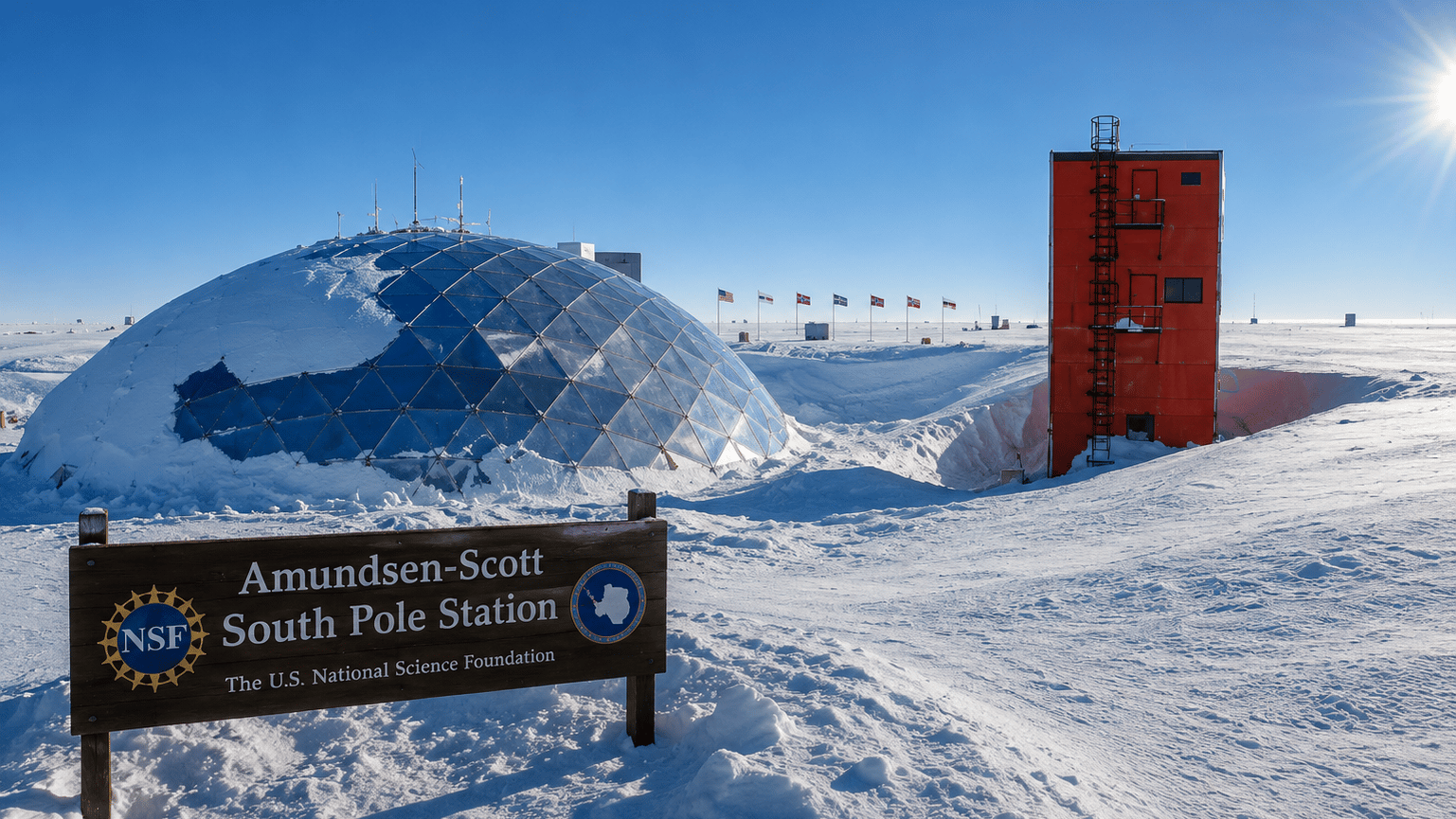
Amundsen-Scott South Pole Station
Antarctica
Amundsen-Scott South Pole Station is strongest on Isolation 10/10 — At the geographic South Pole on the high Antarctic plateau, the station has exceptional real-world separation from ordinary population sources, with access dependent on specialist long-distance aviation or overland logistics. This fits the highest credible geographic-separation class.. Its clearest scored constraint is Maintenance Resilience 2/10 — Survival depends on highly engineered heat, power, water and sewage systems in a lethal climate. Rodwell pumping/treatment, generator/fuel systems and specialist repair cycles create several critical dependencies with limited low-tech fallback..
Overall
7.7 out of 10Defensibility
4 out of 10Isolation
10 out of 10Sustainability
9 out of 10Ranking context
How this base ranks
Global
#1 of 91 · Top 1.1%
Region · Polar/Arctic
#1 of 3 · Top 33.33%
Base Type · Institutional Compound
#1 of 7 · Top 14.29%
Field assessment
At a glance
Bottom Line
For the fixed 20-person Base boundary, the most important endurance constraint is Maintenance Resilience 2/10 — Survival depends on highly engineered heat, power, water and sewage systems in a lethal climate. Rodwell pumping/treatment, generator/fuel systems and specialist repair cycles create several critical dependencies with limited low-tech fallback..
Biggest Trade-off
The central trade-off is the catalogue's strongest evidenced dimension, Isolation at 10/10, against its weakest evidenced dimension, Maintenance Resilience at 2/10.
Most Likely Failure
The clearest evidenced failure pressure is Maintenance Resilience: Survival depends on highly engineered heat, power, water and sewage systems in a lethal climate. Rodwell pumping/treatment, generator/fuel systems and specialist repair cycles create several critical dependencies with limited low-tech fallback.
Score rationale
Why it scores this way
Defensibility · 4/10
The occupied station is physically elevated above the plateau, and NSF documents an internally connected vertical-tower/support-arch layout plus a Pod B fallback that can be sealed from the rest of the station while retaining essential occupied functions. Those features provide real separation, a useful access/choke geometry and documented internal fallback, but the site is not evidenced as a hardened defended perimeter and no breach-resistant exterior access-control system is established. It therefore fits a genuinely defendable location with important weaknesses rather than the stronger 5-10 classes.
Advantages
- Positive credit is limited to what supports the Defensibility score of 4/10; the component rationale is: The occupied station is physically elevated above the plateau, and NSF documents an internally connected vertical-tower/support-arch layout plus a Pod B fallback that can be sealed from the rest of the station while retaining essential occupied functions. Those features provide real separation, a useful access/choke geometry and documented internal fallback, but the site is not evidenced as a hardened defended perimeter and no breach-resistant exterior access-control system is established. It therefore fits a genuinely defendable location with important weaknesses rather than the stronger 5-10 classes.
Limitations
- Do not infer additional Defensibility capability outside the fixed Base boundary or beyond the recorded evidence.
Isolation · 10/10
At the geographic South Pole on the high Antarctic plateau, the station has exceptional real-world separation from ordinary population sources, with access dependent on specialist long-distance aviation or overland logistics. This fits the highest credible geographic-separation class.
Advantages
- Positive credit is limited to what supports the Isolation score of 10/10; the component rationale is: At the geographic South Pole on the high Antarctic plateau, the station has exceptional real-world separation from ordinary population sources, with access dependent on specialist long-distance aviation or overland logistics. This fits the highest credible geographic-separation class.
Limitations
- Do not infer additional Isolation capability outside the fixed Base boundary or beyond the recorded evidence.
Sustainability · 9/10
The station is purpose-built for year-round occupation in an extreme environment and includes housing, dining, medical, recreation, food-growth, water and sewage systems. For twenty people it offers outstanding habitat capability, with technical dependence preventing a 10.
Advantages
- Positive credit is limited to what supports the Sustainability score of 9/10; the component rationale is: The station is purpose-built for year-round occupation in an extreme environment and includes housing, dining, medical, recreation, food-growth, water and sewage systems. For twenty people it offers outstanding habitat capability, with technical dependence preventing a 10.
Limitations
- Do not infer additional Sustainability capability outside the fixed Base boundary or beyond the recorded evidence.
Survival horizons
How survival changes over time
First 7 days: current defence/contact profile
First 7 Days
This horizon does not invent future upgrades or resupply. It carries the current evaluated conditions forward and keeps unknown future capability uncredited.
Positive factors
- The stronger current condition in this horizon is Exposure Control 6/10 — The flat open plateau offers unusually long warning and little urban blind ground, but the station itself is not evidenced as a narrow chokepoint system and sustained all-direction monitoring remains a burden. Strong visibility therefore stops short of the tightly channelled upper classes..
Risks
- The weaker current condition in this horizon is Defensibility 4/10 — The occupied station is physically elevated above the plateau, and NSF documents an internally connected vertical-tower/support-arch layout plus a Pod B fallback that can be sealed from the rest of the station while retaining essential occupied functions. Those features provide real separation, a useful access/choke geometry and documented internal fallback, but the site is not evidenced as a hardened defended perimeter and no breach-resistant exterior access-control system is established. It therefore fits a genuinely defendable location with important weaknesses rather than the stronger 5-10 classes.; no better future state is assumed.
First 100 days: current habitat/capacity profile
First 100 Days
This horizon does not invent future upgrades or resupply. It carries the current evaluated conditions forward and keeps unknown future capability uncredited.
Positive factors
- The stronger current condition in this horizon is Sustainability 9/10 — The station is purpose-built for year-round occupation in an extreme environment and includes housing, dining, medical, recreation, food-growth, water and sewage systems. For twenty people it offers outstanding habitat capability, with technical dependence preventing a 10..
Risks
- The weaker current condition in this horizon is Population Capacity 8/10 — Current operation supports roughly 42 winter residents and about 150 summer residents with purpose-built housing and supporting systems, leaving substantial functional headroom beyond the fixed twenty-person reference.; no better future state is assumed.
Long term: current resource/maintenance profile
Long Term
This horizon does not invent future upgrades or resupply. It carries the current evaluated conditions forward and keeps unknown future capability uncredited.
Positive factors
- The stronger current condition in this horizon is Resource Security 4/10 — The station has large fuel storage and a credible on-site ice-to-water pathway plus some food growth, but food and fuel remain dependent on seasonal external resupply and water production is technically intensive. Strong stores do not amount to durable independence..
Risks
- The weaker current condition in this horizon is Maintenance Resilience 2/10 — Survival depends on highly engineered heat, power, water and sewage systems in a lethal climate. Rodwell pumping/treatment, generator/fuel systems and specialist repair cycles create several critical dependencies with limited low-tech fallback.; no better future state is assumed.
Tactical assessment
Practical Reality
Reality Check
Scores apply only to the defined Base and exactly 20 capable adults. Unknown, excluded or external assets are not credited as hidden capability.
Best Use
Within the evaluated boundary, treat Isolation as the primary operational strength; do not promote that score into capabilities the evidence does not establish.
Key Risk
Maintenance Resilience is the key evidenced long-duration risk: Survival depends on highly engineered heat, power, water and sewage systems in a lethal climate. Rodwell pumping/treatment, generator/fuel systems and specialist repair cycles create several critical dependencies with limited low-tech fallback.
Strengths
- One of the strongest scored dimensions is Isolation 10/10 — At the geographic South Pole on the high Antarctic plateau, the station has exceptional real-world separation from ordinary population sources, with access dependent on specialist long-distance aviation or overland logistics. This fits the highest credible geographic-separation class..
- One of the strongest scored dimensions is Sustainability 9/10 — The station is purpose-built for year-round occupation in an extreme environment and includes housing, dining, medical, recreation, food-growth, water and sewage systems. For twenty people it offers outstanding habitat capability, with technical dependence preventing a 10..
- One of the strongest scored dimensions is Population Capacity 8/10 — Current operation supports roughly 42 winter residents and about 150 summer residents with purpose-built housing and supporting systems, leaving substantial functional headroom beyond the fixed twenty-person reference..
Weaknesses
- One of the weakest scored dimensions is Maintenance Resilience 2/10 — Survival depends on highly engineered heat, power, water and sewage systems in a lethal climate. Rodwell pumping/treatment, generator/fuel systems and specialist repair cycles create several critical dependencies with limited low-tech fallback..
- One of the weakest scored dimensions is Defensibility 4/10 — The occupied station is physically elevated above the plateau, and NSF documents an internally connected vertical-tower/support-arch layout plus a Pod B fallback that can be sealed from the rest of the station while retaining essential occupied functions. Those features provide real separation, a useful access/choke geometry and documented internal fallback, but the site is not evidenced as a hardened defended perimeter and no breach-resistant exterior access-control system is established. It therefore fits a genuinely defendable location with important weaknesses rather than the stronger 5-10 classes..
- One of the weakest scored dimensions is Resource Security 4/10 — The station has large fuel storage and a credible on-site ice-to-water pathway plus some food growth, but food and fuel remain dependent on seasonal external resupply and water production is technically intensive. Strong stores do not amount to durable independence..
Assumptions / constraints
- Only assets inside the recorded Core Base and immediate operating boundary are credited; excluded surroundings and unproven future access remain outside the score.
Decision context
Rivals / Alternatives
Similar rival
McMurdo Station
Antarctica · Fortified Structure
McMurdo Station keeps the same Polar/Arctic risk context, with only 1.0 points between the overall scores and closely matched defensibility pressure.
Overall 6.7/10
Strongest alternative
Danum Valley Field Centre
Malaysia · Institutional Compound
Danum Valley Field Centre is the strongest relevant peer available at 6.0 overall versus 7.7, without a higher headline-pillar score.
Overall 6/10
Wildcard rival
Great Mosque of Djenné
Mali · Landmark Structure
Great Mosque of Djenné changes the strategy: it is a landmark structure without a headline-pillar edge over Amundsen-Scott South Pole Station, while Amundsen-Scott South Pole Station holds more of the isolation advantage.
Overall 1.3/10