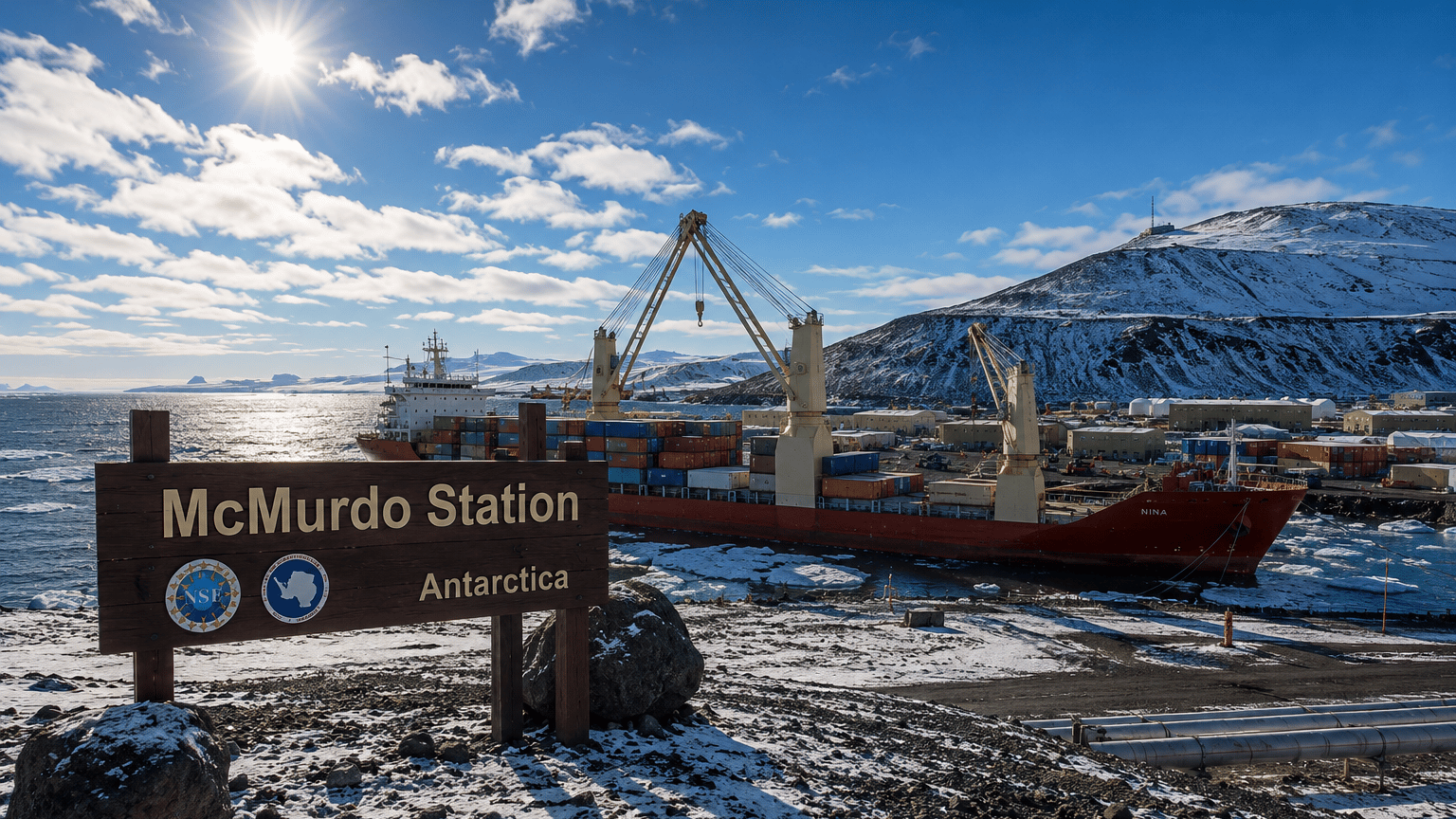
Polar/Arctic · Fortified Structure
McMurdo Station
Antarctica
McMurdo Station is strongest on Isolation 9/10 — McMurdo is an exceptionally remote Antarctic station separated from major population sources by continental-scale distance and difficult air/sea logistics. Its large seasonal population and established transport links keep it below the rarest 10-class separation.. Its clearest scored constraint is Defensibility 3/10 — McMurdo has many secureable substantial buildings and some local terrain advantage, but the documented Base is a dispersed roughly 49-acre road-and-building campus with no continuous hardened perimeter. Twenty survivors could fortify selected buildings but could not treat the entire operating station as a strong defended compound. Antarctic remoteness is deliberately excluded from this score..
Overall
6.7 out of 10Defensibility
3 out of 10Isolation
9 out of 10Sustainability
8 out of 10Ranking context
How this base ranks
Global
#4 of 91 · Top 4.4%
Region · Polar/Arctic
#2 of 3 · Top 66.67%
Base Type · Fortified Structure
#3 of 18 · Top 16.67%
Field assessment
At a glance
Bottom Line
For the fixed 20-person Base boundary, the most important endurance constraint is Maintenance Resilience 3/10 — The station's critical water and power systems depend on reverse osmosis, diesel generation, large engineered utilities and a normal maintenance ecosystem. NSF explicitly records degraded failure-prone infrastructure, and above-ground utility links expose distributed dependencies, so substantial capability erodes as fuel, parts and specialist support disappear..
Biggest Trade-off
The central trade-off is the catalogue's strongest evidenced dimension, Isolation at 9/10, against its weakest evidenced dimension, Defensibility at 3/10.
Most Likely Failure
The clearest evidenced failure pressure is Maintenance Resilience: The station's critical water and power systems depend on reverse osmosis, diesel generation, large engineered utilities and a normal maintenance ecosystem. NSF explicitly records degraded failure-prone infrastructure, and above-ground utility links expose distributed dependencies, so substantial capability erodes as fuel, parts and specialist support disappear.
Score rationale
Why it scores this way
Defensibility · 3/10
McMurdo has many secureable substantial buildings and some local terrain advantage, but the documented Base is a dispersed roughly 49-acre road-and-building campus with no continuous hardened perimeter. Twenty survivors could fortify selected buildings but could not treat the entire operating station as a strong defended compound. Antarctic remoteness is deliberately excluded from this score.
Advantages
- Positive credit is limited to what supports the Defensibility score of 3/10; the component rationale is: McMurdo has many secureable substantial buildings and some local terrain advantage, but the documented Base is a dispersed roughly 49-acre road-and-building campus with no continuous hardened perimeter. Twenty survivors could fortify selected buildings but could not treat the entire operating station as a strong defended compound. Antarctic remoteness is deliberately excluded from this score.
Limitations
- Do not infer additional Defensibility capability outside the fixed Base boundary or beyond the recorded evidence.
Isolation · 9/10
McMurdo is an exceptionally remote Antarctic station separated from major population sources by continental-scale distance and difficult air/sea logistics. Its large seasonal population and established transport links keep it below the rarest 10-class separation.
Advantages
- Positive credit is limited to what supports the Isolation score of 9/10; the component rationale is: McMurdo is an exceptionally remote Antarctic station separated from major population sources by continental-scale distance and difficult air/sea logistics. Its large seasonal population and established transport links keep it below the rarest 10-class separation.
Limitations
- Do not infer additional Isolation capability outside the fixed Base boundary or beyond the recorded evidence.
Sustainability · 8/10
Purpose-built dormitories, medical and communal facilities, laboratories, workshops, potable-water production and year-round operation demonstrate a highly capable cold-climate habitat for twenty people. Current large-scale lodging with showers/restrooms reinforces this, while the extreme environment and technically intensive life-support remain limitations.
Advantages
- Positive credit is limited to what supports the Sustainability score of 8/10; the component rationale is: Purpose-built dormitories, medical and communal facilities, laboratories, workshops, potable-water production and year-round operation demonstrate a highly capable cold-climate habitat for twenty people. Current large-scale lodging with showers/restrooms reinforces this, while the extreme environment and technically intensive life-support remain limitations.
Limitations
- Do not infer additional Sustainability capability outside the fixed Base boundary or beyond the recorded evidence.
Survival horizons
How survival changes over time
First 7 days: current defence/contact profile
First 7 Days
This horizon does not invent future upgrades or resupply. It carries the current evaluated conditions forward and keeps unknown future capability uncredited.
Positive factors
- The stronger current condition in this horizon is Exposure Control 6/10 — The exposed peninsula setting, broad open terrain and Observation Hill give a clear visibility and early-warning advantage once threats are in the local area. The station itself is large and dispersed with many roads, buildings and support zones rather than a few engineered approach funnels, so monitoring remains a real twenty-person burden. No credit is added merely for continental remoteness..
Risks
- The weaker current condition in this horizon is Defensibility 3/10 — McMurdo has many secureable substantial buildings and some local terrain advantage, but the documented Base is a dispersed roughly 49-acre road-and-building campus with no continuous hardened perimeter. Twenty survivors could fortify selected buildings but could not treat the entire operating station as a strong defended compound. Antarctic remoteness is deliberately excluded from this score.; no better future state is assumed.
First 100 days: current habitat/capacity profile
First 100 Days
This horizon does not invent future upgrades or resupply. It carries the current evaluated conditions forward and keeps unknown future capability uncredited.
Positive factors
- The stronger current condition in this horizon is Population Capacity 9/10 — A campus designed to support hundreds year-round and more than a thousand at peak, with new 285-bed lodging and dedicated showers/restrooms, has exceptional accommodation, sanitation, circulation, medical, storage and workspace headroom relative to twenty survivors..
Risks
- The weaker current condition in this horizon is Sustainability 8/10 — Purpose-built dormitories, medical and communal facilities, laboratories, workshops, potable-water production and year-round operation demonstrate a highly capable cold-climate habitat for twenty people. Current large-scale lodging with showers/restrooms reinforces this, while the extreme environment and technically intensive life-support remain limitations.; no better future state is assumed.
Long term: current resource/maintenance profile
Long Term
This horizon does not invent future upgrades or resupply. It carries the current evaluated conditions forward and keeps unknown future capability uncredited.
Positive factors
- The stronger current condition in this horizon is Resource Security 4/10 — McMurdo has large treated-water storage, seawater reverse-osmosis production, fuel and major food/material logistics infrastructure. Existing stocks and storage provide substantial time, but food, fuel and material are materially dependent on annual external resupply and critical water/power pathways remain technically intensive. The position therefore covers several needs with one major systemic fragility rather than durable independence..
Risks
- The weaker current condition in this horizon is Maintenance Resilience 3/10 — The station's critical water and power systems depend on reverse osmosis, diesel generation, large engineered utilities and a normal maintenance ecosystem. NSF explicitly records degraded failure-prone infrastructure, and above-ground utility links expose distributed dependencies, so substantial capability erodes as fuel, parts and specialist support disappear.; no better future state is assumed.
Tactical assessment
Practical Reality
Reality Check
Scores apply only to the defined Base and exactly 20 capable adults. Unknown, excluded or external assets are not credited as hidden capability.
Best Use
Within the evaluated boundary, treat Isolation as the primary operational strength; do not promote that score into capabilities the evidence does not establish.
Key Risk
Maintenance Resilience is the key evidenced long-duration risk: The station's critical water and power systems depend on reverse osmosis, diesel generation, large engineered utilities and a normal maintenance ecosystem. NSF explicitly records degraded failure-prone infrastructure, and above-ground utility links expose distributed dependencies, so substantial capability erodes as fuel, parts and specialist support disappear.
Strengths
- One of the strongest scored dimensions is Isolation 9/10 — McMurdo is an exceptionally remote Antarctic station separated from major population sources by continental-scale distance and difficult air/sea logistics. Its large seasonal population and established transport links keep it below the rarest 10-class separation..
- One of the strongest scored dimensions is Population Capacity 9/10 — A campus designed to support hundreds year-round and more than a thousand at peak, with new 285-bed lodging and dedicated showers/restrooms, has exceptional accommodation, sanitation, circulation, medical, storage and workspace headroom relative to twenty survivors..
- One of the strongest scored dimensions is Sustainability 8/10 — Purpose-built dormitories, medical and communal facilities, laboratories, workshops, potable-water production and year-round operation demonstrate a highly capable cold-climate habitat for twenty people. Current large-scale lodging with showers/restrooms reinforces this, while the extreme environment and technically intensive life-support remain limitations..
Weaknesses
- One of the weakest scored dimensions is Defensibility 3/10 — McMurdo has many secureable substantial buildings and some local terrain advantage, but the documented Base is a dispersed roughly 49-acre road-and-building campus with no continuous hardened perimeter. Twenty survivors could fortify selected buildings but could not treat the entire operating station as a strong defended compound. Antarctic remoteness is deliberately excluded from this score..
- One of the weakest scored dimensions is Maintenance Resilience 3/10 — The station's critical water and power systems depend on reverse osmosis, diesel generation, large engineered utilities and a normal maintenance ecosystem. NSF explicitly records degraded failure-prone infrastructure, and above-ground utility links expose distributed dependencies, so substantial capability erodes as fuel, parts and specialist support disappear..
- One of the weakest scored dimensions is Resource Security 4/10 — McMurdo has large treated-water storage, seawater reverse-osmosis production, fuel and major food/material logistics infrastructure. Existing stocks and storage provide substantial time, but food, fuel and material are materially dependent on annual external resupply and critical water/power pathways remain technically intensive. The position therefore covers several needs with one major systemic fragility rather than durable independence..
Assumptions / constraints
- Only assets inside the recorded Core Base and immediate operating boundary are credited; excluded surroundings and unproven future access remain outside the score.
Decision context
Rivals / Alternatives
Similar rival
Amundsen-Scott South Pole Station
Antarctica · Institutional Compound
Amundsen-Scott South Pole Station keeps the same Polar/Arctic risk context, with only 1.0 points between the overall scores and closely matched defensibility pressure.
Overall 7.7/10
Strongest alternative
Suomenlinna Fortress
Finland · Fortified Structure
Suomenlinna Fortress is the strongest relevant peer available at 6.3 overall versus 6.7, with a clearer edge in defensibility.
Overall 6.3/10
Wildcard rival
Great Mosque of Djenné
Mali · Landmark Structure
Great Mosque of Djenné changes the strategy: it is a landmark structure without a headline-pillar edge over McMurdo Station, while McMurdo Station holds more of the isolation advantage.
Overall 1.3/10