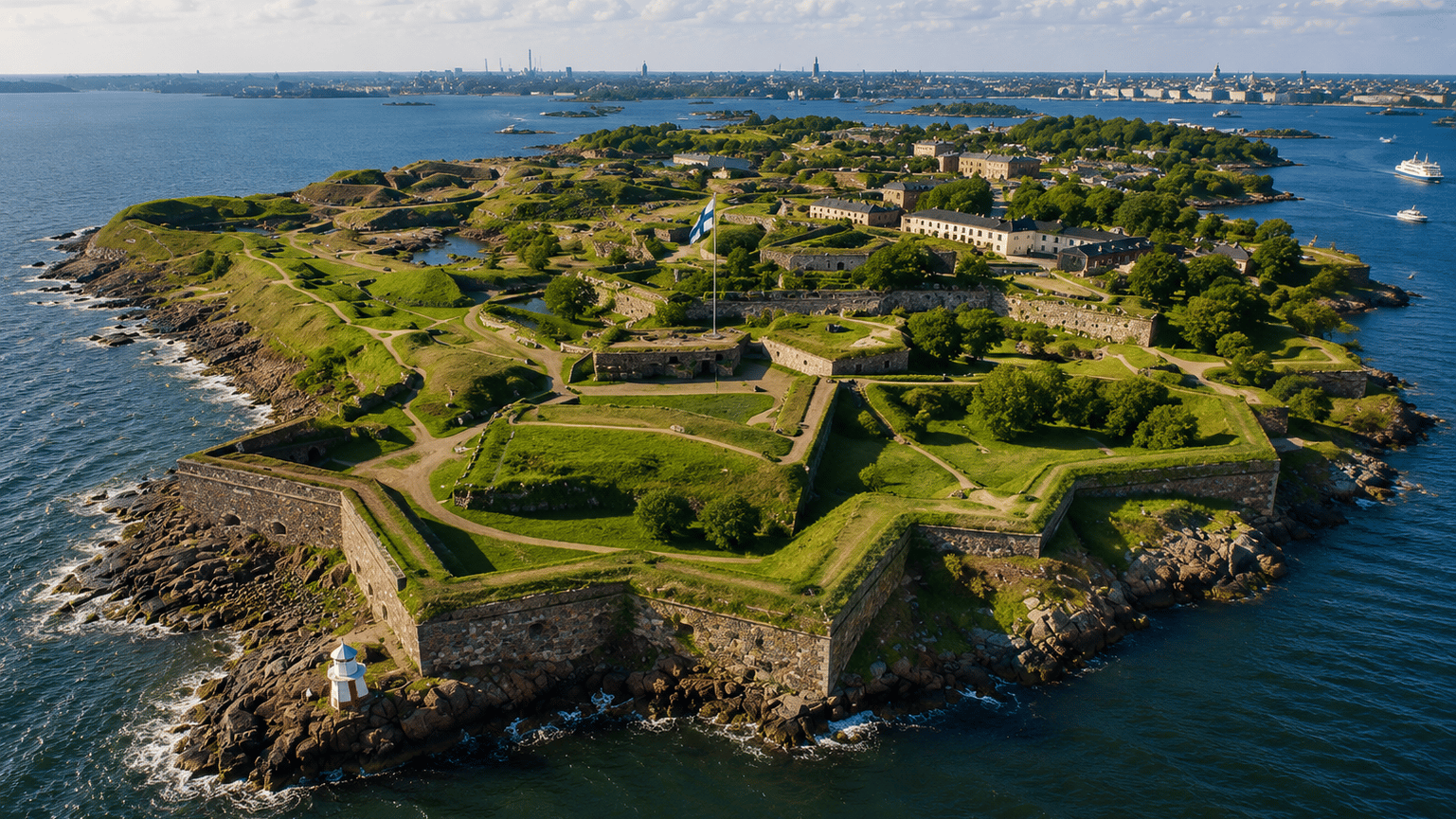
Eastern Europe · Fortified Structure
Suomenlinna Fortress
Finland
Suomenlinna is already a functioning year-round island community with hundreds of apartments and extensive services, giving twenty survivors exceptional habitat capacity, but its six-island footprint and dependence on Helsinki utilities and replenishment limit defensive efficiency and resource independence.
Overall
6.3 out of 10Defensibility
6 out of 10Isolation
5 out of 10Sustainability
8 out of 10Ranking context
How this base ranks
Global
#10 of 91 · Top 10.99%
Region · Eastern Europe
#1 of 10 · Top 10%
Base Type · Fortified Structure
#5 of 18 · Top 27.78%
Field assessment
At a glance
Bottom Line
An unusually ready-made survivor community with excellent living capacity, balanced by a broad shoreline defence burden and weak independent long-term resource renewal.
Biggest Trade-off
Exceptional existing housing and community infrastructure versus mainland-dependent utilities, supplies and a large multi-island perimeter.
Most Likely Failure
Mainland-linked utilities and replenishment fail while the survivors spread themselves too thinly across the six-island district instead of concentrating on a sustainable core.
Score rationale
Why it scores this way
Defensibility · 6/10
Stone fortifications and island separation provide solid passive defence, but the inhabited district is too broad and shoreline-heavy to behave like a compact fortress for twenty people.
Advantages
- Bastions, walls, tunnels and water gaps provide multiple durable protected positions.
Limitations
- The large civilian multi-island footprint creates too many shoreline sectors to hold uniformly with a small group.
Isolation · 5/10
Water separation creates useful friction, but Suomenlinna remains closely integrated with Helsinki rather than genuinely remote.
Advantages
- Ordinary ground movement cannot reach the islands without crossing water or using controlled transport links.
Limitations
- The islands sit next to a major city and are normally served by frequent transport, limiting regional separation.
Sustainability · 8/10
Existing apartments, civic services and workshops make Suomenlinna one of the strongest ready-made habitats for twenty people, even though its utilities are not fully independent.
Advantages
- Current year-round housing and community infrastructure already support a population many times larger than the reference group.
Limitations
- Long-term food, water and energy security remains tied to mainland systems and replenishment rather than proven island self-sufficiency.
Survival horizons
How survival changes over time
Excellent ready-made habitat
First 7 Days
Twenty survivors can move directly into a functioning residential community with extraordinary spare accommodation and service capacity.
Positive factors
- Existing apartments, kitchens, bathrooms and civic spaces greatly reduce the need for immediate adaptation.
Risks
- The group must choose a compact defended footprint rather than dispersing across the full six-island district.
Mainland dependencies surface
First 100 Days
As ordinary services fail, the challenge shifts from housing to maintaining heat, power, water, food and transport without Helsinki support.
Positive factors
- Local workshops and durable stone infrastructure provide useful repair and shelter resilience.
Risks
- Current evidence does not establish autonomous island food, potable-water or energy systems sufficient for prolonged isolation.
Habitable, not self-sufficient
Long Term
The community can remain highly liveable only if the survivors replace mainland replenishment with durable local resource pathways and keep the defended footprint deliberately small.
Positive factors
- The existing residential scale gives exceptional room to simplify and repurpose space for a much smaller community.
Risks
- Without independent resource renewal, excellent housing becomes a comfortable but externally dependent shell.
Tactical assessment
Practical Reality
Reality Check
Suomenlinna is scored as its current civilian island community and fortifications. V2 does not add Finnish military personnel, guaranteed ferries or mainland municipal supply as survivor-owned assets.
Best Use
Occupy a deliberately compact residential and fortified core while using the island community's housing, workshops and controlled docks without trying to defend every shoreline sector equally.
Key Risk
The group inherits a highly liveable community whose water, energy, food and transport systems still depend heavily on Helsinki and whose shoreline footprint is large for twenty defenders.
Strengths
- A functioning year-round community already provides hundreds of apartments, kitchens, bathrooms and civic facilities.
- Stone fortifications, bastions and water-separated islands provide meaningful passive defensive structure.
- Dry-dock, blacksmith, boatyard and sail-making activity preserve useful practical repair capability.
Weaknesses
- Six islands and extensive shoreline create a substantial watch burden for a twenty-person group.
- District heating, electricity and everyday supplies remain materially linked to Helsinki systems and ferries.
- Water separation helps, but Suomenlinna remains a Helsinki district only a short trip from the city centre rather than a remote refuge.
Assumptions / constraints
- The fixed twenty-person group may use current housing and workshops but does not inherit defence-force capability, guaranteed ferry service or mainland municipal continuity.
Decision context
Rivals / Alternatives
Similar rival
Fort George
United Kingdom · Fortified Structure
Fort George keeps the same fortified structure strategy, with only 0.3 points between the overall scores and closely matched defensibility pressure.
Overall 6.7/10
Strongest alternative
McMurdo Station
Antarctica · Fortified Structure
McMurdo Station scores 6.7 overall versus 6.3, adding a stronger isolation profile while staying relevant as another fortified structure.
Overall 6.7/10
Wildcard rival
Great Mosque of Djenné
Mali · Landmark Structure
Great Mosque of Djenné changes the strategy: it is a landmark structure without a headline-pillar edge over Suomenlinna Fortress, while Suomenlinna Fortress holds more of the sustainability advantage.
Overall 1.3/10