UK & Ireland · Fortified Structure
Fort George
United Kingdom
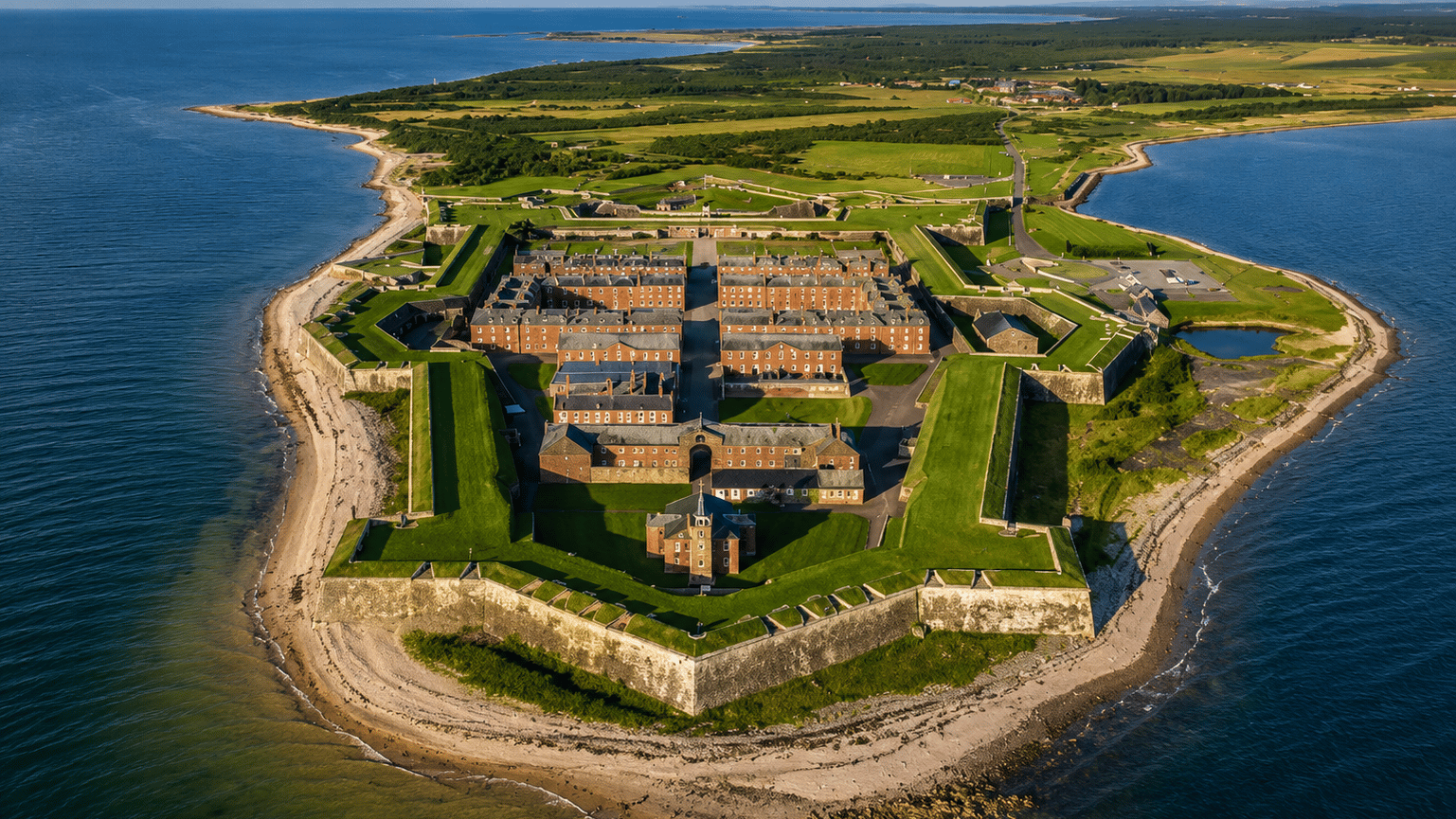
Fort George is strongest on Exposure Control 9/10 — The promontory, concentrated landward outworks, ravelin and ditches, principal bridge and gate, limited sallyports and elevated bastions make ground approach exceptionally channelled and observable. The large perimeter still requires watches, keeping the score short of the highest class.. Its clearest scored constraint is Resource Security 3/10 — A working military/visitor site with current potable refill, cafe/tea service and purpose-built provision-store/bakehouse/brewhouse infrastructure provides useful starting resources. The historic wells are explicitly recorded as brackish and the present water source, protected storage, food stocks/production and survival-energy continuity are not established independently of external military/civilian logistics. This therefore fits useful starting resources with major dependencies..
Overall
6.7 out of 10Defensibility
8 out of 10Isolation
5 out of 10Sustainability
7 out of 10Ranking context
How this base ranks
Global
#2 of 91 · Top 2.2%
Region · UK & Ireland
#1 of 11 · Top 9.09%
Base Type · Fortified Structure
#1 of 18 · Top 5.56%
Field assessment
At a glance
Bottom Line
For the fixed 20-person Base boundary, the most important endurance constraint is Resource Security 3/10 — A working military/visitor site with current potable refill, cafe/tea service and purpose-built provision-store/bakehouse/brewhouse infrastructure provides useful starting resources. The historic wells are explicitly recorded as brackish and the present water source, protected storage, food stocks/production and survival-energy continuity are not established independently of external military/civilian logistics. This therefore fits useful starting resources with major dependencies..
Biggest Trade-off
The central trade-off is the catalogue's strongest evidenced dimension, Exposure Control at 9/10, against its weakest evidenced dimension, Resource Security at 3/10.
Most Likely Failure
The evaluation leaves this material failure condition unresolved: A current potable refill point is evidenced, but its supply independence, protected storage/treatment and outage continuity are not. The historic internal wells are explicitly brackish. Resource Security 3 credits the current starting position while preserving the independence limitation for package adjudication.
Score rationale
Why it scores this way
Defensibility · 8/10
Layered landward outworks, ravelin, ditches, bastions, curtain walls, casemates and controlled gates create very strong defence in depth with fallback. The kilometre-scale rampart is a significant manpower burden for twenty people, preventing an exceptional higher score.
Advantages
- Positive credit is limited to what supports the Defensibility score of 8/10; the component rationale is: Layered landward outworks, ravelin, ditches, bastions, curtain walls, casemates and controlled gates create very strong defence in depth with fallback. The kilometre-scale rampart is a significant manpower burden for twenty people, preventing an exceptional higher score.
Limitations
- Do not infer additional Defensibility capability outside the fixed Base boundary or beyond the recorded evidence.
Isolation · 5/10
A promontory projecting into the Moray Firth gives meaningful water separation and constrains land connection, but the fort is near Ardersier/Nairn and remains readily connected to the regional road/public network. This is mixed isolation rather than remote wilderness.
Advantages
- Positive credit is limited to what supports the Isolation score of 5/10; the component rationale is: A promontory projecting into the Moray Firth gives meaningful water separation and constrains land connection, but the fort is near Ardersier/Nairn and remains readily connected to the regional road/public network. This is mixed isolation rather than remote wilderness.
Limitations
- Do not infer additional Isolation capability outside the fixed Base boundary or beyond the recorded evidence.
Sustainability · 7/10
Large barrack blocks, casemates, staff buildings, former hospital/stores/workshops and current toilets/cafe provide strong sheltered functional space for twenty. Modern services add dependencies, but habitat quality and functional separation are substantially evidenced.
Advantages
- Positive credit is limited to what supports the Sustainability score of 7/10; the component rationale is: Large barrack blocks, casemates, staff buildings, former hospital/stores/workshops and current toilets/cafe provide strong sheltered functional space for twenty. Modern services add dependencies, but habitat quality and functional separation are substantially evidenced.
Limitations
- Do not infer additional Sustainability capability outside the fixed Base boundary or beyond the recorded evidence.
Survival horizons
How survival changes over time
First 7 days: current defence/contact profile
First 7 Days
This horizon does not invent future upgrades or resupply. It carries the current evaluated conditions forward and keeps unknown future capability uncredited.
Positive factors
- The stronger current condition in this horizon is Exposure Control 9/10 — The promontory, concentrated landward outworks, ravelin and ditches, principal bridge and gate, limited sallyports and elevated bastions make ground approach exceptionally channelled and observable. The large perimeter still requires watches, keeping the score short of the highest class..
Risks
- The weaker current condition in this horizon is Defensibility 8/10 — Layered landward outworks, ravelin, ditches, bastions, curtain walls, casemates and controlled gates create very strong defence in depth with fallback. The kilometre-scale rampart is a significant manpower burden for twenty people, preventing an exceptional higher score.; no better future state is assumed.
First 100 days: current habitat/capacity profile
First 100 Days
This horizon does not invent future upgrades or resupply. It carries the current evaluated conditions forward and keeps unknown future capability uncredited.
Positive factors
- The stronger current condition in this horizon is Population Capacity 8/10 — The fort was purpose-designed for roughly 2,000 military occupants and retains extensive barracks, casemates, stores, workshops and large internal circulation space. The twenty-person reference has substantial headroom, though historical nominal garrison size is not treated as direct survival capacity..
Risks
- The weaker current condition in this horizon is Sustainability 7/10 — Large barrack blocks, casemates, staff buildings, former hospital/stores/workshops and current toilets/cafe provide strong sheltered functional space for twenty. Modern services add dependencies, but habitat quality and functional separation are substantially evidenced.; no better future state is assumed.
Long term: current resource/maintenance profile
Long Term
This horizon does not invent future upgrades or resupply. It carries the current evaluated conditions forward and keeps unknown future capability uncredited.
Positive factors
- The stronger current condition in this horizon is Maintenance Resilience 5/10 — Massive masonry, passive ditches and ramparts and long-lived buildings retain substantial function without complex technology, while current military/visitor sanitation and services depend on maintained modern infrastructure. The fort should degrade in stages rather than suffer immediate technical collapse..
Risks
- The weaker current condition in this horizon is Resource Security 3/10 — A working military/visitor site with current potable refill, cafe/tea service and purpose-built provision-store/bakehouse/brewhouse infrastructure provides useful starting resources. The historic wells are explicitly recorded as brackish and the present water source, protected storage, food stocks/production and survival-energy continuity are not established independently of external military/civilian logistics. This therefore fits useful starting resources with major dependencies.; no better future state is assumed.
Tactical assessment
Practical Reality
Reality Check
Scores apply only to the defined Base and exactly 20 capable adults. Unknown, excluded or external assets are not credited as hidden capability.
Best Use
Within the evaluated boundary, treat Exposure Control as the primary operational strength; do not promote that score into capabilities the evidence does not establish.
Key Risk
Resource Security is the key evidenced long-duration risk: A working military/visitor site with current potable refill, cafe/tea service and purpose-built provision-store/bakehouse/brewhouse infrastructure provides useful starting resources. The historic wells are explicitly recorded as brackish and the present water source, protected storage, food stocks/production and survival-energy continuity are not established independently of external military/civilian logistics. This therefore fits useful starting resources with major dependencies.
Strengths
- One of the strongest scored dimensions is Exposure Control 9/10 — The promontory, concentrated landward outworks, ravelin and ditches, principal bridge and gate, limited sallyports and elevated bastions make ground approach exceptionally channelled and observable. The large perimeter still requires watches, keeping the score short of the highest class..
- One of the strongest scored dimensions is Defensibility 8/10 — Layered landward outworks, ravelin, ditches, bastions, curtain walls, casemates and controlled gates create very strong defence in depth with fallback. The kilometre-scale rampart is a significant manpower burden for twenty people, preventing an exceptional higher score..
- One of the strongest scored dimensions is Population Capacity 8/10 — The fort was purpose-designed for roughly 2,000 military occupants and retains extensive barracks, casemates, stores, workshops and large internal circulation space. The twenty-person reference has substantial headroom, though historical nominal garrison size is not treated as direct survival capacity..
Weaknesses
- One of the weakest scored dimensions is Resource Security 3/10 — A working military/visitor site with current potable refill, cafe/tea service and purpose-built provision-store/bakehouse/brewhouse infrastructure provides useful starting resources. The historic wells are explicitly recorded as brackish and the present water source, protected storage, food stocks/production and survival-energy continuity are not established independently of external military/civilian logistics. This therefore fits useful starting resources with major dependencies..
- One of the weakest scored dimensions is Isolation 5/10 — A promontory projecting into the Moray Firth gives meaningful water separation and constrains land connection, but the fort is near Ardersier/Nairn and remains readily connected to the regional road/public network. This is mixed isolation rather than remote wilderness..
- One of the weakest scored dimensions is Maintenance Resilience 5/10 — Massive masonry, passive ditches and ramparts and long-lived buildings retain substantial function without complex technology, while current military/visitor sanitation and services depend on maintained modern infrastructure. The fort should degrade in stages rather than suffer immediate technical collapse..
Assumptions / constraints
- Only assets inside the recorded Core Base and immediate operating boundary are credited; excluded surroundings and unproven future access remain outside the score.
Decision context
Rivals / Alternatives
Similar rival
Caerphilly Castle
United Kingdom · Fortified Structure
Caerphilly Castle keeps the same fortified structure strategy, with only 1.3 points between the overall scores and closely matched defensibility pressure.
Overall 5.3/10
Strongest alternative
Amundsen-Scott South Pole Station
Antarctica · Institutional Compound
Amundsen-Scott South Pole Station scores 7.7 overall versus 6.7, adding a stronger isolation profile while staying relevant as a comparable survival plan.
Overall 7.7/10
Wildcard rival
Great Mosque of Djenné
Mali · Landmark Structure
Great Mosque of Djenné changes the strategy: it is a landmark structure without a headline-pillar edge over Fort George, while Fort George holds more of the defensibility advantage.
Overall 1.3/10