UK & Ireland · Fortified Structure
Caerphilly Castle
United Kingdom
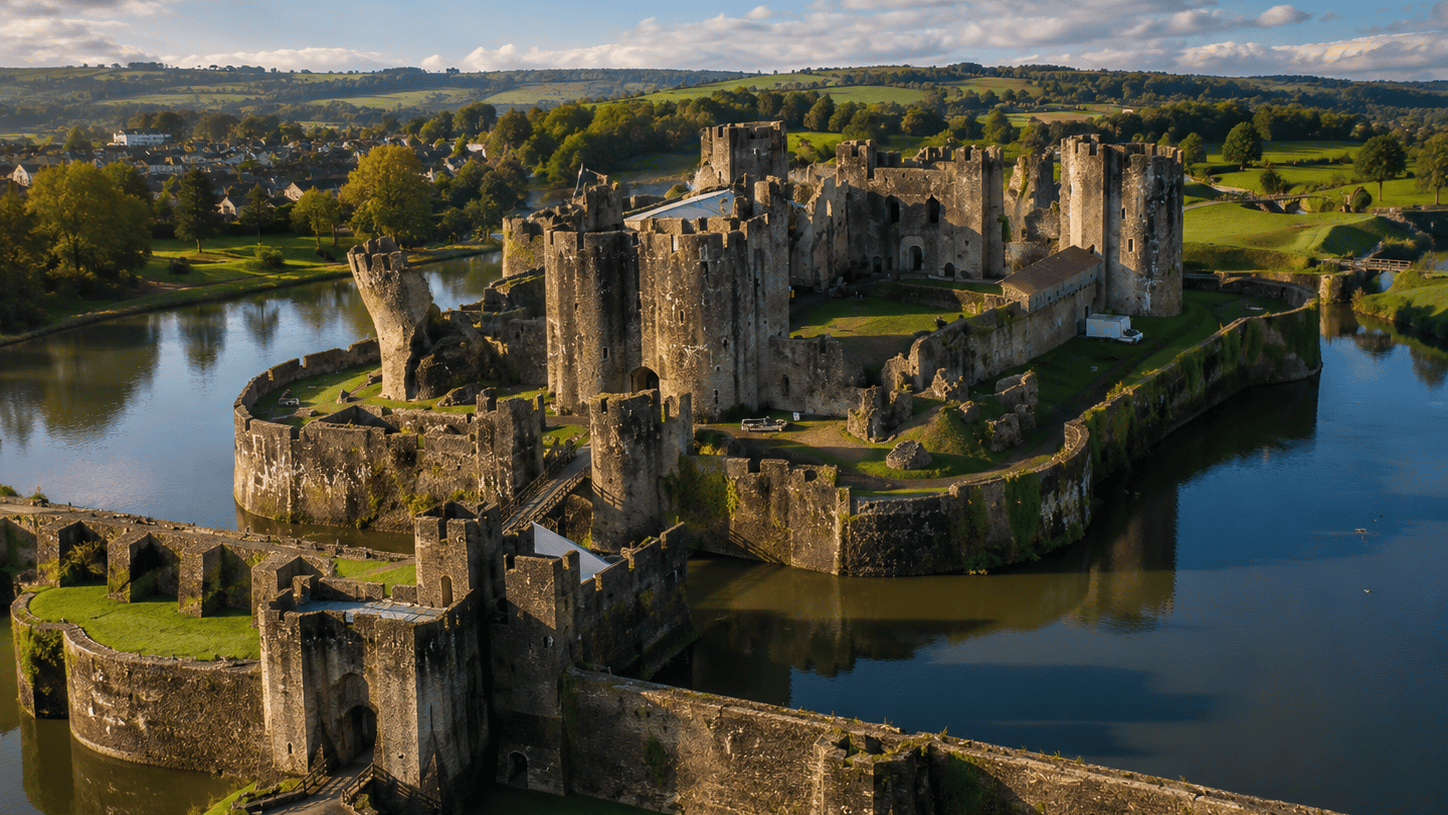
Caerphilly Castle is strongest on Defensibility 8/10 — Concentric walls, towers, gatehouses, water defences and controlled internal routes provide very strong passive defence and meaningful depth. The 30-acre scale creates watch burden for twenty people and ongoing conservation weaknesses prevent an exceptional score.. Its clearest scored constraint is Isolation 1/10 — The castle is directly connected to Caerphilly town by roads, bus and nearby rail. Moats improve local separation but do not materially separate the Base from surrounding population pressure..
Overall
5.3 out of 10Defensibility
8 out of 10Isolation
1 out of 10Sustainability
7 out of 10Ranking context
How this base ranks
Global
#27 of 91 · Top 29.67%
Region · UK & Ireland
#6 of 11 · Top 54.55%
Base Type · Fortified Structure
#9 of 18 · Top 50%
Field assessment
At a glance
Bottom Line
For the fixed 20-person Base boundary, the most important endurance constraint is Resource Security 2/10 — Current mains water and power, an event kitchen and on-site snack inventory provide a real immediate starting position, but every documented critical utility is externally supplied and Cadw explicitly records no visitor water-refill station. No protected independent potable-water, durable food-production or survival-energy pathway is established, so the evidence supports only the short-term-only anchor rather than a stronger supply class..
Biggest Trade-off
The central trade-off is the catalogue's strongest evidenced dimension, Defensibility at 8/10, against its weakest evidenced dimension, Isolation at 1/10.
Most Likely Failure
The evaluation leaves this material failure condition unresolved: Current mains water is real but externally dependent, and no independent protected potable source/storage/treatment pathway is established. Resource Security 2 credits the evidenced immediate supplied position while preserving this limitation for package adjudication.
Score rationale
Why it scores this way
Defensibility · 8/10
Concentric walls, towers, gatehouses, water defences and controlled internal routes provide very strong passive defence and meaningful depth. The 30-acre scale creates watch burden for twenty people and ongoing conservation weaknesses prevent an exceptional score.
Advantages
- Positive credit is limited to what supports the Defensibility score of 8/10; the component rationale is: Concentric walls, towers, gatehouses, water defences and controlled internal routes provide very strong passive defence and meaningful depth. The 30-acre scale creates watch burden for twenty people and ongoing conservation weaknesses prevent an exceptional score.
Limitations
- Do not infer additional Defensibility capability outside the fixed Base boundary or beyond the recorded evidence.
Isolation · 1/10
The castle is directly connected to Caerphilly town by roads, bus and nearby rail. Moats improve local separation but do not materially separate the Base from surrounding population pressure.
Advantages
- Positive credit is limited to what supports the Isolation score of 1/10; the component rationale is: The castle is directly connected to Caerphilly town by roads, bus and nearby rail. Moats improve local separation but do not materially separate the Base from surrounding population pressure.
Limitations
- Do not infer additional Isolation capability outside the fixed Base boundary or beyond the recorded evidence.
Sustainability · 7/10
The restored Great Hall and inner ward, current kitchen, toilets, inside rooms and weather-protected historic fabric give twenty people strong adaptable habitat functions. Long-term utility independence is scored separately.
Advantages
- Positive credit is limited to what supports the Sustainability score of 7/10; the component rationale is: The restored Great Hall and inner ward, current kitchen, toilets, inside rooms and weather-protected historic fabric give twenty people strong adaptable habitat functions. Long-term utility independence is scored separately.
Limitations
- Do not infer additional Sustainability capability outside the fixed Base boundary or beyond the recorded evidence.
Survival horizons
How survival changes over time
First 7 days: current defence/contact profile
First 7 Days
This horizon does not invent future upgrades or resupply. It carries the current evaluated conditions forward and keeps unknown future capability uncredited.
Positive factors
- The stronger current condition in this horizon is Defensibility 8/10 — Concentric walls, towers, gatehouses, water defences and controlled internal routes provide very strong passive defence and meaningful depth. The 30-acre scale creates watch burden for twenty people and ongoing conservation weaknesses prevent an exceptional score..
Risks
- The weaker current condition in this horizon is Defensibility 8/10 — Concentric walls, towers, gatehouses, water defences and controlled internal routes provide very strong passive defence and meaningful depth. The 30-acre scale creates watch burden for twenty people and ongoing conservation weaknesses prevent an exceptional score.; no better future state is assumed.
First 100 days: current habitat/capacity profile
First 100 Days
This horizon does not invent future upgrades or resupply. It carries the current evaluated conditions forward and keeps unknown future capability uncredited.
Positive factors
- The stronger current condition in this horizon is Sustainability 7/10 — The restored Great Hall and inner ward, current kitchen, toilets, inside rooms and weather-protected historic fabric give twenty people strong adaptable habitat functions. Long-term utility independence is scored separately..
Risks
- The weaker current condition in this horizon is Sustainability 7/10 — The restored Great Hall and inner ward, current kitchen, toilets, inside rooms and weather-protected historic fabric give twenty people strong adaptable habitat functions. Long-term utility independence is scored separately.; no better future state is assumed.
Long term: current resource/maintenance profile
Long Term
This horizon does not invent future upgrades or resupply. It carries the current evaluated conditions forward and keeps unknown future capability uncredited.
Positive factors
- The stronger current condition in this horizon is Maintenance Resilience 4/10 — Core stone and water-defence geometry remain useful passively, but current safe occupation includes modern mains-fed toilets, heating/kitchen systems and continuing specialist conservation. Loss of utilities does not erase the fortress, yet living capability degrades materially..
Risks
- The weaker current condition in this horizon is Resource Security 2/10 — Current mains water and power, an event kitchen and on-site snack inventory provide a real immediate starting position, but every documented critical utility is externally supplied and Cadw explicitly records no visitor water-refill station. No protected independent potable-water, durable food-production or survival-energy pathway is established, so the evidence supports only the short-term-only anchor rather than a stronger supply class.; no better future state is assumed.
Tactical assessment
Practical Reality
Reality Check
Scores apply only to the defined Base and exactly 20 capable adults. Unknown, excluded or external assets are not credited as hidden capability.
Best Use
Within the evaluated boundary, treat Defensibility as the primary operational strength; do not promote that score into capabilities the evidence does not establish.
Key Risk
Resource Security is the key evidenced long-duration risk: Current mains water and power, an event kitchen and on-site snack inventory provide a real immediate starting position, but every documented critical utility is externally supplied and Cadw explicitly records no visitor water-refill station. No protected independent potable-water, durable food-production or survival-energy pathway is established, so the evidence supports only the short-term-only anchor rather than a stronger supply class.
Strengths
- One of the strongest scored dimensions is Defensibility 8/10 — Concentric walls, towers, gatehouses, water defences and controlled internal routes provide very strong passive defence and meaningful depth. The 30-acre scale creates watch burden for twenty people and ongoing conservation weaknesses prevent an exceptional score..
- One of the strongest scored dimensions is Exposure Control 8/10 — Sprawling moats, concentric walls, gatehouses, bridges and narrow internal routes strongly channel final approaches and create excellent warning/control. The large footprint and surrounding town keep monitoring burden above the exceptional classes..
- One of the strongest scored dimensions is Sustainability 7/10 — The restored Great Hall and inner ward, current kitchen, toilets, inside rooms and weather-protected historic fabric give twenty people strong adaptable habitat functions. Long-term utility independence is scored separately..
Weaknesses
- One of the weakest scored dimensions is Isolation 1/10 — The castle is directly connected to Caerphilly town by roads, bus and nearby rail. Moats improve local separation but do not materially separate the Base from surrounding population pressure..
- One of the weakest scored dimensions is Resource Security 2/10 — Current mains water and power, an event kitchen and on-site snack inventory provide a real immediate starting position, but every documented critical utility is externally supplied and Cadw explicitly records no visitor water-refill station. No protected independent potable-water, durable food-production or survival-energy pathway is established, so the evidence supports only the short-term-only anchor rather than a stronger supply class..
- One of the weakest scored dimensions is Maintenance Resilience 4/10 — Core stone and water-defence geometry remain useful passively, but current safe occupation includes modern mains-fed toilets, heating/kitchen systems and continuing specialist conservation. Loss of utilities does not erase the fortress, yet living capability degrades materially..
Assumptions / constraints
- Only assets inside the recorded Core Base and immediate operating boundary are credited; excluded surroundings and unproven future access remain outside the score.
Decision context
Rivals / Alternatives
Similar rival
Fort George
United Kingdom · Fortified Structure
Fort George keeps the same fortified structure strategy, with only 1.3 points between the overall scores and closely matched isolation pressure.
Overall 6.7/10
Strongest alternative
Mont Saint-Michel
France · Fortified Structure
Mont Saint-Michel scores 6.3 overall versus 5.3, adding a stronger isolation profile while staying relevant as another fortified structure.
Overall 6.3/10
Wildcard rival
Waw an Namus Caldera
Libya · Subterranean
Waw an Namus Caldera changes the strategy: it is a subterranean with a isolation edge, while Caerphilly Castle holds more of the defensibility advantage.
Overall 4.3/10