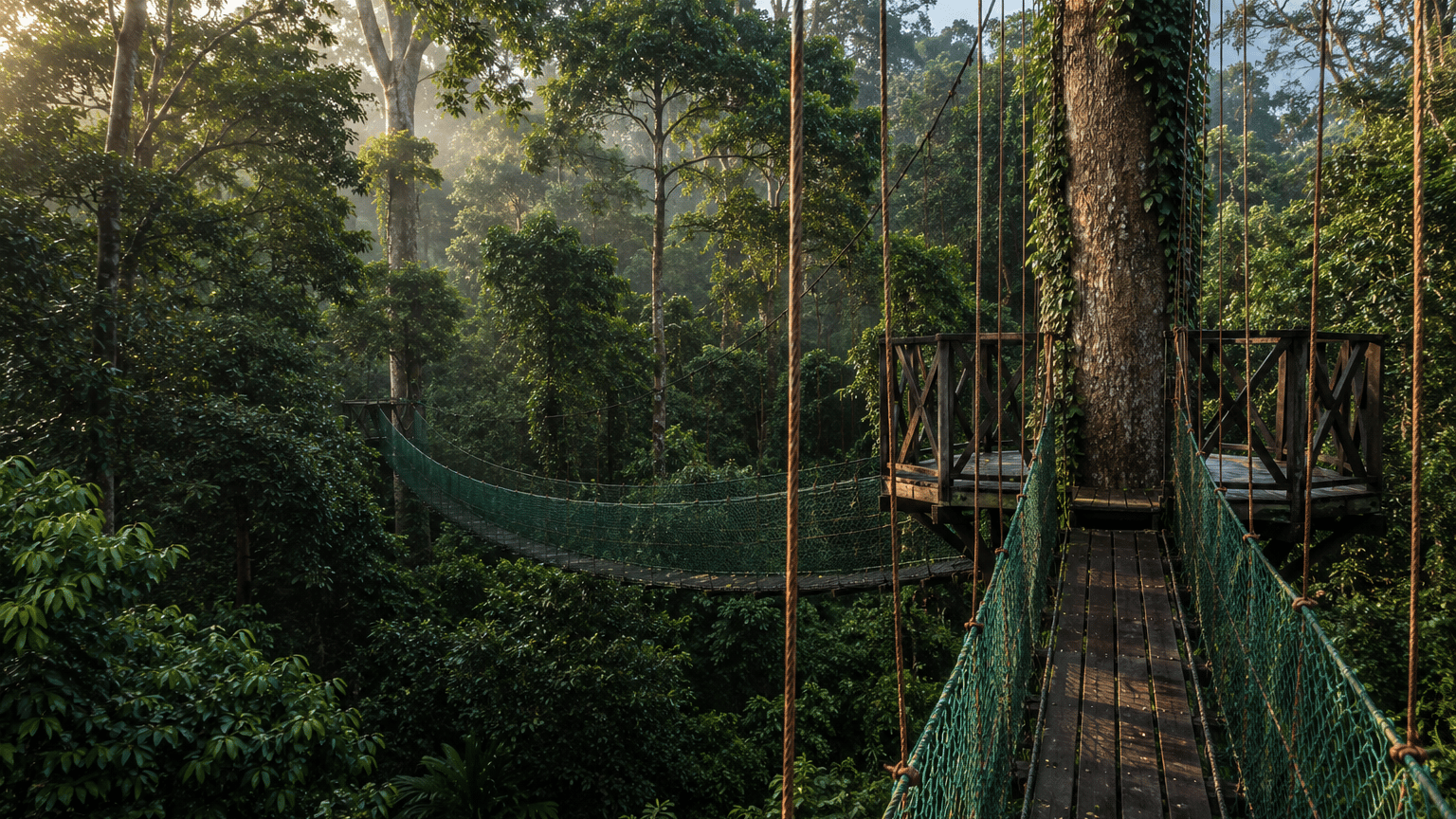
Southeast Asia · Institutional Compound
Danum Valley Field Centre
Malaysia
Danum Valley Field Centre is strongest on Population Capacity 9/10 — Documented 48-bed hostel blocks, additional rooms/camping and a dining hall around 70 covers provide direct accommodation and service headroom far above the fixed twenty-person group.. Its clearest scored constraint is Defensibility 2/10 — The centre is a research/accommodation compound rather than a fortified site. Restricted access, a controlled private-road approach and ordinary secureable buildings provide some real protection, but no hardened perimeter, breach-resistant gates or compartmentalised fallback are established at the occupied compound. Remoteness is not double-counted as defence..
Overall
6 out of 10Defensibility
2 out of 10Isolation
8 out of 10Sustainability
8 out of 10Ranking context
How this base ranks
Global
#12 of 91 · Top 13.19%
Region · Southeast Asia
#1 of 8 · Top 12.5%
Base Type · Institutional Compound
#2 of 7 · Top 28.57%
Field assessment
At a glance
Bottom Line
For the fixed 20-person Base boundary, the most important endurance constraint is Maintenance Resilience 3/10 — Most accommodation is ordinary low-complexity building fabric and the centre routinely tolerates an overnight electrical shutdown, but critical modern capability still depends on generator fuel, water distribution/treatment, refrigeration, sanitation and a remote maintenance chain. The local catchment source reduces one dependency while generator and logistics reliance keep the Base in the substantial-dependency class..
Biggest Trade-off
The central trade-off is the catalogue's strongest evidenced dimension, Population Capacity at 9/10, against its weakest evidenced dimension, Defensibility at 2/10.
Most Likely Failure
The clearest evidenced failure pressure is Maintenance Resilience: Most accommodation is ordinary low-complexity building fabric and the centre routinely tolerates an overnight electrical shutdown, but critical modern capability still depends on generator fuel, water distribution/treatment, refrigeration, sanitation and a remote maintenance chain. The local catchment source reduces one dependency while generator and logistics reliance keep the Base in the substantial-dependency class.
Score rationale
Why it scores this way
Defensibility · 2/10
The centre is a research/accommodation compound rather than a fortified site. Restricted access, a controlled private-road approach and ordinary secureable buildings provide some real protection, but no hardened perimeter, breach-resistant gates or compartmentalised fallback are established at the occupied compound. Remoteness is not double-counted as defence.
Advantages
- Positive credit is limited to what supports the Defensibility score of 2/10; the component rationale is: The centre is a research/accommodation compound rather than a fortified site. Restricted access, a controlled private-road approach and ordinary secureable buildings provide some real protection, but no hardened perimeter, breach-resistant gates or compartmentalised fallback are established at the occupied compound. Remoteness is not double-counted as defence.
Limitations
- Do not infer additional Defensibility capability outside the fixed Base boundary or beyond the recorded evidence.
Isolation · 8/10
An 81 km inland location reached largely by private unsealed road through a protected rainforest creates unusually strong geographic separation. The maintained road and continuing research/tourism access prevent the highest isolation classes.
Advantages
- Positive credit is limited to what supports the Isolation score of 8/10; the component rationale is: An 81 km inland location reached largely by private unsealed road through a protected rainforest creates unusually strong geographic separation. The maintained road and continuing research/tourism access prevent the highest isolation classes.
Limitations
- Do not infer additional Isolation capability outside the fixed Base boundary or beyond the recorded evidence.
Sustainability · 8/10
Current bedrooms, hostel accommodation, dining, kitchens/self-catering, boiled drinking water, sanitation and research/support buildings establish a highly capable long-duration habitat for twenty people. Tropical heat/humidity and generator dependence remain meaningful constraints rather than negating the existing habitat.
Advantages
- Positive credit is limited to what supports the Sustainability score of 8/10; the component rationale is: Current bedrooms, hostel accommodation, dining, kitchens/self-catering, boiled drinking water, sanitation and research/support buildings establish a highly capable long-duration habitat for twenty people. Tropical heat/humidity and generator dependence remain meaningful constraints rather than negating the existing habitat.
Limitations
- Do not infer additional Sustainability capability outside the fixed Base boundary or beyond the recorded evidence.
Survival horizons
How survival changes over time
First 7 days: current defence/contact profile
First 7 Days
This horizon does not invent future upgrades or resupply. It carries the current evaluated conditions forward and keeps unknown future capability uncredited.
Positive factors
- The stronger current condition in this horizon is Exposure Control 5/10 — The long private-road approach, gate-pass checkpoint and managed final access provide useful warning and channel normal vehicle movement. Dense rainforest, trails and the lack of a documented hard perimeter mean foot approaches can remain concealed and monitoring the immediate compound is not a few-route problem. This is a manageable mixed environment rather than strong engineered approach control..
Risks
- The weaker current condition in this horizon is Defensibility 2/10 — The centre is a research/accommodation compound rather than a fortified site. Restricted access, a controlled private-road approach and ordinary secureable buildings provide some real protection, but no hardened perimeter, breach-resistant gates or compartmentalised fallback are established at the occupied compound. Remoteness is not double-counted as defence.; no better future state is assumed.
First 100 days: current habitat/capacity profile
First 100 Days
This horizon does not invent future upgrades or resupply. It carries the current evaluated conditions forward and keeps unknown future capability uncredited.
Positive factors
- The stronger current condition in this horizon is Population Capacity 9/10 — Documented 48-bed hostel blocks, additional rooms/camping and a dining hall around 70 covers provide direct accommodation and service headroom far above the fixed twenty-person group..
Risks
- The weaker current condition in this horizon is Sustainability 8/10 — Current bedrooms, hostel accommodation, dining, kitchens/self-catering, boiled drinking water, sanitation and research/support buildings establish a highly capable long-duration habitat for twenty people. Tropical heat/humidity and generator dependence remain meaningful constraints rather than negating the existing habitat.; no better future state is assumed.
Long term: current resource/maintenance profile
Long Term
This horizon does not invent future upgrades or resupply. It carries the current evaluated conditions forward and keeps unknown future capability uncredited.
Positive factors
- The stronger current condition in this horizon is Resource Security 5/10 — The Field Centre has a continuously supplied local catchment water intake, boiled drinking water, kitchens/self-catering, current food service and generator-backed electricity. That creates a mixed but genuinely viable starting supply position, especially because water is locally sourced. Food and generator fuel remain externally replenished and no durable on-site food-production or independent energy pathway is established, preventing a stronger class..
Risks
- The weaker current condition in this horizon is Maintenance Resilience 3/10 — Most accommodation is ordinary low-complexity building fabric and the centre routinely tolerates an overnight electrical shutdown, but critical modern capability still depends on generator fuel, water distribution/treatment, refrigeration, sanitation and a remote maintenance chain. The local catchment source reduces one dependency while generator and logistics reliance keep the Base in the substantial-dependency class.; no better future state is assumed.
Tactical assessment
Practical Reality
Reality Check
Scores apply only to the defined Base and exactly 20 capable adults. Unknown, excluded or external assets are not credited as hidden capability.
Best Use
Within the evaluated boundary, treat Population Capacity as the primary operational strength; do not promote that score into capabilities the evidence does not establish.
Key Risk
Maintenance Resilience is the key evidenced long-duration risk: Most accommodation is ordinary low-complexity building fabric and the centre routinely tolerates an overnight electrical shutdown, but critical modern capability still depends on generator fuel, water distribution/treatment, refrigeration, sanitation and a remote maintenance chain. The local catchment source reduces one dependency while generator and logistics reliance keep the Base in the substantial-dependency class.
Strengths
- One of the strongest scored dimensions is Population Capacity 9/10 — Documented 48-bed hostel blocks, additional rooms/camping and a dining hall around 70 covers provide direct accommodation and service headroom far above the fixed twenty-person group..
- One of the strongest scored dimensions is Isolation 8/10 — An 81 km inland location reached largely by private unsealed road through a protected rainforest creates unusually strong geographic separation. The maintained road and continuing research/tourism access prevent the highest isolation classes..
- One of the strongest scored dimensions is Sustainability 8/10 — Current bedrooms, hostel accommodation, dining, kitchens/self-catering, boiled drinking water, sanitation and research/support buildings establish a highly capable long-duration habitat for twenty people. Tropical heat/humidity and generator dependence remain meaningful constraints rather than negating the existing habitat..
Weaknesses
- One of the weakest scored dimensions is Defensibility 2/10 — The centre is a research/accommodation compound rather than a fortified site. Restricted access, a controlled private-road approach and ordinary secureable buildings provide some real protection, but no hardened perimeter, breach-resistant gates or compartmentalised fallback are established at the occupied compound. Remoteness is not double-counted as defence..
- One of the weakest scored dimensions is Maintenance Resilience 3/10 — Most accommodation is ordinary low-complexity building fabric and the centre routinely tolerates an overnight electrical shutdown, but critical modern capability still depends on generator fuel, water distribution/treatment, refrigeration, sanitation and a remote maintenance chain. The local catchment source reduces one dependency while generator and logistics reliance keep the Base in the substantial-dependency class..
- One of the weakest scored dimensions is Exposure Control 5/10 — The long private-road approach, gate-pass checkpoint and managed final access provide useful warning and channel normal vehicle movement. Dense rainforest, trails and the lack of a documented hard perimeter mean foot approaches can remain concealed and monitoring the immediate compound is not a few-route problem. This is a manageable mixed environment rather than strong engineered approach control..
Assumptions / constraints
- Only assets inside the recorded Core Base and immediate operating boundary are credited; excluded surroundings and unproven future access remain outside the score.
Decision context
Rivals / Alternatives
Similar rival
Tambopata Research Center
Peru · Institutional Compound
Tambopata Research Center keeps the same institutional compound strategy, with only 0.3 points between the overall scores and closely matched sustainability pressure.
Overall 5.7/10
Strongest alternative
Amundsen-Scott South Pole Station
Antarctica · Institutional Compound
Amundsen-Scott South Pole Station scores 7.7 overall versus 6.0, adding a stronger defensibility profile while staying relevant as another institutional compound.
Overall 7.7/10
Wildcard rival
San Felipe Fortress
Colombia · Fortified Structure
San Felipe Fortress changes the strategy: it is a fortified structure with a defensibility edge, while Danum Valley Field Centre holds more of the isolation advantage.
Overall 3.7/10