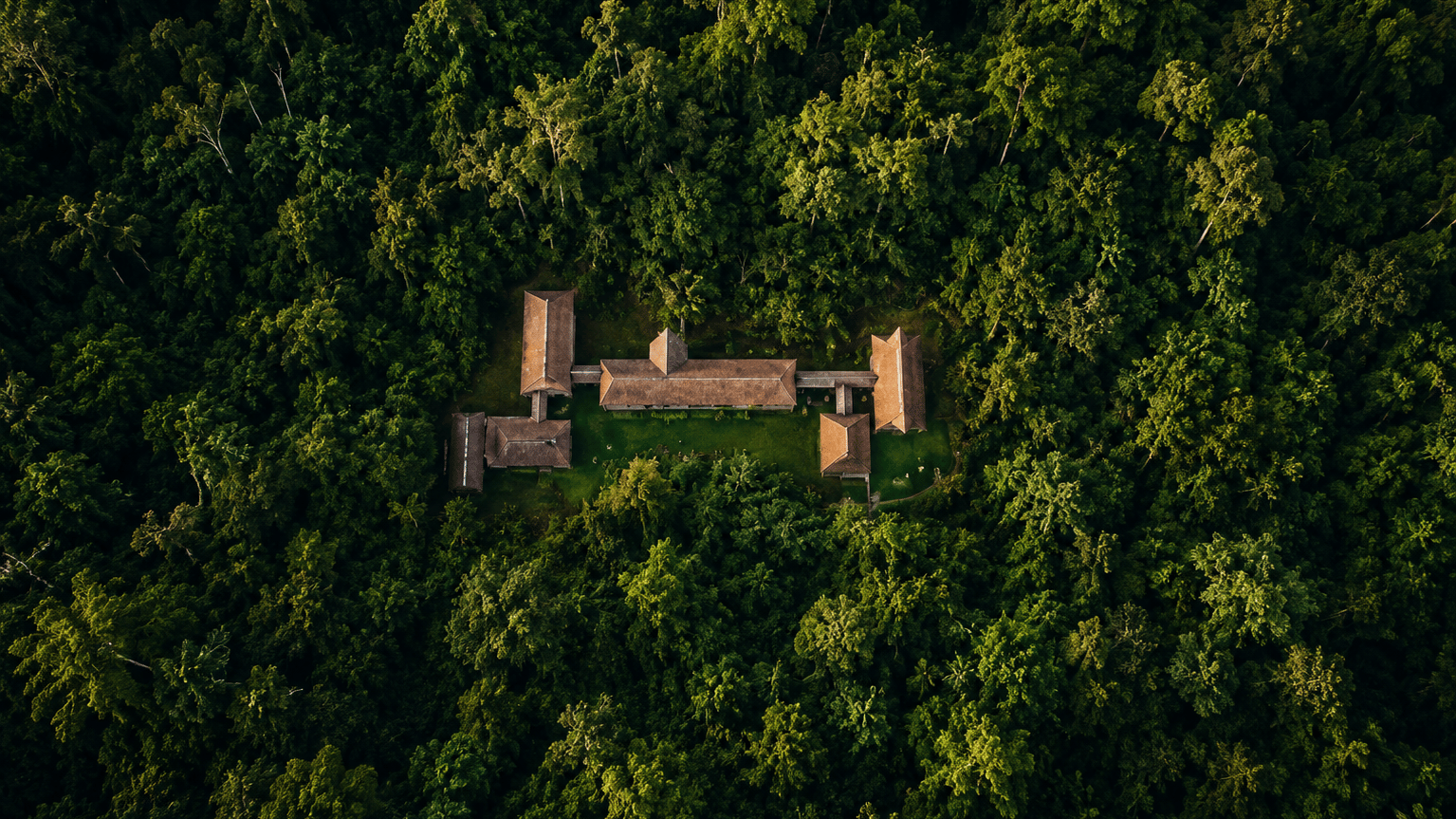
South America · Institutional Compound
Tambopata Research Center
Peru
Tambopata Research Center is strongest on Isolation 8/10 — The lodge sits deep inside a protected Amazon reserve beyond normal habitation, requiring a long combined road-and-river journey from Puerto Maldonado. Regular operated transfers prevent an extreme no-access score.. Its clearest scored constraint is Defensibility 1/10 — TRC is explicitly an open-air ecolodge with rooms open toward the forest, not a hardened or enclosed compound. Ordinary doors/service spaces provide minimal secureable positions, but no perimeter, barrier system or defensible fallback geometry is evidenced. Remoteness is deliberately excluded from this score..
Overall
5.7 out of 10Defensibility
1 out of 10Isolation
8 out of 10Sustainability
8 out of 10Ranking context
How this base ranks
Global
#25 of 91 · Top 27.47%
Region · South America
#1 of 8 · Top 12.5%
Base Type · Institutional Compound
#5 of 7 · Top 71.43%
Field assessment
At a glance
Bottom Line
For the fixed 20-person Base boundary, the most important endurance constraint is Maintenance Resilience 5/10 — The lodge already operates with scheduled rather than continuous electricity, uses simple open-air construction, has an independent natural-spring drinking-water treatment pathway and solar-powered communications. Generator fuel, pumps/treatment, refrigeration and food logistics remain dependencies, but core shelter/water/communications do not hinge on one continuously powered system..
Biggest Trade-off
The central trade-off is the catalogue's strongest evidenced dimension, Isolation at 8/10, against its weakest evidenced dimension, Defensibility at 1/10.
Most Likely Failure
The clearest evidenced failure pressure is Maintenance Resilience: The lodge already operates with scheduled rather than continuous electricity, uses simple open-air construction, has an independent natural-spring drinking-water treatment pathway and solar-powered communications. Generator fuel, pumps/treatment, refrigeration and food logistics remain dependencies, but core shelter/water/communications do not hinge on one continuously powered system.
Score rationale
Why it scores this way
Defensibility · 1/10
TRC is explicitly an open-air ecolodge with rooms open toward the forest, not a hardened or enclosed compound. Ordinary doors/service spaces provide minimal secureable positions, but no perimeter, barrier system or defensible fallback geometry is evidenced. Remoteness is deliberately excluded from this score.
Advantages
- Positive credit is limited to what supports the Defensibility score of 1/10; the component rationale is: TRC is explicitly an open-air ecolodge with rooms open toward the forest, not a hardened or enclosed compound. Ordinary doors/service spaces provide minimal secureable positions, but no perimeter, barrier system or defensible fallback geometry is evidenced. Remoteness is deliberately excluded from this score.
Limitations
- Do not infer additional Defensibility capability outside the fixed Base boundary or beyond the recorded evidence.
Isolation · 8/10
The lodge sits deep inside a protected Amazon reserve beyond normal habitation, requiring a long combined road-and-river journey from Puerto Maldonado. Regular operated transfers prevent an extreme no-access score.
Advantages
- Positive credit is limited to what supports the Isolation score of 8/10; the component rationale is: The lodge sits deep inside a protected Amazon reserve beyond normal habitation, requiring a long combined road-and-river journey from Puerto Maldonado. Regular operated transfers prevent an extreme no-access score.
Limitations
- Do not infer additional Isolation capability outside the fixed Base boundary or beyond the recorded evidence.
Sustainability · 8/10
Twenty-four current rooms, private bathrooms/hot showers, three meals daily, purified spring water, first-aid-trained staff and established common/research spaces create a highly capable long-duration habitat for twenty. Open-air tropical construction and externally supported utilities remain meaningful constraints.
Advantages
- Positive credit is limited to what supports the Sustainability score of 8/10; the component rationale is: Twenty-four current rooms, private bathrooms/hot showers, three meals daily, purified spring water, first-aid-trained staff and established common/research spaces create a highly capable long-duration habitat for twenty. Open-air tropical construction and externally supported utilities remain meaningful constraints.
Limitations
- Do not infer additional Sustainability capability outside the fixed Base boundary or beyond the recorded evidence.
Survival horizons
How survival changes over time
First 7 days: current defence/contact profile
First 7 Days
This horizon does not invent future upgrades or resupply. It carries the current evaluated conditions forward and keeps unknown future capability uncredited.
Positive factors
- The stronger current condition in this horizon is Exposure Control 6/10 — The long upriver service route through an uninhabited reserve makes the main practical approach highly channelled and provides substantial warning before ordinary arrivals. Dense surrounding rainforest allows concealed cross-country foot movement and the open-air lodge has no hardened final funnel, keeping the score below the strong few-route classes..
Risks
- The weaker current condition in this horizon is Defensibility 1/10 — TRC is explicitly an open-air ecolodge with rooms open toward the forest, not a hardened or enclosed compound. Ordinary doors/service spaces provide minimal secureable positions, but no perimeter, barrier system or defensible fallback geometry is evidenced. Remoteness is deliberately excluded from this score.; no better future state is assumed.
First 100 days: current habitat/capacity profile
First 100 Days
This horizon does not invent future upgrades or resupply. It carries the current evaluated conditions forward and keeps unknown future capability uncredited.
Positive factors
- The stronger current condition in this horizon is Sustainability 8/10 — Twenty-four current rooms, private bathrooms/hot showers, three meals daily, purified spring water, first-aid-trained staff and established common/research spaces create a highly capable long-duration habitat for twenty. Open-air tropical construction and externally supported utilities remain meaningful constraints..
Risks
- The weaker current condition in this horizon is Population Capacity 7/10 — A 24-room lodge with multiple double-bed room types, private bathrooms, full meal service and common/research areas gives twenty survivors comfortable functional headroom. The property is intentionally small and does not justify the much larger-community classes.; no better future state is assumed.
Long term: current resource/maintenance profile
Long Term
This horizon does not invent future upgrades or resupply. It carries the current evaluated conditions forward and keeps unknown future capability uncredited.
Positive factors
- The stronger current condition in this horizon is Maintenance Resilience 5/10 — The lodge already operates with scheduled rather than continuous electricity, uses simple open-air construction, has an independent natural-spring drinking-water treatment pathway and solar-powered communications. Generator fuel, pumps/treatment, refrigeration and food logistics remain dependencies, but core shelter/water/communications do not hinge on one continuously powered system..
Risks
- The weaker current condition in this horizon is Maintenance Resilience 5/10 — The lodge already operates with scheduled rather than continuous electricity, uses simple open-air construction, has an independent natural-spring drinking-water treatment pathway and solar-powered communications. Generator fuel, pumps/treatment, refrigeration and food logistics remain dependencies, but core shelter/water/communications do not hinge on one continuously powered system.; no better future state is assumed.
Tactical assessment
Practical Reality
Reality Check
Scores apply only to the defined Base and exactly 20 capable adults. Unknown, excluded or external assets are not credited as hidden capability.
Best Use
Within the evaluated boundary, treat Isolation as the primary operational strength; do not promote that score into capabilities the evidence does not establish.
Key Risk
Maintenance Resilience is the key evidenced long-duration risk: The lodge already operates with scheduled rather than continuous electricity, uses simple open-air construction, has an independent natural-spring drinking-water treatment pathway and solar-powered communications. Generator fuel, pumps/treatment, refrigeration and food logistics remain dependencies, but core shelter/water/communications do not hinge on one continuously powered system.
Strengths
- One of the strongest scored dimensions is Isolation 8/10 — The lodge sits deep inside a protected Amazon reserve beyond normal habitation, requiring a long combined road-and-river journey from Puerto Maldonado. Regular operated transfers prevent an extreme no-access score..
- One of the strongest scored dimensions is Sustainability 8/10 — Twenty-four current rooms, private bathrooms/hot showers, three meals daily, purified spring water, first-aid-trained staff and established common/research spaces create a highly capable long-duration habitat for twenty. Open-air tropical construction and externally supported utilities remain meaningful constraints..
- One of the strongest scored dimensions is Population Capacity 7/10 — A 24-room lodge with multiple double-bed room types, private bathrooms, full meal service and common/research areas gives twenty survivors comfortable functional headroom. The property is intentionally small and does not justify the much larger-community classes..
Weaknesses
- One of the weakest scored dimensions is Defensibility 1/10 — TRC is explicitly an open-air ecolodge with rooms open toward the forest, not a hardened or enclosed compound. Ordinary doors/service spaces provide minimal secureable positions, but no perimeter, barrier system or defensible fallback geometry is evidenced. Remoteness is deliberately excluded from this score..
- One of the weakest scored dimensions is Maintenance Resilience 5/10 — The lodge already operates with scheduled rather than continuous electricity, uses simple open-air construction, has an independent natural-spring drinking-water treatment pathway and solar-powered communications. Generator fuel, pumps/treatment, refrigeration and food logistics remain dependencies, but core shelter/water/communications do not hinge on one continuously powered system..
- One of the weakest scored dimensions is Resource Security 5/10 — TRC has a 24-hour natural spring drinking-water supply treated by ozone, substantial current food/drink stocks and meal preparation, generator power and solar-backed communications. This is a mixed but viable resource position with a particularly strong local water pathway. Fresh food and generator fuel are externally replenished from Puerto Maldonado and no durable on-site food-production system is established, preventing a stronger class..
Assumptions / constraints
- Only assets inside the recorded Core Base and immediate operating boundary are credited; excluded surroundings and unproven future access remain outside the score.
Decision context
Rivals / Alternatives
Similar rival
Amazon Tall Tower Observatory
Brazil · Institutional Compound
Amazon Tall Tower Observatory keeps the same institutional compound strategy, with only 0.3 points between the overall scores and closely matched defensibility pressure.
Overall 5.3/10
Strongest alternative
Amundsen-Scott South Pole Station
Antarctica · Institutional Compound
Amundsen-Scott South Pole Station scores 7.7 overall versus 5.7, adding a stronger defensibility profile while staying relevant as another institutional compound.
Overall 7.7/10
Wildcard rival
San Felipe Fortress
Colombia · Fortified Structure
San Felipe Fortress changes the strategy: it is a fortified structure with a defensibility edge, while Tambopata Research Center holds more of the isolation advantage.
Overall 3.7/10