Southeast Asia · Elevated Stronghold
Batad Rice Terraces
Philippines
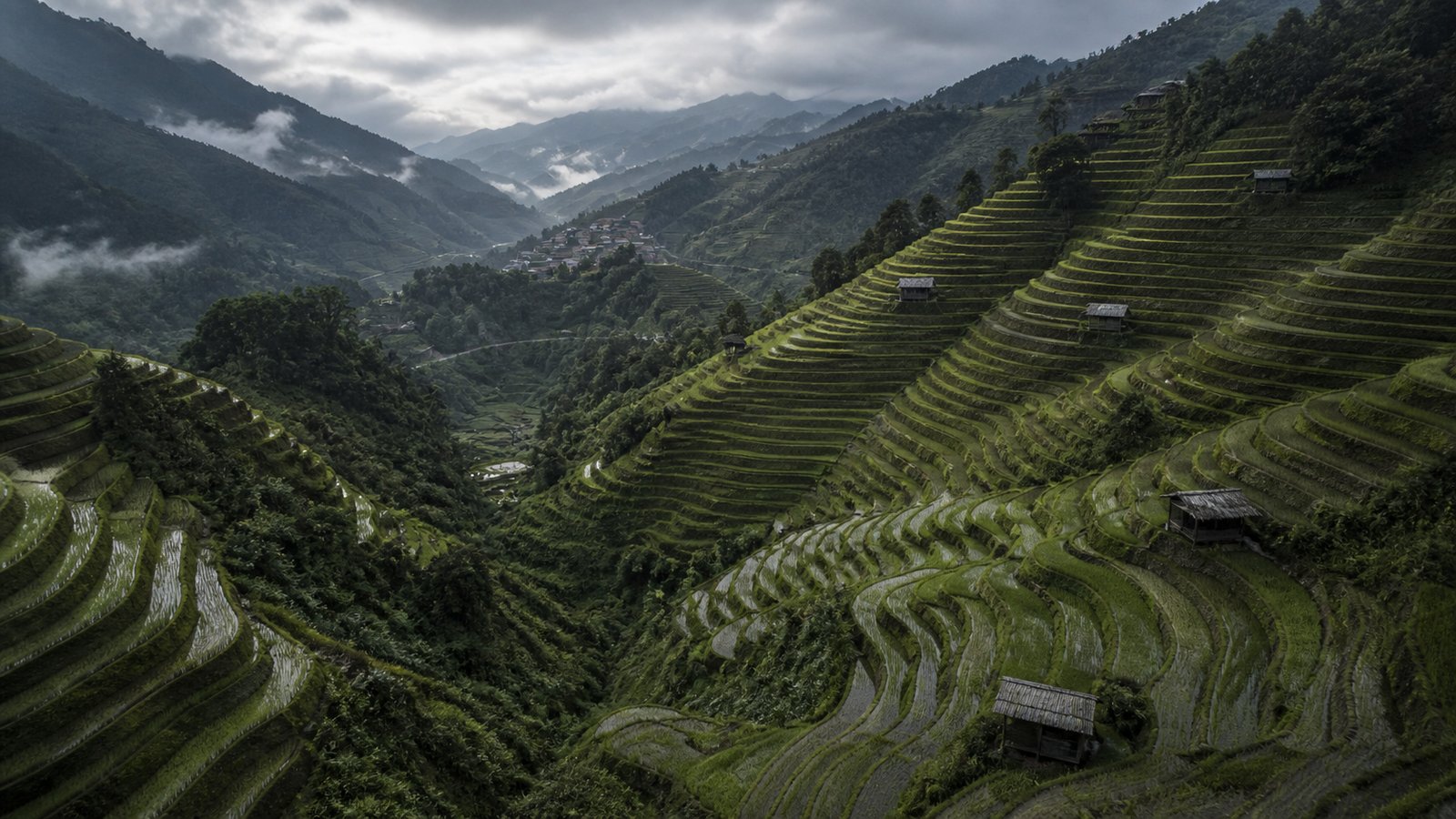
Batad Rice Terraces is strongest on Population Capacity 8/10 — An inhabited village with traditional houses and a resident workforce far exceeding twenty provides clear community-scale physical capacity. Rugged circulation and storm vulnerability keep it below large modern-settlement capacity.. Its clearest scored constraint is Defensibility 2/10 — Batad's steep bowl and terraced slopes hinder movement, but the canonical Base is an open agricultural village and landscape rather than a fortified perimeter. Twenty people cannot seal the extensive terraces and paths..
Overall
5 out of 10Defensibility
2 out of 10Isolation
6 out of 10Sustainability
7 out of 10Ranking context
How this base ranks
Global
#32 of 91 · Top 35.16%
Region · Southeast Asia
#2 of 8 · Top 25%
Base Type · Elevated Stronghold
#1 of 13 · Top 7.69%
Field assessment
At a glance
Bottom Line
For the fixed 20-person Base boundary, the most important endurance constraint is Maintenance Resilience 6/10 — The low-tech irrigation and agricultural system is community-maintained and has persisted for generations, but terrace walls, trails and canals require substantial recurring labour and are vulnerable to typhoons and landslides, as the 2026 repairs demonstrate..
Biggest Trade-off
The central trade-off is the catalogue's strongest evidenced dimension, Population Capacity at 8/10, against its weakest evidenced dimension, Defensibility at 2/10.
Most Likely Failure
The evaluation leaves this material failure condition unresolved: Forest-fed irrigation and community water management are established, but current protected potable-water treatment and storage for long-duration twenty-person use is not directly established by the authoritative sources.
Score rationale
Why it scores this way
Defensibility · 2/10
Batad's steep bowl and terraced slopes hinder movement, but the canonical Base is an open agricultural village and landscape rather than a fortified perimeter. Twenty people cannot seal the extensive terraces and paths.
Advantages
- Positive credit is limited to what supports the Defensibility score of 2/10; the component rationale is: Batad's steep bowl and terraced slopes hinder movement, but the canonical Base is an open agricultural village and landscape rather than a fortified perimeter. Twenty people cannot seal the extensive terraces and paths.
Limitations
- Do not infer additional Defensibility capability outside the fixed Base boundary or beyond the recorded evidence.
Isolation · 6/10
Remote Cordillera terrain and steep walking approaches provide substantial separation, while a living village, tourism and established access routes prevent extreme-isolation scoring.
Advantages
- Positive credit is limited to what supports the Isolation score of 6/10; the component rationale is: Remote Cordillera terrain and steep walking approaches provide substantial separation, while a living village, tourism and established access routes prevent extreme-isolation scoring.
Limitations
- Do not infer additional Isolation capability outside the fixed Base boundary or beyond the recorded evidence.
Sustainability · 7/10
Batad is a living village embedded in an actively cultivated rice landscape with traditional houses, communal irrigation and resident agricultural labour. Recent storm damage demonstrates vulnerability but also confirms functioning habitat and recovery capacity.
Advantages
- Positive credit is limited to what supports the Sustainability score of 7/10; the component rationale is: Batad is a living village embedded in an actively cultivated rice landscape with traditional houses, communal irrigation and resident agricultural labour. Recent storm damage demonstrates vulnerability but also confirms functioning habitat and recovery capacity.
Limitations
- Do not infer additional Sustainability capability outside the fixed Base boundary or beyond the recorded evidence.
Survival horizons
How survival changes over time
First 7 days: current defence/contact profile
First 7 Days
This horizon does not invent future upgrades or resupply. It carries the current evaluated conditions forward and keeps unknown future capability uncredited.
Positive factors
- The stronger current condition in this horizon is Exposure Control 7/10 — The amphitheatre terrain, steep terrace paths and limited practical approaches provide excellent observation and movement friction, though the settlement remains open and agricultural rather than gated..
Risks
- The weaker current condition in this horizon is Defensibility 2/10 — Batad's steep bowl and terraced slopes hinder movement, but the canonical Base is an open agricultural village and landscape rather than a fortified perimeter. Twenty people cannot seal the extensive terraces and paths.; no better future state is assumed.
First 100 days: current habitat/capacity profile
First 100 Days
This horizon does not invent future upgrades or resupply. It carries the current evaluated conditions forward and keeps unknown future capability uncredited.
Positive factors
- The stronger current condition in this horizon is Population Capacity 8/10 — An inhabited village with traditional houses and a resident workforce far exceeding twenty provides clear community-scale physical capacity. Rugged circulation and storm vulnerability keep it below large modern-settlement capacity..
Risks
- The weaker current condition in this horizon is Sustainability 7/10 — Batad is a living village embedded in an actively cultivated rice landscape with traditional houses, communal irrigation and resident agricultural labour. Recent storm damage demonstrates vulnerability but also confirms functioning habitat and recovery capacity.; no better future state is assumed.
Long term: current resource/maintenance profile
Long Term
This horizon does not invent future upgrades or resupply. It carries the current evaluated conditions forward and keeps unknown future capability uncredited.
Positive factors
- The stronger current condition in this horizon is Maintenance Resilience 6/10 — The low-tech irrigation and agricultural system is community-maintained and has persisted for generations, but terrace walls, trails and canals require substantial recurring labour and are vulnerable to typhoons and landslides, as the 2026 repairs demonstrate..
Risks
- The weaker current condition in this horizon is Maintenance Resilience 6/10 — The low-tech irrigation and agricultural system is community-maintained and has persisted for generations, but terrace walls, trails and canals require substantial recurring labour and are vulnerable to typhoons and landslides, as the 2026 repairs demonstrate.; no better future state is assumed.
Tactical assessment
Practical Reality
Reality Check
Scores apply only to the defined Base and exactly 20 capable adults. Unknown, excluded or external assets are not credited as hidden capability.
Best Use
Within the evaluated boundary, treat Population Capacity as the primary operational strength; do not promote that score into capabilities the evidence does not establish.
Key Risk
Maintenance Resilience is the key evidenced long-duration risk: The low-tech irrigation and agricultural system is community-maintained and has persisted for generations, but terrace walls, trails and canals require substantial recurring labour and are vulnerable to typhoons and landslides, as the 2026 repairs demonstrate.
Strengths
- One of the strongest scored dimensions is Population Capacity 8/10 — An inhabited village with traditional houses and a resident workforce far exceeding twenty provides clear community-scale physical capacity. Rugged circulation and storm vulnerability keep it below large modern-settlement capacity..
- One of the strongest scored dimensions is Sustainability 7/10 — Batad is a living village embedded in an actively cultivated rice landscape with traditional houses, communal irrigation and resident agricultural labour. Recent storm damage demonstrates vulnerability but also confirms functioning habitat and recovery capacity..
- One of the strongest scored dimensions is Exposure Control 7/10 — The amphitheatre terrain, steep terrace paths and limited practical approaches provide excellent observation and movement friction, though the settlement remains open and agricultural rather than gated..
Weaknesses
- One of the weakest scored dimensions is Defensibility 2/10 — Batad's steep bowl and terraced slopes hinder movement, but the canonical Base is an open agricultural village and landscape rather than a fortified perimeter. Twenty people cannot seal the extensive terraces and paths..
- One of the weakest scored dimensions is Isolation 6/10 — Remote Cordillera terrain and steep walking approaches provide substantial separation, while a living village, tourism and established access routes prevent extreme-isolation scoring..
- One of the weakest scored dimensions is Maintenance Resilience 6/10 — The low-tech irrigation and agricultural system is community-maintained and has persisted for generations, but terrace walls, trails and canals require substantial recurring labour and are vulnerable to typhoons and landslides, as the 2026 repairs demonstrate..
Assumptions / constraints
- Only assets inside the recorded Core Base and immediate operating boundary are credited; excluded surroundings and unproven future access remain outside the score.
Decision context
Rivals / Alternatives
Similar rival
Banda Neira
Indonesia · Remote Settlement
Banda Neira keeps the same Southeast Asia risk context, with only 0.3 points between the overall scores and closely matched isolation pressure.
Overall 4.7/10
Strongest alternative
Amundsen-Scott South Pole Station
Antarctica · Institutional Compound
Amundsen-Scott South Pole Station scores 7.7 overall versus 5.0, adding a stronger isolation profile while staying relevant as a comparable survival plan.
Overall 7.7/10
Wildcard rival
San Felipe Fortress
Colombia · Fortified Structure
San Felipe Fortress changes the strategy: it is a fortified structure with a defensibility edge, while Batad Rice Terraces holds more of the isolation advantage.
Overall 3.7/10