North America · Fortified Structure
Fort Jefferson
United States
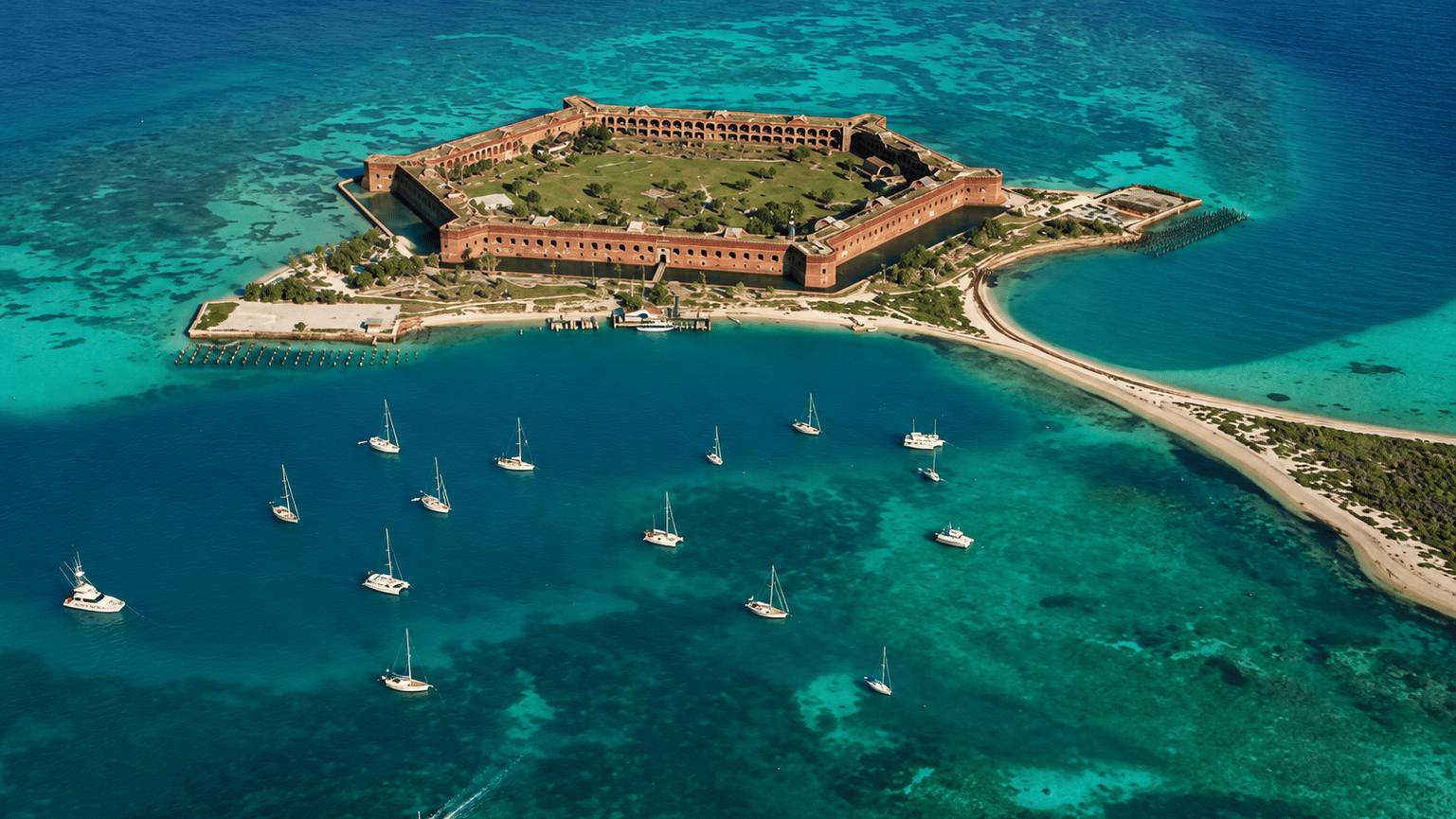
Fort Jefferson is an exceptionally remote masonry stronghold with a moat, casemates and open-water approaches, but current Dry Tortugas operations provide no food, fresh water or fuel on site.
Overall
6.7 out of 10Defensibility
8 out of 10Isolation
9 out of 10Sustainability
3 out of 10Ranking context
How this base ranks
Global
#3 of 91 · Top 3.3%
Region · North America
#1 of 9 · Top 11.11%
Base Type · Fortified Structure
#2 of 18 · Top 11.11%
Field assessment
At a glance
Bottom Line
One of the strongest defensive and isolation profiles in the catalogue, undermined by a present-day resource position that starts at zero for independent food, water and fuel.
Biggest Trade-off
Extreme remoteness and fortress geometry versus almost total dependence on imported survival consumables.
Most Likely Failure
Potable water or food runs out long before the fort's walls or isolation cease to protect the group.
Score rationale
Why it scores this way
Defensibility · 8/10
Fort Jefferson's walls, casemates, bastions and moat provide very strong layered passive defence, tempered by documented structural degradation.
Advantages
- The fort's masonry geometry creates multiple protected positions and internal fallback spaces.
Limitations
- Collapsed and degrading wall sections prevent treating the structure as uniformly intact or failure-tolerant.
Isolation · 9/10
Open-water separation and the absence of roads or bridges place Fort Jefferson in the extreme-remoteness class.
Advantages
- Ordinary ground movement cannot reach Garden Key; regional access requires a vessel or aircraft.
Limitations
- The fort is still reachable by routine marine and air transport when those systems exist, so it is not physically inaccessible.
Sustainability · 3/10
The fort offers enormous shelter but current island habitation is primitive and dependent on supplies brought from outside the park.
Advantages
- The masonry fort provides abundant protected space for sleeping, storage and work.
Limitations
- No food, fresh water or fuel is currently available on site, making long-duration occupation resource-constrained from the start.
Survival horizons
How survival changes over time
Exceptional refuge, finite supplies
First 7 Days
A prepared group arrives at a highly defensible remote fort, but immediate viability depends entirely on the water and food it brought with it.
Positive factors
- Fortification, moat and open water make the first defensive problem unusually manageable.
Risks
- Fresh water and food are finite imported stores rather than current on-site resources.
Water becomes decisive
First 100 Days
The fort remains defensible, but without a new potable-water and food pathway its resource position becomes the dominant constraint.
Positive factors
- Large casemates and passive masonry provide durable shelter without complex life-support machinery.
Risks
- A secure structure cannot compensate for the direct absence of current fresh-water and food provision.
Resource solution required
Long Term
Long-term survival is credible only if the group establishes independent water and food systems while keeping pace with salt-driven structural degradation.
Positive factors
- The fort's passive mass and very low surrounding ground pressure remain durable strategic advantages.
Risks
- Without independent resource renewal, extreme isolation turns from a defence advantage into a resupply liability.
Tactical assessment
Practical Reality
Reality Check
Historic scale and military purpose do not create modern supplies. The V2 score uses the surviving fort and current Garden Key conditions, not a historic garrison or stocked nineteenth-century installation.
Best Use
Exploit the fort's moat, casemates and water separation as a highly controllable refuge while treating water capture, storage and food supply as the first operational priority.
Key Risk
The group reaches a secure position that cannot support prolonged life because fresh water, food and fuel must all be brought in.
Strengths
- A massive six-sided masonry fort, moat, casemates and bastions provide strong passive defence and fallback space.
- Roughly seventy miles of open water and boat/seaplane-only access create exceptional geographic isolation.
- The fort's enormous enclosed footprint gives twenty survivors substantial shelter and storage headroom.
Weaknesses
- NPS explicitly states that no food, water or fuel is available in the park.
- Current camping is primitive, with visitors required to bring fresh water and food.
- Salt-driven corrosion and documented wall collapse create a continuing structural maintenance burden.
Assumptions / constraints
- The fixed twenty-person group may use the existing fort and island facilities but cannot assume ferries, seaplanes or mainland provisioning continue after collapse.
Decision context
Rivals / Alternatives
Similar rival
Alcatraz Island
United States · Fortified Structure
Alcatraz Island keeps the same fortified structure strategy, with only 0.7 points between the overall scores and closely matched sustainability pressure.
Overall 6/10
Strongest alternative
Amundsen-Scott South Pole Station
Antarctica · Institutional Compound
Amundsen-Scott South Pole Station scores 7.7 overall versus 6.7, adding a stronger sustainability profile while staying relevant as a comparable survival plan.
Overall 7.7/10
Wildcard rival
Okinawa
Japan · Isolated Landmass
Okinawa changes the strategy: it is a isolated landmass with a sustainability edge, while Fort Jefferson holds more of the isolation advantage.
Overall 3.7/10