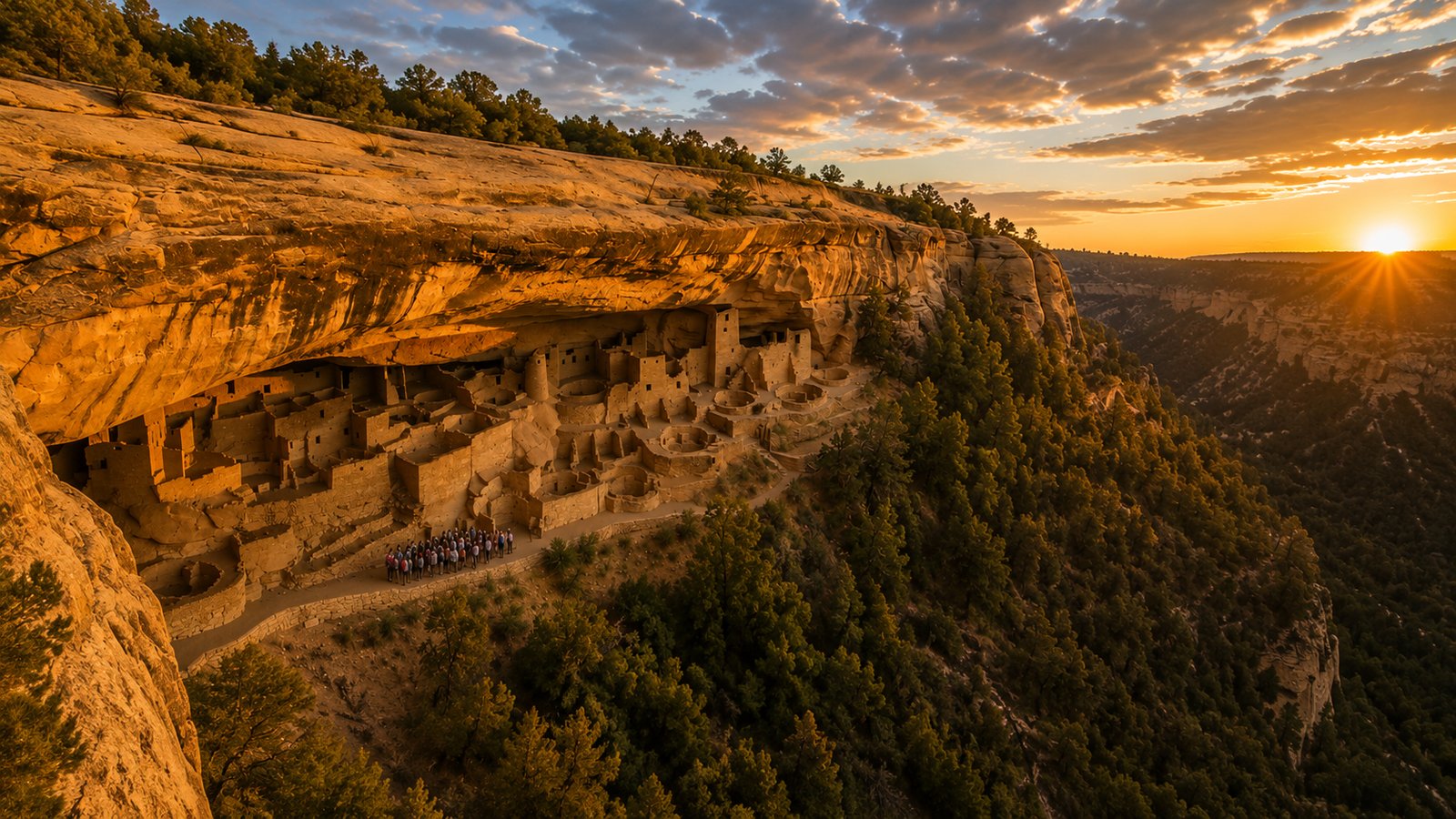
North America · Elevated Stronghold
Mesa Verde
United States
Mesa Verde is strongest on Population Capacity 9/10 — The 267-site campground alone has enormous physical headroom beyond twenty people, supplemented by an in-park lodge and multiple developed visitor areas. Capacity is reduced from the maximum because much of the overnight support is seasonal.. Its clearest scored constraint is Defensibility 1/10 — Individual cliff dwellings possess strong terrain features, but the canonical Base is the entire distributed national park with long roads, many visitor areas and no continuous perimeter that twenty people could defend. No preferred dwelling is substituted..
Overall
3.7 out of 10Defensibility
1 out of 10Isolation
4 out of 10Sustainability
6 out of 10Ranking context
How this base ranks
Global
#78 of 91 · Top 85.71%
Region · North America
#9 of 9 · Top 100%
Base Type · Elevated Stronghold
#11 of 13 · Top 84.62%
Field assessment
At a glance
Bottom Line
For the fixed 20-person Base boundary, the most important endurance constraint is Maintenance Resilience 4/10 — Campsites, roads, masonry and simple sanitation retain some passive value, but current water, showers, lodging and restaurant operation are seasonally maintained systems. Winter closure of overnight facilities demonstrates a meaningful service dependency rather than immediate total failure..
Biggest Trade-off
The central trade-off is the catalogue's strongest evidenced dimension, Population Capacity at 9/10, against its weakest evidenced dimension, Defensibility at 1/10.
Most Likely Failure
The clearest evidenced failure pressure is Maintenance Resilience: Campsites, roads, masonry and simple sanitation retain some passive value, but current water, showers, lodging and restaurant operation are seasonally maintained systems. Winter closure of overnight facilities demonstrates a meaningful service dependency rather than immediate total failure.
Score rationale
Why it scores this way
Defensibility · 1/10
Individual cliff dwellings possess strong terrain features, but the canonical Base is the entire distributed national park with long roads, many visitor areas and no continuous perimeter that twenty people could defend. No preferred dwelling is substituted.
Advantages
- Positive credit is limited to what supports the Defensibility score of 1/10; the component rationale is: Individual cliff dwellings possess strong terrain features, but the canonical Base is the entire distributed national park with long roads, many visitor areas and no continuous perimeter that twenty people could defend. No preferred dwelling is substituted.
Limitations
- Do not infer additional Defensibility capability outside the fixed Base boundary or beyond the recorded evidence.
Isolation · 4/10
The high mesa setting and long winding access road provide useful regional separation, but the park is a developed destination connected to surrounding Colorado communities and normal road networks rather than a remote outpost.
Advantages
- Positive credit is limited to what supports the Isolation score of 4/10; the component rationale is: The high mesa setting and long winding access road provide useful regional separation, but the park is a developed destination connected to surrounding Colorado communities and normal road networks rather than a remote outpost.
Limitations
- Do not infer additional Isolation capability outside the fixed Base boundary or beyond the recorded evidence.
Sustainability · 6/10
A large developed campground, in-park lodge, toilets, showers, grocery and restaurants provide strong current shelter/sanitation/food-support options for twenty people. Most residential services are seasonal and many facilities depend on concessions/utilities, preventing a high autonomous-habitat score.
Advantages
- Positive credit is limited to what supports the Sustainability score of 6/10; the component rationale is: A large developed campground, in-park lodge, toilets, showers, grocery and restaurants provide strong current shelter/sanitation/food-support options for twenty people. Most residential services are seasonal and many facilities depend on concessions/utilities, preventing a high autonomous-habitat score.
Limitations
- Do not infer additional Sustainability capability outside the fixed Base boundary or beyond the recorded evidence.
Survival horizons
How survival changes over time
First 7 days: current defence/contact profile
First 7 Days
This horizon does not invent future upgrades or resupply. It carries the current evaluated conditions forward and keeps unknown future capability uncredited.
Positive factors
- The stronger current condition in this horizon is Exposure Control 4/10 — Mesa roads, canyons and cliff terrain channel some movement and provide useful observation, but the park spans many miles with multiple developed areas and archaeological sites. Monitoring the whole canonical landscape remains manpower-intensive..
Risks
- The weaker current condition in this horizon is Defensibility 1/10 — Individual cliff dwellings possess strong terrain features, but the canonical Base is the entire distributed national park with long roads, many visitor areas and no continuous perimeter that twenty people could defend. No preferred dwelling is substituted.; no better future state is assumed.
First 100 days: current habitat/capacity profile
First 100 Days
This horizon does not invent future upgrades or resupply. It carries the current evaluated conditions forward and keeps unknown future capability uncredited.
Positive factors
- The stronger current condition in this horizon is Population Capacity 9/10 — The 267-site campground alone has enormous physical headroom beyond twenty people, supplemented by an in-park lodge and multiple developed visitor areas. Capacity is reduced from the maximum because much of the overnight support is seasonal..
Risks
- The weaker current condition in this horizon is Sustainability 6/10 — A large developed campground, in-park lodge, toilets, showers, grocery and restaurants provide strong current shelter/sanitation/food-support options for twenty people. Most residential services are seasonal and many facilities depend on concessions/utilities, preventing a high autonomous-habitat score.; no better future state is assumed.
Long term: current resource/maintenance profile
Long Term
This horizon does not invent future upgrades or resupply. It carries the current evaluated conditions forward and keeps unknown future capability uncredited.
Positive factors
- The stronger current condition in this horizon is Maintenance Resilience 4/10 — Campsites, roads, masonry and simple sanitation retain some passive value, but current water, showers, lodging and restaurant operation are seasonally maintained systems. Winter closure of overnight facilities demonstrates a meaningful service dependency rather than immediate total failure..
Risks
- The weaker current condition in this horizon is Maintenance Resilience 4/10 — Campsites, roads, masonry and simple sanitation retain some passive value, but current water, showers, lodging and restaurant operation are seasonally maintained systems. Winter closure of overnight facilities demonstrates a meaningful service dependency rather than immediate total failure.; no better future state is assumed.
Tactical assessment
Practical Reality
Reality Check
Scores apply only to the defined Base and exactly 20 capable adults. Unknown, excluded or external assets are not credited as hidden capability.
Best Use
Within the evaluated boundary, treat Population Capacity as the primary operational strength; do not promote that score into capabilities the evidence does not establish.
Key Risk
Maintenance Resilience is the key evidenced long-duration risk: Campsites, roads, masonry and simple sanitation retain some passive value, but current water, showers, lodging and restaurant operation are seasonally maintained systems. Winter closure of overnight facilities demonstrates a meaningful service dependency rather than immediate total failure.
Strengths
- One of the strongest scored dimensions is Population Capacity 9/10 — The 267-site campground alone has enormous physical headroom beyond twenty people, supplemented by an in-park lodge and multiple developed visitor areas. Capacity is reduced from the maximum because much of the overnight support is seasonal..
- One of the strongest scored dimensions is Sustainability 6/10 — A large developed campground, in-park lodge, toilets, showers, grocery and restaurants provide strong current shelter/sanitation/food-support options for twenty people. Most residential services are seasonal and many facilities depend on concessions/utilities, preventing a high autonomous-habitat score..
- One of the strongest scored dimensions is Isolation 4/10 — The high mesa setting and long winding access road provide useful regional separation, but the park is a developed destination connected to surrounding Colorado communities and normal road networks rather than a remote outpost..
Weaknesses
- One of the weakest scored dimensions is Defensibility 1/10 — Individual cliff dwellings possess strong terrain features, but the canonical Base is the entire distributed national park with long roads, many visitor areas and no continuous perimeter that twenty people could defend. No preferred dwelling is substituted..
- One of the weakest scored dimensions is Isolation 4/10 — The high mesa setting and long winding access road provide useful regional separation, but the park is a developed destination connected to surrounding Colorado communities and normal road networks rather than a remote outpost..
- One of the weakest scored dimensions is Exposure Control 4/10 — Mesa roads, canyons and cliff terrain channel some movement and provide useful observation, but the park spans many miles with multiple developed areas and archaeological sites. Monitoring the whole canonical landscape remains manpower-intensive..
Assumptions / constraints
- Only assets inside the recorded Core Base and immediate operating boundary are credited; excluded surroundings and unproven future access remain outside the score.
Decision context
Rivals / Alternatives
Similar rival
Mount Huashan
China · Elevated Stronghold
Mount Huashan keeps the same elevated stronghold strategy, with only 1.0 points between the overall scores and closely matched defensibility pressure.
Overall 4.7/10
Strongest alternative
Guantanamo Bay
Cuba · Institutional Compound
Guantanamo Bay scores 6.0 overall versus 3.7, adding a stronger defensibility profile while staying relevant as a North America option.
Overall 6/10
Wildcard rival
Amundsen-Scott South Pole Station
Antarctica · Institutional Compound
Amundsen-Scott South Pole Station changes the strategy: it is a institutional compound with a isolation edge, while Mesa Verde has no headline-pillar edge in return.
Overall 7.7/10