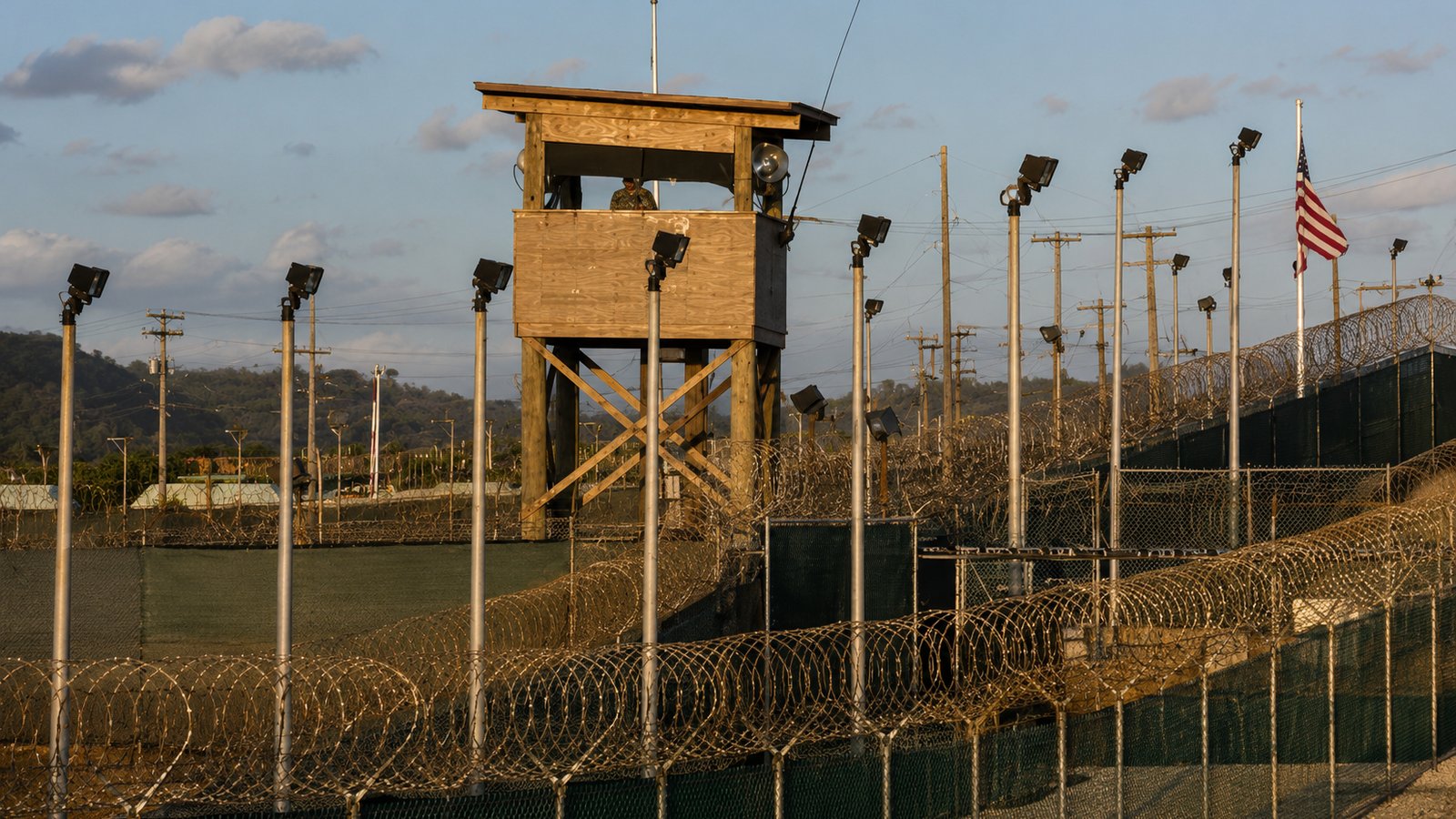
North America · Institutional Compound
Guantanamo Bay
Cuba
Guantanamo Bay is strongest on Population Capacity 10/10 — Current Navy housing alone accommodates thousands of residents across family neighbourhoods, barracks and dormitories, with hospital, school and community services far beyond the fixed twenty-person reference.. Its clearest scored constraint is Isolation 4/10 — The station is geographically separated from U.S. population centres and functions as a restricted enclave, but it is on the Cuban mainland rather than an offshore island and nearby regional population remains materially closer than the U.S. mainland. Political/security separation is not double-counted as geographic remoteness..
Overall
6 out of 10Defensibility
5 out of 10Isolation
4 out of 10Sustainability
9 out of 10Ranking context
How this base ranks
Global
#13 of 91 · Top 14.29%
Region · North America
#3 of 9 · Top 33.33%
Base Type · Institutional Compound
#3 of 7 · Top 42.86%
Field assessment
At a glance
Bottom Line
For the fixed 20-person Base boundary, the most important endurance constraint is Maintenance Resilience 5/10 — Independent water/power capability, extensive housing/support infrastructure and mature maintenance/logistics functions provide redundancy and institutional resilience. Reverse-osmosis water, generation, hospital, refrigeration, sanitation and fuel systems remain technically complex and parts/fuel dependent, so full operation is not low-tech or graceful under prolonged supply loss..
Biggest Trade-off
The central trade-off is the catalogue's strongest evidenced dimension, Population Capacity at 10/10, against its weakest evidenced dimension, Isolation at 4/10.
Most Likely Failure
The clearest evidenced failure pressure is Maintenance Resilience: Independent water/power capability, extensive housing/support infrastructure and mature maintenance/logistics functions provide redundancy and institutional resilience. Reverse-osmosis water, generation, hospital, refrigeration, sanitation and fuel systems remain technically complex and parts/fuel dependent, so full operation is not low-tech or graceful under prolonged supply loss.
Score rationale
Why it scores this way
Defensibility · 5/10
The installation has a real controlled boundary and closed-base status, but the canonical Base spans 45 square miles with a fence line over 17 miles long. Twenty survivors face a very large perimeter burden, so broad access control and secureable buildings support only a moderate score without counting weapons, military personnel or non-public security systems.
Advantages
- Positive credit is limited to what supports the Defensibility score of 5/10; the component rationale is: The installation has a real controlled boundary and closed-base status, but the canonical Base spans 45 square miles with a fence line over 17 miles long. Twenty survivors face a very large perimeter burden, so broad access control and secureable buildings support only a moderate score without counting weapons, military personnel or non-public security systems.
Limitations
- Do not infer additional Defensibility capability outside the fixed Base boundary or beyond the recorded evidence.
Isolation · 4/10
The station is geographically separated from U.S. population centres and functions as a restricted enclave, but it is on the Cuban mainland rather than an offshore island and nearby regional population remains materially closer than the U.S. mainland. Political/security separation is not double-counted as geographic remoteness.
Advantages
- Positive credit is limited to what supports the Isolation score of 4/10; the component rationale is: The station is geographically separated from U.S. population centres and functions as a restricted enclave, but it is on the Cuban mainland rather than an offshore island and nearby regional population remains materially closer than the U.S. mainland. Political/security separation is not double-counted as geographic remoteness.
Limitations
- Do not infer additional Isolation capability outside the fixed Base boundary or beyond the recorded evidence.
Sustainability · 9/10
Thousands of current housing spaces, family neighbourhoods, hospital, school, food retail/services, utilities and independently produced drinking water demonstrate an exceptionally capable existing habitat for twenty people. Dependence on complex maintained systems and external food/fuel replenishment prevents the highest class.
Advantages
- Positive credit is limited to what supports the Sustainability score of 9/10; the component rationale is: Thousands of current housing spaces, family neighbourhoods, hospital, school, food retail/services, utilities and independently produced drinking water demonstrate an exceptionally capable existing habitat for twenty people. Dependence on complex maintained systems and external food/fuel replenishment prevents the highest class.
Limitations
- Do not infer additional Sustainability capability outside the fixed Base boundary or beyond the recorded evidence.
Survival horizons
How survival changes over time
First 7 days: current defence/contact profile
First 7 Days
This horizon does not invent future upgrades or resupply. It carries the current evaluated conditions forward and keeps unknown future capability uncredited.
Positive factors
- The stronger current condition in this horizon is Defensibility 5/10 — The installation has a real controlled boundary and closed-base status, but the canonical Base spans 45 square miles with a fence line over 17 miles long. Twenty survivors face a very large perimeter burden, so broad access control and secureable buildings support only a moderate score without counting weapons, military personnel or non-public security systems..
Risks
- The weaker current condition in this horizon is Defensibility 5/10 — The installation has a real controlled boundary and closed-base status, but the canonical Base spans 45 square miles with a fence line over 17 miles long. Twenty survivors face a very large perimeter burden, so broad access control and secureable buildings support only a moderate score without counting weapons, military personnel or non-public security systems.; no better future state is assumed.
First 100 days: current habitat/capacity profile
First 100 Days
This horizon does not invent future upgrades or resupply. It carries the current evaluated conditions forward and keeps unknown future capability uncredited.
Positive factors
- The stronger current condition in this horizon is Population Capacity 10/10 — Current Navy housing alone accommodates thousands of residents across family neighbourhoods, barracks and dormitories, with hospital, school and community services far beyond the fixed twenty-person reference..
Risks
- The weaker current condition in this horizon is Sustainability 9/10 — Thousands of current housing spaces, family neighbourhoods, hospital, school, food retail/services, utilities and independently produced drinking water demonstrate an exceptionally capable existing habitat for twenty people. Dependence on complex maintained systems and external food/fuel replenishment prevents the highest class.; no better future state is assumed.
Long term: current resource/maintenance profile
Long Term
This horizon does not invent future upgrades or resupply. It carries the current evaluated conditions forward and keeps unknown future capability uncredited.
Positive factors
- The stronger current condition in this horizon is Resource Security 7/10 — The installation has its own drinking-water production/storage, its own power sources, fuel/logistics functions, commissary/food services and large current inventories. That covers several critical needs locally and independently of Cuban utilities. Food diversity, generation fuel and specialist replacement parts still depend materially on maritime/air supply, so the Base is strong but not autonomous..
Risks
- The weaker current condition in this horizon is Maintenance Resilience 5/10 — Independent water/power capability, extensive housing/support infrastructure and mature maintenance/logistics functions provide redundancy and institutional resilience. Reverse-osmosis water, generation, hospital, refrigeration, sanitation and fuel systems remain technically complex and parts/fuel dependent, so full operation is not low-tech or graceful under prolonged supply loss.; no better future state is assumed.
Tactical assessment
Practical Reality
Reality Check
Scores apply only to the defined Base and exactly 20 capable adults. Unknown, excluded or external assets are not credited as hidden capability.
Best Use
Within the evaluated boundary, treat Population Capacity as the primary operational strength; do not promote that score into capabilities the evidence does not establish.
Key Risk
Maintenance Resilience is the key evidenced long-duration risk: Independent water/power capability, extensive housing/support infrastructure and mature maintenance/logistics functions provide redundancy and institutional resilience. Reverse-osmosis water, generation, hospital, refrigeration, sanitation and fuel systems remain technically complex and parts/fuel dependent, so full operation is not low-tech or graceful under prolonged supply loss.
Strengths
- One of the strongest scored dimensions is Population Capacity 10/10 — Current Navy housing alone accommodates thousands of residents across family neighbourhoods, barracks and dormitories, with hospital, school and community services far beyond the fixed twenty-person reference..
- One of the strongest scored dimensions is Sustainability 9/10 — Thousands of current housing spaces, family neighbourhoods, hospital, school, food retail/services, utilities and independently produced drinking water demonstrate an exceptionally capable existing habitat for twenty people. Dependence on complex maintained systems and external food/fuel replenishment prevents the highest class..
- One of the strongest scored dimensions is Resource Security 7/10 — The installation has its own drinking-water production/storage, its own power sources, fuel/logistics functions, commissary/food services and large current inventories. That covers several critical needs locally and independently of Cuban utilities. Food diversity, generation fuel and specialist replacement parts still depend materially on maritime/air supply, so the Base is strong but not autonomous..
Weaknesses
- One of the weakest scored dimensions is Isolation 4/10 — The station is geographically separated from U.S. population centres and functions as a restricted enclave, but it is on the Cuban mainland rather than an offshore island and nearby regional population remains materially closer than the U.S. mainland. Political/security separation is not double-counted as geographic remoteness..
- One of the weakest scored dimensions is Defensibility 5/10 — The installation has a real controlled boundary and closed-base status, but the canonical Base spans 45 square miles with a fence line over 17 miles long. Twenty survivors face a very large perimeter burden, so broad access control and secureable buildings support only a moderate score without counting weapons, military personnel or non-public security systems..
- One of the weakest scored dimensions is Exposure Control 5/10 — A closed installation boundary and controlled ordinary access materially reduce random approach and provide broad warning, but the enormous 45-square-mile footprint and long boundary create substantial watch burden. No tactical gate, patrol or surveillance detail is credited..
Assumptions / constraints
- Only assets inside the recorded Core Base and immediate operating boundary are credited; excluded surroundings and unproven future access remain outside the score.
Decision context
Rivals / Alternatives
Similar rival
Al Udeid Air Base
Qatar · Institutional Compound
Al Udeid Air Base keeps the same institutional compound strategy, with only 0.3 points between the overall scores and closely matched defensibility pressure.
Overall 5.7/10
Strongest alternative
Amundsen-Scott South Pole Station
Antarctica · Institutional Compound
Amundsen-Scott South Pole Station scores 7.7 overall versus 6.0, adding a stronger isolation profile while staying relevant as another institutional compound.
Overall 7.7/10
Wildcard rival
Great Mosque of Djenné
Mali · Landmark Structure
Great Mosque of Djenné changes the strategy: it is a landmark structure without a headline-pillar edge over Guantanamo Bay, while Guantanamo Bay holds more of the sustainability advantage.
Overall 1.3/10