Middle East · Institutional Compound
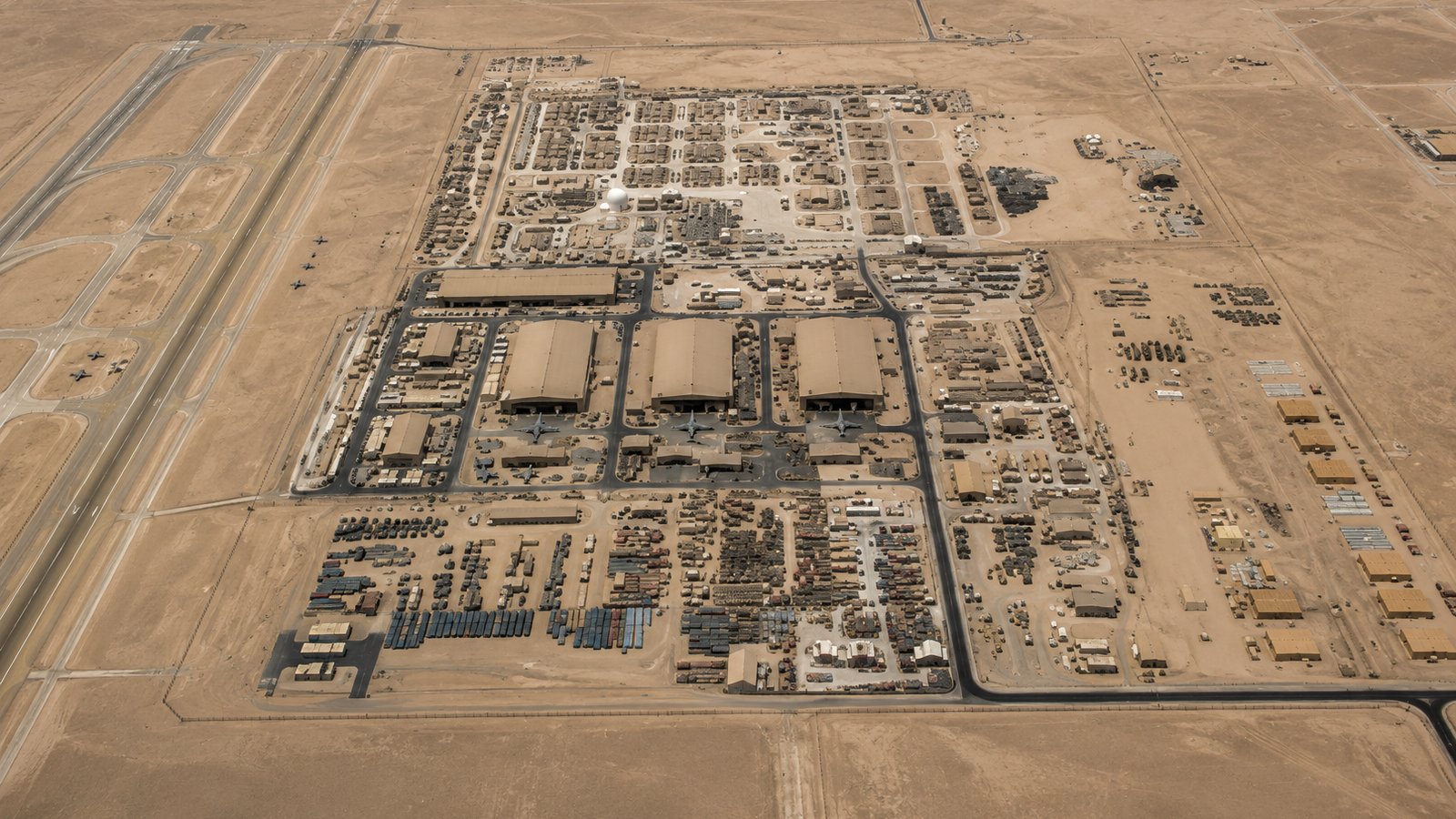
Al Udeid Air Base
Qatar
Al Udeid offers enormous hardened accommodation and support capacity, but its scale works against a 20-person survivor group: the perimeter is too large to defend like a compact fortress and long-term habitability remains dependent on sophisticated utilities and external supply.
Overall
5.7 out of 10Defensibility
5 out of 10Isolation
4 out of 10Sustainability
8 out of 10Ranking context
How this base ranks
Global
#18 of 91 · Top 19.78%
Region · Middle East
#2 of 5 · Top 40%
Base Type · Institutional Compound
#4 of 7 · Top 57.14%
Field assessment
At a glance
Bottom Line
A superbly equipped habitat with far more space than the group needs, but only middling defensive efficiency once current military manpower and weapons are removed from the model.
Biggest Trade-off
Exceptional accommodation and support capacity versus a vast perimeter and specialist infrastructure burden.
Most Likely Failure
Utilities and logistics degrade while the survivors remain burdened by an installation whose full perimeter and systems they cannot sustainably operate.
Score rationale
Why it scores this way
Defensibility · 5/10
Al Udeid contains real hardened and controlled features, but the installation is so large that twenty survivors cannot defend it like a compact military compound.
Advantages
- Hardened accommodation and controlled gate infrastructure provide useful protected positions.
Limitations
- The enormous air-base footprint creates a perimeter burden that overwhelms the fixed group's ability to watch and hold every approach.
Isolation · 4/10
Open desert provides some separation from Doha, but the Base remains road-connected within a densely developed small state rather than genuinely remote.
Advantages
- Desert surroundings create noticeable open-ground separation from the metropolitan core.
Limitations
- The installation remains connected to Qatar's road network and wider developed environment.
Sustainability · 8/10
Hardened accommodation, high-throughput dining, safe water and modern utilities make Al Udeid an unusually capable existing habitat, albeit one dependent on complex systems.
Advantages
- Current facilities demonstrate year-round accommodation, food preparation, potable water and utility capacity vastly above the reference group's needs.
Limitations
- Cooling, water, sewer and electrical systems impose significant specialist maintenance demands when normal support disappears.
Survival horizons
How survival changes over time
High-capacity immediate refuge
First 7 Days
Hardened accommodation, water, dining and utility infrastructure give a small group an exceptionally well-equipped starting environment.
Positive factors
- Existing support facilities can absorb the reference group with enormous spare capacity.
Risks
- The group must immediately shrink its defended footprint rather than attempting to hold the full installation perimeter.
Technical burden rises
First 100 Days
As normal support chains degrade, sustaining cooling, power, water, sewer and stored supplies becomes more important than the Base's abundant floor space.
Positive factors
- Hardened facilities and existing stores provide meaningful operating margin while systems remain serviceable.
Risks
- Specialist infrastructure and replacement-part dependency can convert excess capacity into maintenance liability.
Too large unless simplified
Long Term
Long-term survival requires concentrating on a much smaller useful core and replacing external supply dependence with resource pathways the fixed group can actually sustain.
Positive factors
- The installation offers substantial durable built space and accommodation headroom for a deliberately reduced operating footprint.
Risks
- No independent long-term food-production or Base-owned durable primary water and energy pathway is established by the current evidence.
Tactical assessment
Practical Reality
Reality Check
Current military staffing, weapons and force capability are not survival-score bonuses; V2 evaluates the physical installation and what the fixed survivor group can realistically operate.
Best Use
Use hardened accommodation and support facilities while keeping the active survivor footprint as small and manageable as the existing installation allows.
Key Risk
A 20-person group inherits infrastructure and perimeter built for thousands, creating maintenance and watch demands far beyond the useful occupied footprint.
Strengths
- Hardened dormitories, controlled gates and dedicated security infrastructure provide genuine physical defensive assets.
- Current drinking-water, dining, food-storage and utility infrastructure provide a very strong starting habitat.
- Accommodation and support throughput for thousands give extraordinary capacity relative to the fixed 20-person group.
Weaknesses
- The installation's broad perimeter creates a severe watch and defence burden for only twenty survivors.
- Habitability depends on sophisticated electrical, water, sewer and cooling systems that normally receive specialist support.
- Current evidence does not establish independent long-term food production or a Base-owned durable primary water and energy source.
Assumptions / constraints
- The fixed 20-capable-adult reference may use existing facilities but does not inherit current military manpower, weapons or rare specialist expertise as scoring bonuses.
Decision context
Rivals / Alternatives
Similar rival
Guantanamo Bay
Cuba · Institutional Compound
Guantanamo Bay keeps the same institutional compound strategy, with only 0.3 points between the overall scores and closely matched sustainability pressure.
Overall 6/10
Strongest alternative
Amundsen-Scott South Pole Station
Antarctica · Institutional Compound
Amundsen-Scott South Pole Station scores 7.7 overall versus 5.7, adding a stronger isolation profile while staying relevant as another institutional compound.
Overall 7.7/10
Wildcard rival
Great Mosque of Djenné
Mali · Landmark Structure
Great Mosque of Djenné changes the strategy: it is a landmark structure without a headline-pillar edge over Al Udeid Air Base, while Al Udeid Air Base holds more of the sustainability advantage.
Overall 1.3/10