UK & Ireland · Remote Settlement
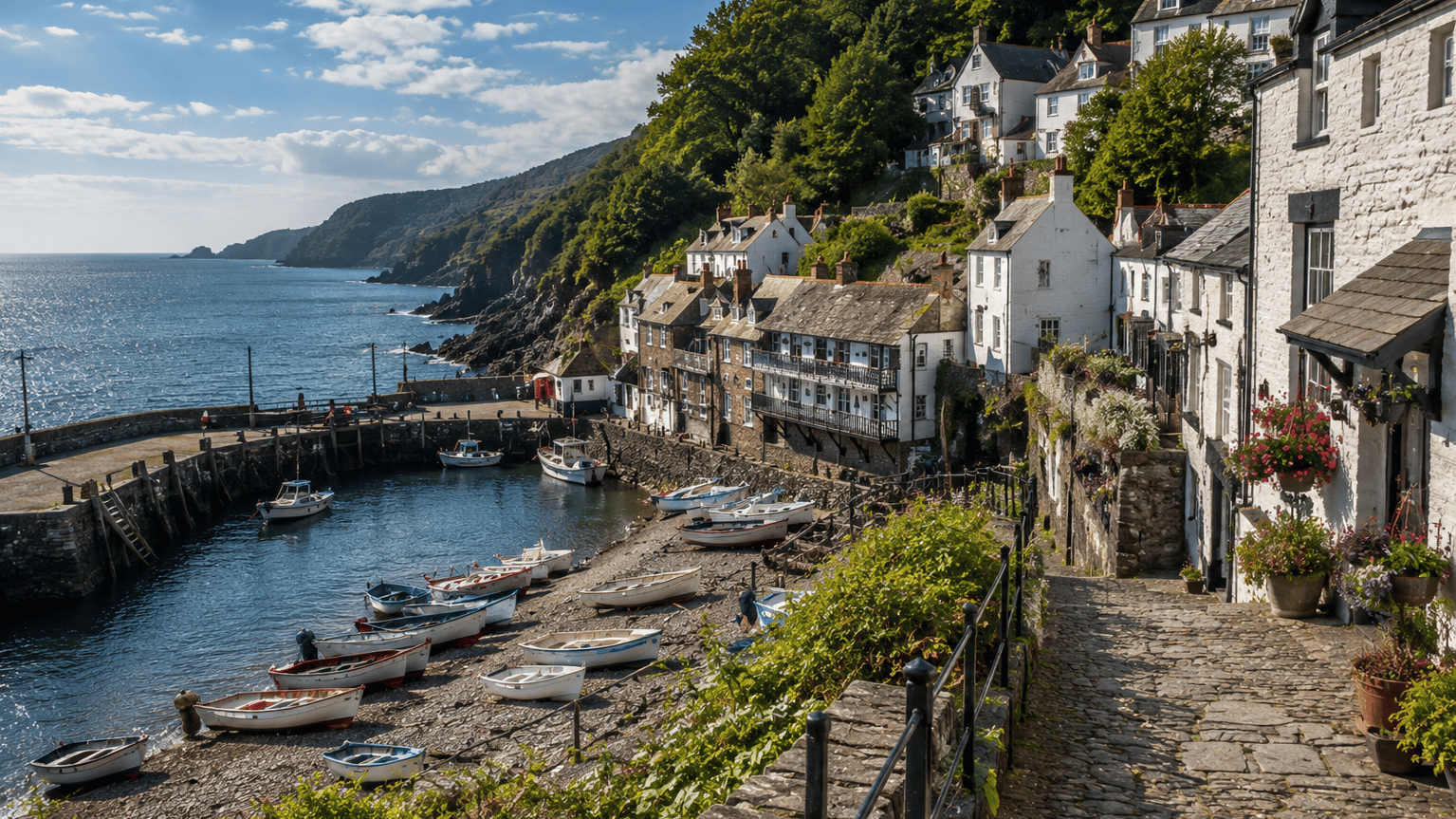
Clovelly
United Kingdom
Clovelly is strongest on Population Capacity 8/10 — Eighty-three fully occupied houses and around 300 residents, plus a 17-room hotel and village businesses, establish substantially larger-community residential and functional capacity than the fixed twenty-person group.. Its clearest scored constraint is Isolation 1/10 — Clovelly is only about ten miles from Bideford and has ordinary bus/road access to the visitor centre. Its vehicle-free internal street affects final approach and logistics, not regional separation from surrounding population..
Overall
3.7 out of 10Defensibility
3 out of 10Isolation
1 out of 10Sustainability
7 out of 10Ranking context
How this base ranks
Global
#74 of 91 · Top 81.32%
Region · UK & Ireland
#9 of 11 · Top 81.82%
Base Type · Remote Settlement
#15 of 17 · Top 88.24%
Field assessment
At a glance
Bottom Line
For the fixed 20-person Base boundary, the most important endurance constraint is Resource Security 4/10 — Clovelly has unusually meaningful local food pathways for a small village: daily landed fish/seafood, estate game/beef, gardens supplying vegetables and current food-service stocks, plus a working harbour. Those cover a major need beyond ordinary shop dependence, but a protected independent potable-water source/storage/treatment pathway and survival-energy continuity are not established inside the village boundary. This fits several needs covered with an important fragility..
Biggest Trade-off
The central trade-off is the catalogue's strongest evidenced dimension, Population Capacity at 8/10, against its weakest evidenced dimension, Isolation at 1/10.
Most Likely Failure
The evaluation leaves this material failure condition unresolved: The village is currently inhabited and serviced, but no protected independent potable-water source, storage/treatment or outage continuity is established by the operator evidence. Resource Security 4 credits strong local food production while preserving this critical utility uncertainty.
Score rationale
Why it scores this way
Defensibility · 3/10
The privately managed upper entry, 400-foot cliff setting, vehicle-free steep street and harbour geometry create a partial defendable position with controllable sectors. The village remains an open civilian settlement with foot/coastal approaches and no hardened perimeter or fallback barrier system, keeping it in the partial rather than genuine-fortification classes.
Advantages
- Positive credit is limited to what supports the Defensibility score of 3/10; the component rationale is: The privately managed upper entry, 400-foot cliff setting, vehicle-free steep street and harbour geometry create a partial defendable position with controllable sectors. The village remains an open civilian settlement with foot/coastal approaches and no hardened perimeter or fallback barrier system, keeping it in the partial rather than genuine-fortification classes.
Limitations
- Do not infer additional Defensibility capability outside the fixed Base boundary or beyond the recorded evidence.
Isolation · 1/10
Clovelly is only about ten miles from Bideford and has ordinary bus/road access to the visitor centre. Its vehicle-free internal street affects final approach and logistics, not regional separation from surrounding population.
Advantages
- Positive credit is limited to what supports the Isolation score of 1/10; the component rationale is: Clovelly is only about ten miles from Bideford and has ordinary bus/road access to the visitor centre. Its vehicle-free internal street affects final approach and logistics, not regional separation from surrounding population.
Limitations
- Do not infer additional Isolation capability outside the fixed Base boundary or beyond the recorded evidence.
Sustainability · 7/10
A fully occupied 83-house community of around 300 residents, plus hotel, restaurants, harbour and established resident logistics, provides a strong existing long-term habitat for twenty people. The village is steep, historic and utility-dependent, but it is demonstrably a functioning residential community rather than a visitor shell.
Advantages
- Positive credit is limited to what supports the Sustainability score of 7/10; the component rationale is: A fully occupied 83-house community of around 300 residents, plus hotel, restaurants, harbour and established resident logistics, provides a strong existing long-term habitat for twenty people. The village is steep, historic and utility-dependent, but it is demonstrably a functioning residential community rather than a visitor shell.
Limitations
- Do not infer additional Sustainability capability outside the fixed Base boundary or beyond the recorded evidence.
Survival horizons
How survival changes over time
First 7 days: current defence/contact profile
First 7 Days
This horizon does not invent future upgrades or resupply. It carries the current evaluated conditions forward and keeps unknown future capability uncredited.
Positive factors
- The stronger current condition in this horizon is Exposure Control 7/10 — The main internal movement corridor is an exceptionally steep vehicle-free High Street between a managed upper entry and harbour, with cliff/coast terrain strongly shaping final approaches. Coastal paths and harbour access prevent the few-route exceptional classes, but ordinary mass ground movement is substantially channelled..
Risks
- The weaker current condition in this horizon is Defensibility 3/10 — The privately managed upper entry, 400-foot cliff setting, vehicle-free steep street and harbour geometry create a partial defendable position with controllable sectors. The village remains an open civilian settlement with foot/coastal approaches and no hardened perimeter or fallback barrier system, keeping it in the partial rather than genuine-fortification classes.; no better future state is assumed.
First 100 days: current habitat/capacity profile
First 100 Days
This horizon does not invent future upgrades or resupply. It carries the current evaluated conditions forward and keeps unknown future capability uncredited.
Positive factors
- The stronger current condition in this horizon is Population Capacity 8/10 — Eighty-three fully occupied houses and around 300 residents, plus a 17-room hotel and village businesses, establish substantially larger-community residential and functional capacity than the fixed twenty-person group..
Risks
- The weaker current condition in this horizon is Sustainability 7/10 — A fully occupied 83-house community of around 300 residents, plus hotel, restaurants, harbour and established resident logistics, provides a strong existing long-term habitat for twenty people. The village is steep, historic and utility-dependent, but it is demonstrably a functioning residential community rather than a visitor shell.; no better future state is assumed.
Long term: current resource/maintenance profile
Long Term
This horizon does not invent future upgrades or resupply. It carries the current evaluated conditions forward and keeps unknown future capability uncredited.
Positive factors
- The stronger current condition in this horizon is Maintenance Resilience 5/10 — The village already uses low-tech resident-maintained sledges because normal vehicles cannot operate internally, while its historic houses and harbour retain substantial passive usefulness. Modern water, sanitation, electricity and building conservation still depend on external systems and maintenance, producing balanced rather than strong resilience..
Risks
- The weaker current condition in this horizon is Resource Security 4/10 — Clovelly has unusually meaningful local food pathways for a small village: daily landed fish/seafood, estate game/beef, gardens supplying vegetables and current food-service stocks, plus a working harbour. Those cover a major need beyond ordinary shop dependence, but a protected independent potable-water source/storage/treatment pathway and survival-energy continuity are not established inside the village boundary. This fits several needs covered with an important fragility.; no better future state is assumed.
Tactical assessment
Practical Reality
Reality Check
Scores apply only to the defined Base and exactly 20 capable adults. Unknown, excluded or external assets are not credited as hidden capability.
Best Use
Within the evaluated boundary, treat Population Capacity as the primary operational strength; do not promote that score into capabilities the evidence does not establish.
Key Risk
Resource Security is the key evidenced long-duration risk: Clovelly has unusually meaningful local food pathways for a small village: daily landed fish/seafood, estate game/beef, gardens supplying vegetables and current food-service stocks, plus a working harbour. Those cover a major need beyond ordinary shop dependence, but a protected independent potable-water source/storage/treatment pathway and survival-energy continuity are not established inside the village boundary. This fits several needs covered with an important fragility.
Strengths
- One of the strongest scored dimensions is Population Capacity 8/10 — Eighty-three fully occupied houses and around 300 residents, plus a 17-room hotel and village businesses, establish substantially larger-community residential and functional capacity than the fixed twenty-person group..
- One of the strongest scored dimensions is Sustainability 7/10 — A fully occupied 83-house community of around 300 residents, plus hotel, restaurants, harbour and established resident logistics, provides a strong existing long-term habitat for twenty people. The village is steep, historic and utility-dependent, but it is demonstrably a functioning residential community rather than a visitor shell..
- One of the strongest scored dimensions is Exposure Control 7/10 — The main internal movement corridor is an exceptionally steep vehicle-free High Street between a managed upper entry and harbour, with cliff/coast terrain strongly shaping final approaches. Coastal paths and harbour access prevent the few-route exceptional classes, but ordinary mass ground movement is substantially channelled..
Weaknesses
- One of the weakest scored dimensions is Isolation 1/10 — Clovelly is only about ten miles from Bideford and has ordinary bus/road access to the visitor centre. Its vehicle-free internal street affects final approach and logistics, not regional separation from surrounding population..
- One of the weakest scored dimensions is Defensibility 3/10 — The privately managed upper entry, 400-foot cliff setting, vehicle-free steep street and harbour geometry create a partial defendable position with controllable sectors. The village remains an open civilian settlement with foot/coastal approaches and no hardened perimeter or fallback barrier system, keeping it in the partial rather than genuine-fortification classes..
- One of the weakest scored dimensions is Resource Security 4/10 — Clovelly has unusually meaningful local food pathways for a small village: daily landed fish/seafood, estate game/beef, gardens supplying vegetables and current food-service stocks, plus a working harbour. Those cover a major need beyond ordinary shop dependence, but a protected independent potable-water source/storage/treatment pathway and survival-energy continuity are not established inside the village boundary. This fits several needs covered with an important fragility..
Assumptions / constraints
- Only assets inside the recorded Core Base and immediate operating boundary are credited; excluded surroundings and unproven future access remain outside the score.
Decision context
Rivals / Alternatives
Similar rival
Eguisheim
France · Remote Settlement
Eguisheim keeps the same remote settlement strategy, with only 0.3 points between the overall scores and closely matched sustainability pressure.
Overall 3.3/10
Strongest alternative
Isle of Eigg Village
United Kingdom · Remote Settlement
Isle of Eigg Village scores 6.3 overall versus 3.7, adding a stronger isolation profile while staying relevant as another remote settlement.
Overall 6.3/10
Wildcard rival
Fort Jefferson
United States · Fortified Structure
Fort Jefferson changes the strategy: it is a fortified structure with a isolation edge, while Clovelly holds more of the sustainability advantage.
Overall 6.7/10