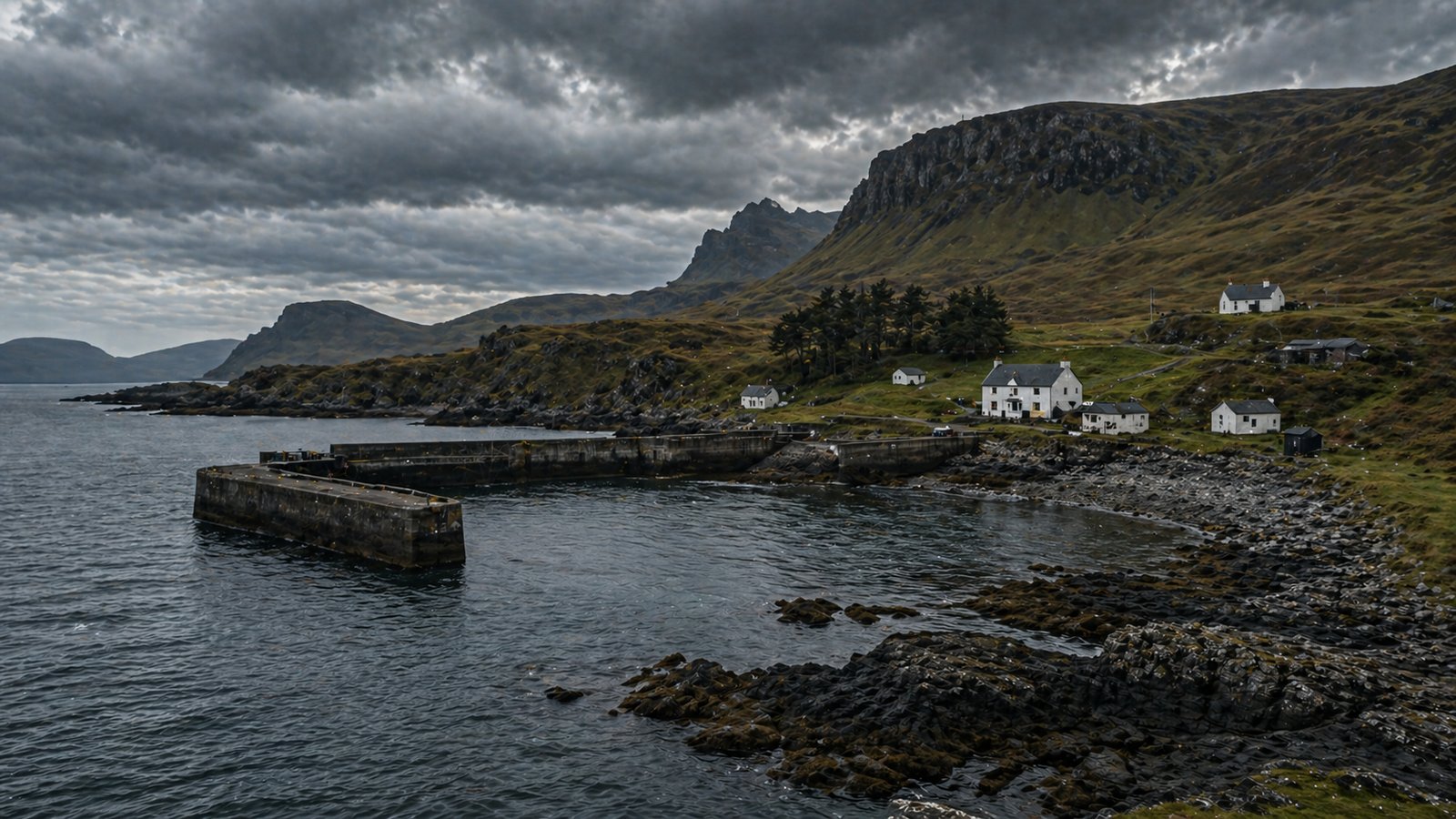
UK & Ireland · Remote Settlement
Isle of Eigg Village
United Kingdom
Isle of Eigg Village is strongest on Isolation 8/10 — A roughly 12-mile sea crossing creates genuine regional separation with no road connection to mainland population centres. Eigg remains regularly accessible by sea rather than extremely remote, so it fits the unusually removed class rather than 9-10.. Its clearest scored constraint is Defensibility 4/10 — The inhabited settlement is not a fortress: homes, crofts, roads and community facilities do not form a continuous hardened defended boundary. Sea separation helps before contact but belongs mainly to Isolation and Exposure Control, so direct walker pressure still requires improvised local defence around chosen occupied nodes..
Overall
6.3 out of 10Defensibility
4 out of 10Isolation
8 out of 10Sustainability
7 out of 10Ranking context
How this base ranks
Global
#7 of 91 · Top 7.69%
Region · UK & Ireland
#3 of 11 · Top 27.27%
Base Type · Remote Settlement
#1 of 17 · Top 5.88%
Field assessment
At a glance
Bottom Line
For the fixed 20-person Base boundary, the most important endurance constraint is Resource Security 6/10 — The settlement system has directly evidenced safe spring/well drinking-water sources, a stand-alone diversified renewable electricity grid maintained by residents, and active croft/local food production. The island still imports substantial food, specialist parts and other supplies, and Highland Council records limited local water capacity, so the position is clearly credible for twenty people without qualifying as strongly independent or abundant..
Biggest Trade-off
The central trade-off is the catalogue's strongest evidenced dimension, Isolation at 8/10, against its weakest evidenced dimension, Defensibility at 4/10.
Most Likely Failure
The clearest evidenced failure pressure is Resource Security: The settlement system has directly evidenced safe spring/well drinking-water sources, a stand-alone diversified renewable electricity grid maintained by residents, and active croft/local food production. The island still imports substantial food, specialist parts and other supplies, and Highland Council records limited local water capacity, so the position is clearly credible for twenty people without qualifying as strongly independent or abundant.
Score rationale
Why it scores this way
Defensibility · 4/10
The inhabited settlement is not a fortress: homes, crofts, roads and community facilities do not form a continuous hardened defended boundary. Sea separation helps before contact but belongs mainly to Isolation and Exposure Control, so direct walker pressure still requires improvised local defence around chosen occupied nodes.
Advantages
- Positive credit is limited to what supports the Defensibility score of 4/10; the component rationale is: The inhabited settlement is not a fortress: homes, crofts, roads and community facilities do not form a continuous hardened defended boundary. Sea separation helps before contact but belongs mainly to Isolation and Exposure Control, so direct walker pressure still requires improvised local defence around chosen occupied nodes.
Limitations
- Do not infer additional Defensibility capability outside the fixed Base boundary or beyond the recorded evidence.
Isolation · 8/10
A roughly 12-mile sea crossing creates genuine regional separation with no road connection to mainland population centres. Eigg remains regularly accessible by sea rather than extremely remote, so it fits the unusually removed class rather than 9-10.
Advantages
- Positive credit is limited to what supports the Isolation score of 8/10; the component rationale is: A roughly 12-mile sea crossing creates genuine regional separation with no road connection to mainland population centres. Eigg remains regularly accessible by sea rather than extremely remote, so it fits the unusually removed class rather than 9-10.
Limitations
- Do not infer additional Isolation capability outside the fixed Base boundary or beyond the recorded evidence.
Sustainability · 7/10
Eigg is already a year-round community substantially larger than the fixed twenty-person reference, with homes, accommodation, sanitation, laundry, food preparation, medical facilities and continuous local electricity. Its island scale and mainland dependence for specialist services keep it below the highest habitat classes.
Advantages
- Positive credit is limited to what supports the Sustainability score of 7/10; the component rationale is: Eigg is already a year-round community substantially larger than the fixed twenty-person reference, with homes, accommodation, sanitation, laundry, food preparation, medical facilities and continuous local electricity. Its island scale and mainland dependence for specialist services keep it below the highest habitat classes.
Limitations
- Do not infer additional Sustainability capability outside the fixed Base boundary or beyond the recorded evidence.
Survival horizons
How survival changes over time
First 7 days: current defence/contact profile
First 7 Days
This horizon does not invent future upgrades or resupply. It carries the current evaluated conditions forward and keeps unknown future capability uncredited.
Positive factors
- The stronger current condition in this horizon is Exposure Control 7/10 — Normal arrivals are strongly channelled through a small number of piers and sea approaches, giving useful warning and manageable monitoring for twenty people. The whole shoreline is not an engineered barrier and small-craft landings cannot be ruled out everywhere, preventing an 8-10 score..
Risks
- The weaker current condition in this horizon is Defensibility 4/10 — The inhabited settlement is not a fortress: homes, crofts, roads and community facilities do not form a continuous hardened defended boundary. Sea separation helps before contact but belongs mainly to Isolation and Exposure Control, so direct walker pressure still requires improvised local defence around chosen occupied nodes.; no better future state is assumed.
First 100 days: current habitat/capacity profile
First 100 Days
This horizon does not invent future upgrades or resupply. It carries the current evaluated conditions forward and keeps unknown future capability uncredited.
Positive factors
- The stronger current condition in this horizon is Sustainability 7/10 — Eigg is already a year-round community substantially larger than the fixed twenty-person reference, with homes, accommodation, sanitation, laundry, food preparation, medical facilities and continuous local electricity. Its island scale and mainland dependence for specialist services keep it below the highest habitat classes..
Risks
- The weaker current condition in this horizon is Sustainability 7/10 — Eigg is already a year-round community substantially larger than the fixed twenty-person reference, with homes, accommodation, sanitation, laundry, food preparation, medical facilities and continuous local electricity. Its island scale and mainland dependence for specialist services keep it below the highest habitat classes.; no better future state is assumed.
Long term: current resource/maintenance profile
Long Term
This horizon does not invent future upgrades or resupply. It carries the current evaluated conditions forward and keeps unknown future capability uncredited.
Positive factors
- The stronger current condition in this horizon is Maintenance Resilience 7/10 — The island's critical electricity system deliberately diversifies hydro, wind and solar, retains diesel backup and is owned, managed and maintained by resident islanders. Replacement electronics and specialist parts still create outside dependency, but ordinary loss of one generation source does not collapse the whole system..
Risks
- The weaker current condition in this horizon is Resource Security 6/10 — The settlement system has directly evidenced safe spring/well drinking-water sources, a stand-alone diversified renewable electricity grid maintained by residents, and active croft/local food production. The island still imports substantial food, specialist parts and other supplies, and Highland Council records limited local water capacity, so the position is clearly credible for twenty people without qualifying as strongly independent or abundant.; no better future state is assumed.
Tactical assessment
Practical Reality
Reality Check
Scores apply only to the defined Base and exactly 20 capable adults. Unknown, excluded or external assets are not credited as hidden capability.
Best Use
Within the evaluated boundary, treat Isolation as the primary operational strength; do not promote that score into capabilities the evidence does not establish.
Key Risk
Resource Security is the key evidenced long-duration risk: The settlement system has directly evidenced safe spring/well drinking-water sources, a stand-alone diversified renewable electricity grid maintained by residents, and active croft/local food production. The island still imports substantial food, specialist parts and other supplies, and Highland Council records limited local water capacity, so the position is clearly credible for twenty people without qualifying as strongly independent or abundant.
Strengths
- One of the strongest scored dimensions is Isolation 8/10 — A roughly 12-mile sea crossing creates genuine regional separation with no road connection to mainland population centres. Eigg remains regularly accessible by sea rather than extremely remote, so it fits the unusually removed class rather than 9-10..
- One of the strongest scored dimensions is Sustainability 7/10 — Eigg is already a year-round community substantially larger than the fixed twenty-person reference, with homes, accommodation, sanitation, laundry, food preparation, medical facilities and continuous local electricity. Its island scale and mainland dependence for specialist services keep it below the highest habitat classes..
- One of the strongest scored dimensions is Exposure Control 7/10 — Normal arrivals are strongly channelled through a small number of piers and sea approaches, giving useful warning and manageable monitoring for twenty people. The whole shoreline is not an engineered barrier and small-craft landings cannot be ruled out everywhere, preventing an 8-10 score..
Weaknesses
- One of the weakest scored dimensions is Defensibility 4/10 — The inhabited settlement is not a fortress: homes, crofts, roads and community facilities do not form a continuous hardened defended boundary. Sea separation helps before contact but belongs mainly to Isolation and Exposure Control, so direct walker pressure still requires improvised local defence around chosen occupied nodes..
- One of the weakest scored dimensions is Resource Security 6/10 — The settlement system has directly evidenced safe spring/well drinking-water sources, a stand-alone diversified renewable electricity grid maintained by residents, and active croft/local food production. The island still imports substantial food, specialist parts and other supplies, and Highland Council records limited local water capacity, so the position is clearly credible for twenty people without qualifying as strongly independent or abundant..
- One of the weakest scored dimensions is Sustainability 7/10 — Eigg is already a year-round community substantially larger than the fixed twenty-person reference, with homes, accommodation, sanitation, laundry, food preparation, medical facilities and continuous local electricity. Its island scale and mainland dependence for specialist services keep it below the highest habitat classes..
Assumptions / constraints
- Only assets inside the recorded Core Base and immediate operating boundary are credited; excluded surroundings and unproven future access remain outside the score.
Decision context
Rivals / Alternatives
Similar rival
Longyearbyen
Norway · Remote Settlement
Longyearbyen keeps the same remote settlement strategy, with only 0.7 points between the overall scores and closely matched sustainability pressure.
Overall 5.7/10
Strongest alternative
Amundsen-Scott South Pole Station
Antarctica · Institutional Compound
Amundsen-Scott South Pole Station scores 7.7 overall versus 6.3, adding a stronger sustainability profile while staying relevant as a comparable survival plan.
Overall 7.7/10
Wildcard rival
Great Mosque of Djenné
Mali · Landmark Structure
Great Mosque of Djenné changes the strategy: it is a landmark structure without a headline-pillar edge over Isle of Eigg Village, while Isle of Eigg Village holds more of the isolation advantage.
Overall 1.3/10