Western Europe · Remote Settlement
Eguisheim
France
Eguisheim is strongest on Population Capacity 9/10 — A living settlement of 1,729 people and 798 households, with public utilities and active commerce, has exceptional functional headroom relative to a twenty-person reference group.. Its clearest scored constraint is Isolation 1/10 — Eguisheim is an actively visited Alsace village integrated with the Colmar-area road and tourism economy. Historic morphology provides no meaningful regional geographic separation from surrounding population pressure..
Overall
3.3 out of 10Defensibility
2 out of 10Isolation
1 out of 10Sustainability
7 out of 10Ranking context
How this base ranks
Global
#81 of 91 · Top 89.01%
Region · Western Europe
#9 of 9 · Top 100%
Base Type · Remote Settlement
#16 of 17 · Top 94.12%
Field assessment
At a glance
Bottom Line
For the fixed 20-person Base boundary, the most important endurance constraint is Resource Security 3/10 — Eguisheim has current public potable-water production/distribution, collective sanitation and meaningful everyday food stock through local shops, giving useful starting resources. The water network is regional/technical and its latest published microbiological conformity is imperfect; no durable independent energy or diversified survival-food production inside the canonical village is established. This remains a major-dependency resource position..
Biggest Trade-off
The central trade-off is the catalogue's strongest evidenced dimension, Population Capacity at 9/10, against its weakest evidenced dimension, Isolation at 1/10.
Most Likely Failure
The evaluation leaves this material failure condition unresolved: A current public potable-water service is established, but the latest published microbiological conformity is 90.9% and long-duration independent source/storage/treatment continuity is not proven. Resource Security 3 retains this water-reliability dependency for package adjudication.
Score rationale
Why it scores this way
Defensibility · 2/10
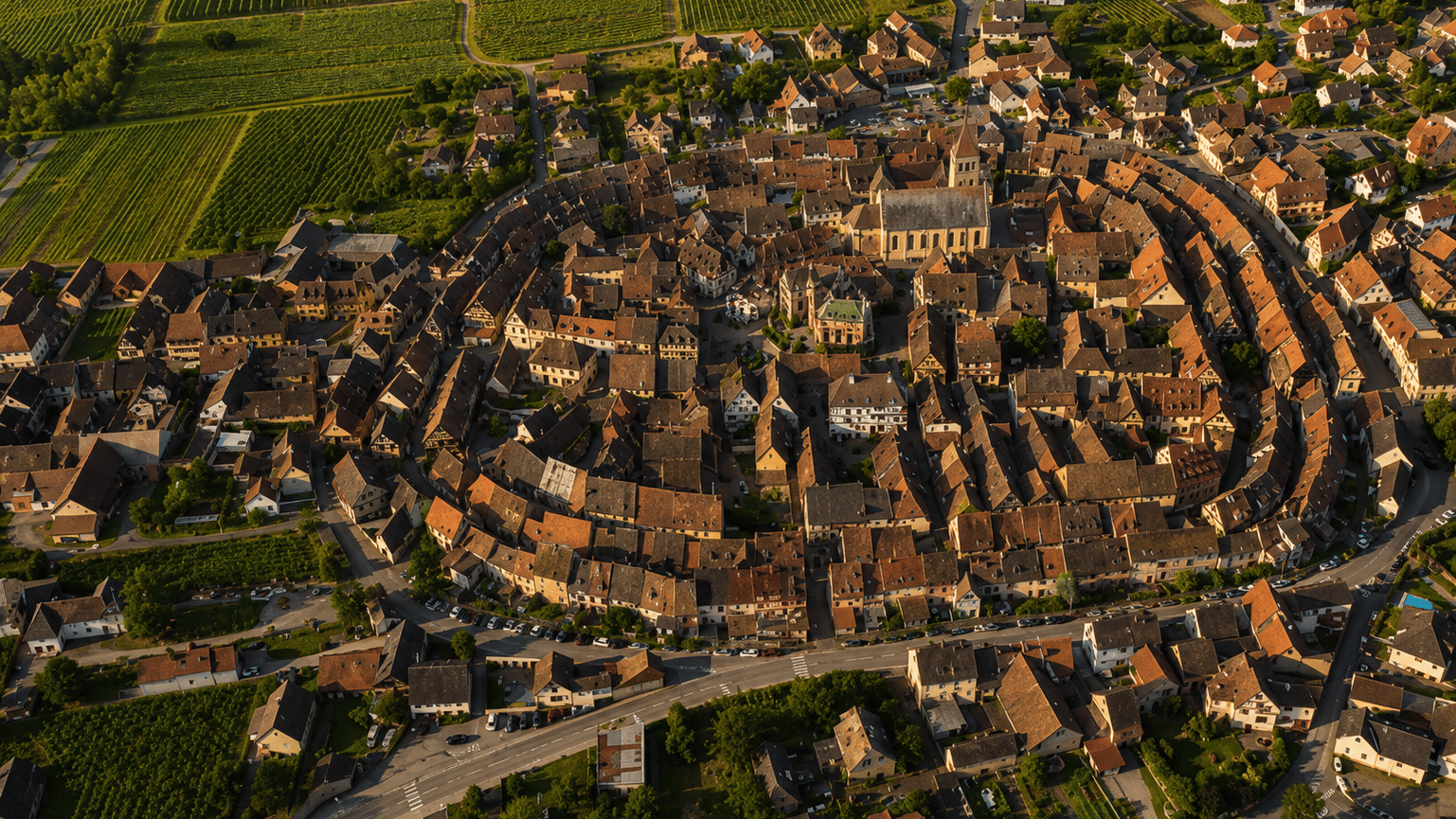
Eguisheim is a compact historic village but remains an open civilian settlement without a current hardened perimeter, controlled gate set or protected fallback sector. Concentric street morphology gives some local structure, but twenty people cannot defend the whole inhabited canonical village as a fortress.
Advantages
- Positive credit is limited to what supports the Defensibility score of 2/10; the component rationale is: Eguisheim is a compact historic village but remains an open civilian settlement without a current hardened perimeter, controlled gate set or protected fallback sector. Concentric street morphology gives some local structure, but twenty people cannot defend the whole inhabited canonical village as a fortress.
Limitations
- Do not infer additional Defensibility capability outside the fixed Base boundary or beyond the recorded evidence.
Isolation · 1/10
Eguisheim is an actively visited Alsace village integrated with the Colmar-area road and tourism economy. Historic morphology provides no meaningful regional geographic separation from surrounding population pressure.
Advantages
- Positive credit is limited to what supports the Isolation score of 1/10; the component rationale is: Eguisheim is an actively visited Alsace village integrated with the Colmar-area road and tourism economy. Historic morphology provides no meaningful regional geographic separation from surrounding population pressure.
Limitations
- Do not infer additional Isolation capability outside the fixed Base boundary or beyond the recorded evidence.
Sustainability · 7/10
A functioning 1,729-resident settlement with hundreds of households, potable-water and sanitation services and current everyday food retail provides a strong existing long-term habitat for twenty. Current water-quality imperfection and dependence on regional utilities/logistics prevent an exceptional self-contained class.
Advantages
- Positive credit is limited to what supports the Sustainability score of 7/10; the component rationale is: A functioning 1,729-resident settlement with hundreds of households, potable-water and sanitation services and current everyday food retail provides a strong existing long-term habitat for twenty. Current water-quality imperfection and dependence on regional utilities/logistics prevent an exceptional self-contained class.
Limitations
- Do not infer additional Sustainability capability outside the fixed Base boundary or beyond the recorded evidence.
Survival horizons
How survival changes over time
First 7 days: current defence/contact profile
First 7 Days
This horizon does not invent future upgrades or resupply. It carries the current evaluated conditions forward and keeps unknown future capability uncredited.
Positive factors
- The stronger current condition in this horizon is Exposure Control 4/10 — Compact concentric streets create a credible but burdensome monitoring structure and make movement through the historic core somewhat predictable. Multiple ordinary road and pedestrian approaches remain open, so the morphology does not justify strong funnel/control scores..
Risks
- The weaker current condition in this horizon is Defensibility 2/10 — Eguisheim is a compact historic village but remains an open civilian settlement without a current hardened perimeter, controlled gate set or protected fallback sector. Concentric street morphology gives some local structure, but twenty people cannot defend the whole inhabited canonical village as a fortress.; no better future state is assumed.
First 100 days: current habitat/capacity profile
First 100 Days
This horizon does not invent future upgrades or resupply. It carries the current evaluated conditions forward and keeps unknown future capability uncredited.
Positive factors
- The stronger current condition in this horizon is Population Capacity 9/10 — A living settlement of 1,729 people and 798 households, with public utilities and active commerce, has exceptional functional headroom relative to a twenty-person reference group..
Risks
- The weaker current condition in this horizon is Sustainability 7/10 — A functioning 1,729-resident settlement with hundreds of households, potable-water and sanitation services and current everyday food retail provides a strong existing long-term habitat for twenty. Current water-quality imperfection and dependence on regional utilities/logistics prevent an exceptional self-contained class.; no better future state is assumed.
Long term: current resource/maintenance profile
Long Term
This horizon does not invent future upgrades or resupply. It carries the current evaluated conditions forward and keeps unknown future capability uncredited.
Positive factors
- The stronger current condition in this horizon is Maintenance Resilience 5/10 — Ordinary masonry housing and commercial buildings retain substantial passive shelter value, while the village has established public water/sewer and active local agricultural/commercial systems. Those utilities still depend on pumps, treatment, regional maintenance and grid/logistics support, producing balanced rather than strong independent resilience..
Risks
- The weaker current condition in this horizon is Resource Security 3/10 — Eguisheim has current public potable-water production/distribution, collective sanitation and meaningful everyday food stock through local shops, giving useful starting resources. The water network is regional/technical and its latest published microbiological conformity is imperfect; no durable independent energy or diversified survival-food production inside the canonical village is established. This remains a major-dependency resource position.; no better future state is assumed.
Tactical assessment
Practical Reality
Reality Check
Scores apply only to the defined Base and exactly 20 capable adults. Unknown, excluded or external assets are not credited as hidden capability.
Best Use
Within the evaluated boundary, treat Population Capacity as the primary operational strength; do not promote that score into capabilities the evidence does not establish.
Key Risk
Resource Security is the key evidenced long-duration risk: Eguisheim has current public potable-water production/distribution, collective sanitation and meaningful everyday food stock through local shops, giving useful starting resources. The water network is regional/technical and its latest published microbiological conformity is imperfect; no durable independent energy or diversified survival-food production inside the canonical village is established. This remains a major-dependency resource position.
Strengths
- One of the strongest scored dimensions is Population Capacity 9/10 — A living settlement of 1,729 people and 798 households, with public utilities and active commerce, has exceptional functional headroom relative to a twenty-person reference group..
- One of the strongest scored dimensions is Sustainability 7/10 — A functioning 1,729-resident settlement with hundreds of households, potable-water and sanitation services and current everyday food retail provides a strong existing long-term habitat for twenty. Current water-quality imperfection and dependence on regional utilities/logistics prevent an exceptional self-contained class..
- One of the strongest scored dimensions is Maintenance Resilience 5/10 — Ordinary masonry housing and commercial buildings retain substantial passive shelter value, while the village has established public water/sewer and active local agricultural/commercial systems. Those utilities still depend on pumps, treatment, regional maintenance and grid/logistics support, producing balanced rather than strong independent resilience..
Weaknesses
- One of the weakest scored dimensions is Isolation 1/10 — Eguisheim is an actively visited Alsace village integrated with the Colmar-area road and tourism economy. Historic morphology provides no meaningful regional geographic separation from surrounding population pressure..
- One of the weakest scored dimensions is Defensibility 2/10 — Eguisheim is a compact historic village but remains an open civilian settlement without a current hardened perimeter, controlled gate set or protected fallback sector. Concentric street morphology gives some local structure, but twenty people cannot defend the whole inhabited canonical village as a fortress..
- One of the weakest scored dimensions is Resource Security 3/10 — Eguisheim has current public potable-water production/distribution, collective sanitation and meaningful everyday food stock through local shops, giving useful starting resources. The water network is regional/technical and its latest published microbiological conformity is imperfect; no durable independent energy or diversified survival-food production inside the canonical village is established. This remains a major-dependency resource position..
Assumptions / constraints
- Only assets inside the recorded Core Base and immediate operating boundary are credited; excluded surroundings and unproven future access remain outside the score.
Decision context
Rivals / Alternatives
Similar rival
Hallstatt
Austria · Remote Settlement
Hallstatt keeps the same remote settlement strategy, with only 1.0 points between the overall scores and closely matched isolation pressure.
Overall 4.3/10
Strongest alternative
Isle of Eigg Village
United Kingdom · Remote Settlement
Isle of Eigg Village scores 6.3 overall versus 3.3, adding a stronger isolation profile while staying relevant as another remote settlement.
Overall 6.3/10
Wildcard rival
Fort Jefferson
United States · Fortified Structure
Fort Jefferson changes the strategy: it is a fortified structure with a isolation edge, while Eguisheim holds more of the sustainability advantage.
Overall 6.7/10