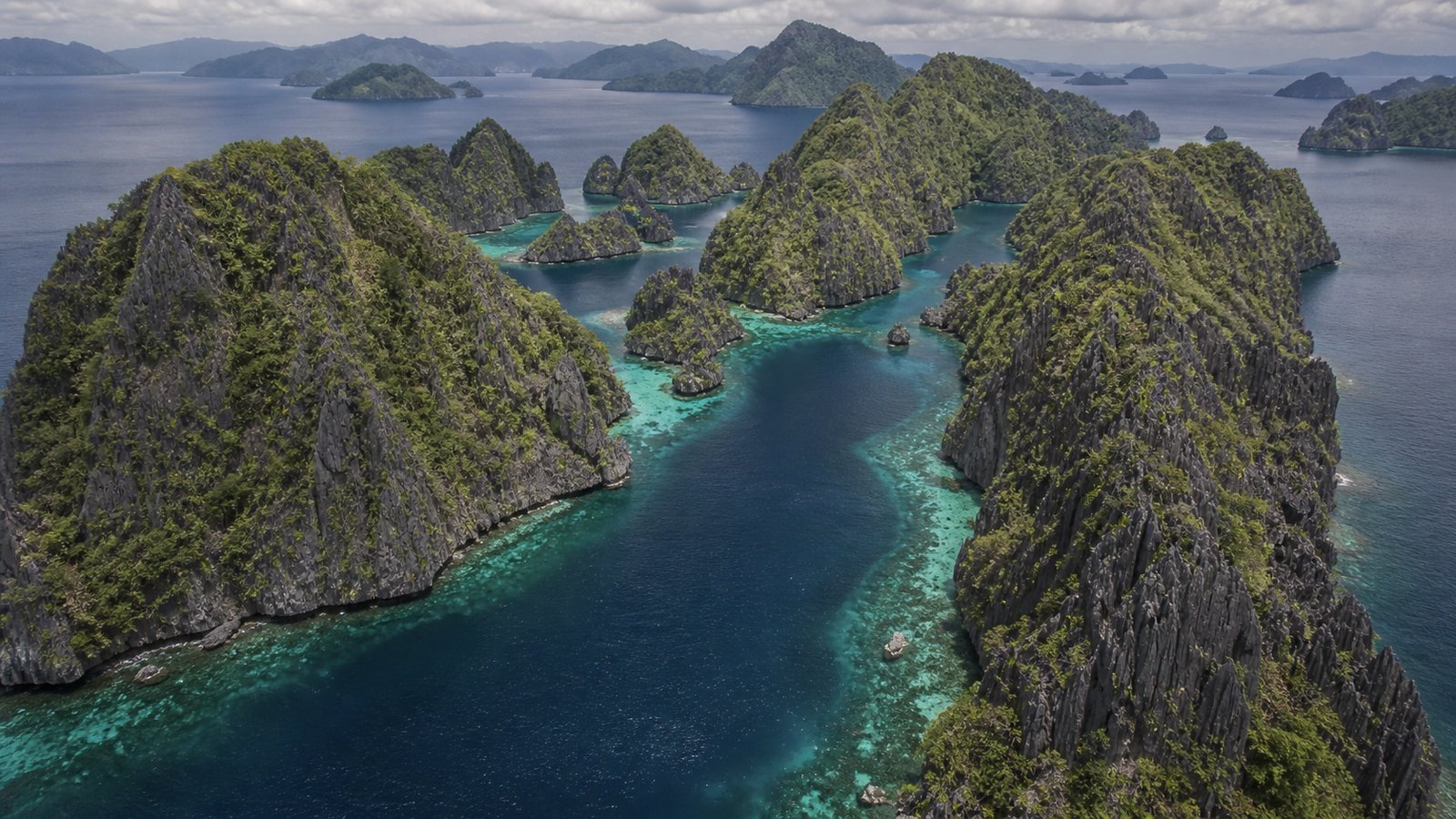
Southeast Asia · Isolated Landmass
Palawan
Philippines
Palawan is strongest on Population Capacity 10/10 — The inherited geography supports well over one million residents when the independent city is included, with mature housing, agriculture, water and service infrastructure; this is the highest credible capacity class relative to twenty people.. Its clearest scored constraint is Defensibility 1/10 — The canonical province/island system spans hundreds of barangays, many islands, long coastlines and major settlements. Twenty survivors cannot defend it as one boundary; no more favourable municipality is substituted..
Overall
4 out of 10Defensibility
1 out of 10Isolation
2 out of 10Sustainability
9 out of 10Ranking context
How this base ranks
Global
#72 of 91 · Top 79.12%
Region · Southeast Asia
#7 of 8 · Top 87.5%
Base Type · Isolated Landmass
#15 of 19 · Top 78.95%
Field assessment
At a glance
Bottom Line
For the fixed 20-person Base boundary, the most important endurance constraint is Maintenance Resilience 5/10 — Agriculture, fisheries, gravity/protected water sources and solar-assisted remote water systems provide significant passive/local resilience. Broad electricity supply remains highly diesel/bunker dependent and many treatment/desalination/distribution systems require machinery, fuel and parts, producing a mixed profile..
Biggest Trade-off
The central trade-off is the catalogue's strongest evidenced dimension, Population Capacity at 10/10, against its weakest evidenced dimension, Defensibility at 1/10.
Most Likely Failure
The clearest evidenced failure pressure is Maintenance Resilience: Agriculture, fisheries, gravity/protected water sources and solar-assisted remote water systems provide significant passive/local resilience. Broad electricity supply remains highly diesel/bunker dependent and many treatment/desalination/distribution systems require machinery, fuel and parts, producing a mixed profile.
Score rationale
Why it scores this way
Defensibility · 1/10
The canonical province/island system spans hundreds of barangays, many islands, long coastlines and major settlements. Twenty survivors cannot defend it as one boundary; no more favourable municipality is substituted.
Advantages
- Positive credit is limited to what supports the Defensibility score of 1/10; the component rationale is: The canonical province/island system spans hundreds of barangays, many islands, long coastlines and major settlements. Twenty survivors cannot defend it as one boundary; no more favourable municipality is substituted.
Limitations
- Do not infer additional Defensibility capability outside the fixed Base boundary or beyond the recorded evidence.
Isolation · 2/10
Palawan's island geography slows pressure from other Philippine regions, but the canonical record itself contains around a million residents outside Puerto Princesa plus the independent city's population. That very large internal pressure source keeps effective isolation low.
Advantages
- Positive credit is limited to what supports the Isolation score of 2/10; the component rationale is: Palawan's island geography slows pressure from other Philippine regions, but the canonical record itself contains around a million residents outside Puerto Princesa plus the independent city's population. That very large internal pressure source keeps effective isolation low.
Limitations
- Do not infer additional Isolation capability outside the fixed Base boundary or beyond the recorded evidence.
Sustainability · 9/10
A large functioning provincial society with major urban/rural housing, extensive food production, potable-water systems and electricity provides exceptional existing habitat for twenty people. Distributed geography and fuel-dependent utility systems prevent a perfect class.
Advantages
- Positive credit is limited to what supports the Sustainability score of 9/10; the component rationale is: A large functioning provincial society with major urban/rural housing, extensive food production, potable-water systems and electricity provides exceptional existing habitat for twenty people. Distributed geography and fuel-dependent utility systems prevent a perfect class.
Limitations
- Do not infer additional Sustainability capability outside the fixed Base boundary or beyond the recorded evidence.
Survival horizons
How survival changes over time
First 7 days: current defence/contact profile
First 7 Days
This horizon does not invent future upgrades or resupply. It carries the current evaluated conditions forward and keeps unknown future capability uncredited.
Positive factors
- The stronger current condition in this horizon is Exposure Control 2/10 — Sea gaps constrain some external arrivals, but the canonical Base contains a very large internal population across many municipalities, roads, ports and islands. Twenty survivors cannot monitor the province as a limited approach set..
Risks
- The weaker current condition in this horizon is Defensibility 1/10 — The canonical province/island system spans hundreds of barangays, many islands, long coastlines and major settlements. Twenty survivors cannot defend it as one boundary; no more favourable municipality is substituted.; no better future state is assumed.
First 100 days: current habitat/capacity profile
First 100 Days
This horizon does not invent future upgrades or resupply. It carries the current evaluated conditions forward and keeps unknown future capability uncredited.
Positive factors
- The stronger current condition in this horizon is Population Capacity 10/10 — The inherited geography supports well over one million residents when the independent city is included, with mature housing, agriculture, water and service infrastructure; this is the highest credible capacity class relative to twenty people..
Risks
- The weaker current condition in this horizon is Sustainability 9/10 — A large functioning provincial society with major urban/rural housing, extensive food production, potable-water systems and electricity provides exceptional existing habitat for twenty people. Distributed geography and fuel-dependent utility systems prevent a perfect class.; no better future state is assumed.
Long term: current resource/maintenance profile
Long Term
This horizon does not invent future upgrades or resupply. It carries the current evaluated conditions forward and keeps unknown future capability uncredited.
Positive factors
- The stronger current condition in this horizon is Resource Security 8/10 — Palawan combines extraordinary rice/coconut production, very large fisheries output and diverse surface/deepwell/desalinated potable-water systems. Electricity and technical supply remain materially diesel/import dependent, but local food and water assets are unusually strong for a twenty-person reference group..
Risks
- The weaker current condition in this horizon is Maintenance Resilience 5/10 — Agriculture, fisheries, gravity/protected water sources and solar-assisted remote water systems provide significant passive/local resilience. Broad electricity supply remains highly diesel/bunker dependent and many treatment/desalination/distribution systems require machinery, fuel and parts, producing a mixed profile.; no better future state is assumed.
Tactical assessment
Practical Reality
Reality Check
Scores apply only to the defined Base and exactly 20 capable adults. Unknown, excluded or external assets are not credited as hidden capability.
Best Use
Within the evaluated boundary, treat Population Capacity as the primary operational strength; do not promote that score into capabilities the evidence does not establish.
Key Risk
Maintenance Resilience is the key evidenced long-duration risk: Agriculture, fisheries, gravity/protected water sources and solar-assisted remote water systems provide significant passive/local resilience. Broad electricity supply remains highly diesel/bunker dependent and many treatment/desalination/distribution systems require machinery, fuel and parts, producing a mixed profile.
Strengths
- One of the strongest scored dimensions is Population Capacity 10/10 — The inherited geography supports well over one million residents when the independent city is included, with mature housing, agriculture, water and service infrastructure; this is the highest credible capacity class relative to twenty people..
- One of the strongest scored dimensions is Sustainability 9/10 — A large functioning provincial society with major urban/rural housing, extensive food production, potable-water systems and electricity provides exceptional existing habitat for twenty people. Distributed geography and fuel-dependent utility systems prevent a perfect class..
- One of the strongest scored dimensions is Resource Security 8/10 — Palawan combines extraordinary rice/coconut production, very large fisheries output and diverse surface/deepwell/desalinated potable-water systems. Electricity and technical supply remain materially diesel/import dependent, but local food and water assets are unusually strong for a twenty-person reference group..
Weaknesses
- One of the weakest scored dimensions is Defensibility 1/10 — The canonical province/island system spans hundreds of barangays, many islands, long coastlines and major settlements. Twenty survivors cannot defend it as one boundary; no more favourable municipality is substituted..
- One of the weakest scored dimensions is Isolation 2/10 — Palawan's island geography slows pressure from other Philippine regions, but the canonical record itself contains around a million residents outside Puerto Princesa plus the independent city's population. That very large internal pressure source keeps effective isolation low..
- One of the weakest scored dimensions is Exposure Control 2/10 — Sea gaps constrain some external arrivals, but the canonical Base contains a very large internal population across many municipalities, roads, ports and islands. Twenty survivors cannot monitor the province as a limited approach set..
Assumptions / constraints
- Only assets inside the recorded Core Base and immediate operating boundary are credited; excluded surroundings and unproven future access remain outside the score.
Decision context
Rivals / Alternatives
Similar rival
Jeju Island
Japan · Isolated Landmass
Jeju Island keeps the same isolated landmass strategy, with only 0.0 points between the overall scores and closely matched defensibility pressure.
Overall 4/10
Strongest alternative
Heligoland
Germany · Isolated Landmass
Heligoland scores 6.3 overall versus 4.0, adding a stronger isolation profile while staying relevant as another isolated landmass.
Overall 6.3/10
Wildcard rival
Fort Jefferson
United States · Fortified Structure
Fort Jefferson changes the strategy: it is a fortified structure with a defensibility edge, while Palawan holds more of the sustainability advantage.
Overall 6.7/10