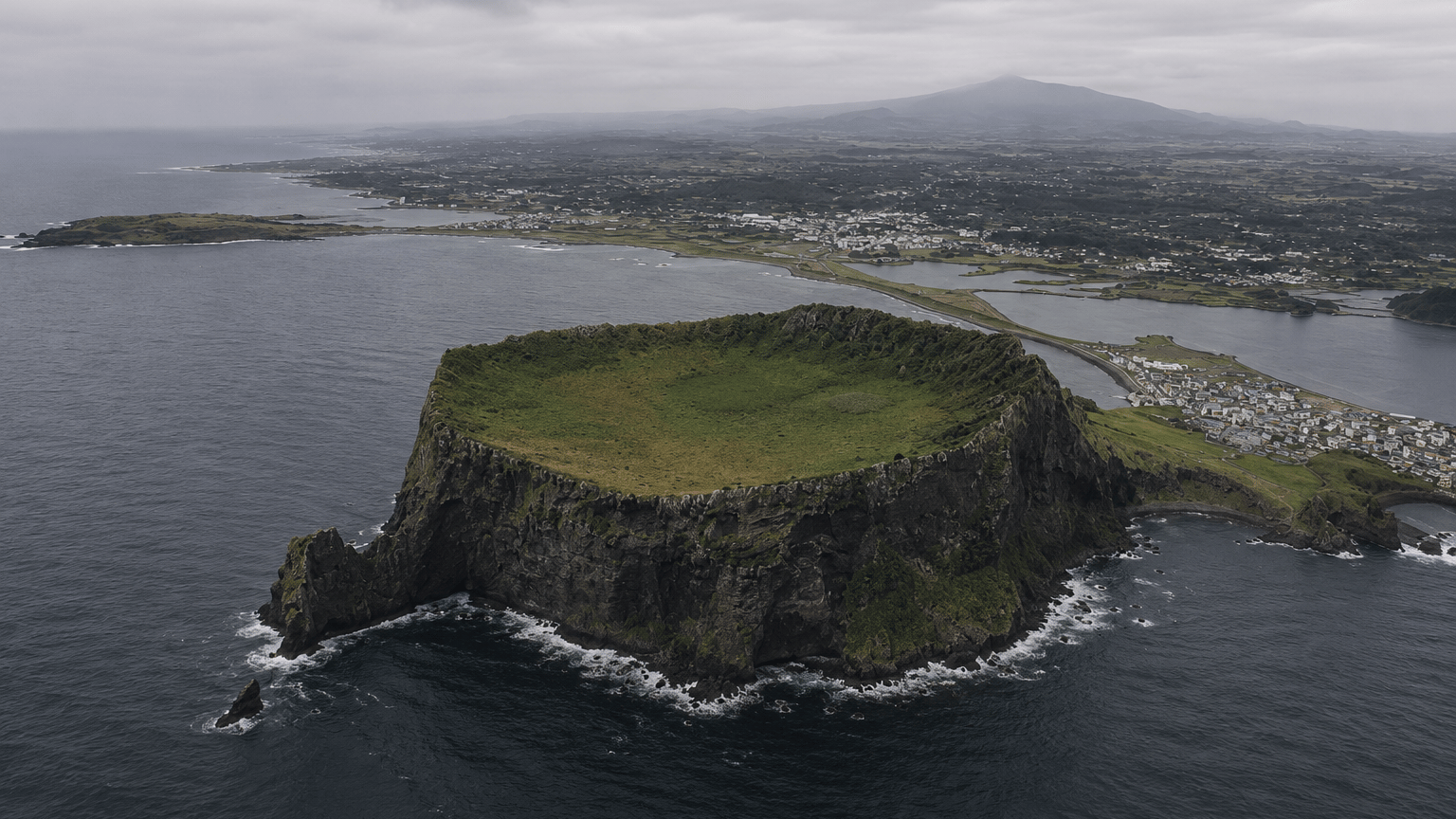
East Asia · Isolated Landmass
Jeju Island
Japan
Jeju Island is strongest on Population Capacity 10/10 — An island currently supporting close to 700,000 residents with extensive settlements, utilities, healthcare, agriculture and commerce represents the highest credible capacity class relative to a twenty-person reference group.. Its clearest scored constraint is Defensibility 1/10 — Jeju is a very large inhabited island with a long coastline, multiple cities, towns, ports, airport and roads. Twenty survivors cannot defend the canonical island as a continuous position; individual strong locations cannot be substituted for the whole record..
Overall
4 out of 10Defensibility
1 out of 10Isolation
2 out of 10Sustainability
9 out of 10Ranking context
How this base ranks
Global
#70 of 91 · Top 76.92%
Region · East Asia
#4 of 5 · Top 80%
Base Type · Isolated Landmass
#13 of 19 · Top 68.42%
Field assessment
At a glance
Bottom Line
For the fixed 20-person Base boundary, the most important endurance constraint is Maintenance Resilience 5/10 — Groundwater, farms and ordinary buildings provide substantial passive resilience, and Jeju has multiple local generation types. Water distribution, sanitation, thermal power, HVDC links and renewable balancing still require maintained technical systems, fuel and specialist parts, so long-term resilience is mixed rather than strong..
Biggest Trade-off
The central trade-off is the catalogue's strongest evidenced dimension, Population Capacity at 10/10, against its weakest evidenced dimension, Defensibility at 1/10.
Most Likely Failure
The clearest evidenced failure pressure is Maintenance Resilience: Groundwater, farms and ordinary buildings provide substantial passive resilience, and Jeju has multiple local generation types. Water distribution, sanitation, thermal power, HVDC links and renewable balancing still require maintained technical systems, fuel and specialist parts, so long-term resilience is mixed rather than strong.
Score rationale
Why it scores this way
Defensibility · 1/10
Jeju is a very large inhabited island with a long coastline, multiple cities, towns, ports, airport and roads. Twenty survivors cannot defend the canonical island as a continuous position; individual strong locations cannot be substituted for the whole record.
Advantages
- Positive credit is limited to what supports the Defensibility score of 1/10; the component rationale is: Jeju is a very large inhabited island with a long coastline, multiple cities, towns, ports, airport and roads. Twenty survivors cannot defend the canonical island as a continuous position; individual strong locations cannot be substituted for the whole record.
Limitations
- Do not infer additional Defensibility capability outside the fixed Base boundary or beyond the recorded evidence.
Isolation · 2/10
Ocean separation slows pressure arriving from mainland Korea, but Jeju already contains roughly 690,000 residents and highly developed transport links. That very large internal human population is a major nearby source of zombie pressure, keeping effective isolation low despite being an island.
Advantages
- Positive credit is limited to what supports the Isolation score of 2/10; the component rationale is: Ocean separation slows pressure arriving from mainland Korea, but Jeju already contains roughly 690,000 residents and highly developed transport links. That very large internal human population is a major nearby source of zombie pressure, keeping effective isolation low despite being an island.
Limitations
- Do not infer additional Isolation capability outside the fixed Base boundary or beyond the recorded evidence.
Sustainability · 9/10
A modern island society supporting nearly 700,000 people has immense housing, sanitation, healthcare, food-preparation and working-space capacity. Extensive groundwater, agriculture and electricity infrastructure make continued twenty-person habitation highly plausible, while dependence on complex utility systems prevents a perfect class.
Advantages
- Positive credit is limited to what supports the Sustainability score of 9/10; the component rationale is: A modern island society supporting nearly 700,000 people has immense housing, sanitation, healthcare, food-preparation and working-space capacity. Extensive groundwater, agriculture and electricity infrastructure make continued twenty-person habitation highly plausible, while dependence on complex utility systems prevents a perfect class.
Limitations
- Do not infer additional Sustainability capability outside the fixed Base boundary or beyond the recorded evidence.
Survival horizons
How survival changes over time
First 7 days: current defence/contact profile
First 7 Days
This horizon does not invent future upgrades or resupply. It carries the current evaluated conditions forward and keeps unknown future capability uncredited.
Positive factors
- The stronger current condition in this horizon is Exposure Control 2/10 — The sea blocks ordinary mainland walkers, but the canonical island contains a very large resident population, dense road networks, several urban centres and a long multi-access coastline. For twenty survivors, most threatening movement begins inside the island rather than at a small number of external landing points..
Risks
- The weaker current condition in this horizon is Defensibility 1/10 — Jeju is a very large inhabited island with a long coastline, multiple cities, towns, ports, airport and roads. Twenty survivors cannot defend the canonical island as a continuous position; individual strong locations cannot be substituted for the whole record.; no better future state is assumed.
First 100 days: current habitat/capacity profile
First 100 Days
This horizon does not invent future upgrades or resupply. It carries the current evaluated conditions forward and keeps unknown future capability uncredited.
Positive factors
- The stronger current condition in this horizon is Population Capacity 10/10 — An island currently supporting close to 700,000 residents with extensive settlements, utilities, healthcare, agriculture and commerce represents the highest credible capacity class relative to a twenty-person reference group..
Risks
- The weaker current condition in this horizon is Sustainability 9/10 — A modern island society supporting nearly 700,000 people has immense housing, sanitation, healthcare, food-preparation and working-space capacity. Extensive groundwater, agriculture and electricity infrastructure make continued twenty-person habitation highly plausible, while dependence on complex utility systems prevents a perfect class.; no better future state is assumed.
Long term: current resource/maintenance profile
Long Term
This horizon does not invent future upgrades or resupply. It carries the current evaluated conditions forward and keeps unknown future capability uncredited.
Positive factors
- The stronger current condition in this horizon is Resource Security 8/10 — Jeju combines abundant developed groundwater/spring-water systems, very large cultivated acreage, substantial agricultural/livestock/fisheries production and a diversified electricity system with significant island generation. Imported fuel, mainland HVDC contribution, replacement parts and some food categories remain vulnerabilities, but for twenty survivors the breadth of local water, food and energy assets is unusually strong..
Risks
- The weaker current condition in this horizon is Maintenance Resilience 5/10 — Groundwater, farms and ordinary buildings provide substantial passive resilience, and Jeju has multiple local generation types. Water distribution, sanitation, thermal power, HVDC links and renewable balancing still require maintained technical systems, fuel and specialist parts, so long-term resilience is mixed rather than strong.; no better future state is assumed.
Tactical assessment
Practical Reality
Reality Check
Scores apply only to the defined Base and exactly 20 capable adults. Unknown, excluded or external assets are not credited as hidden capability.
Best Use
Within the evaluated boundary, treat Population Capacity as the primary operational strength; do not promote that score into capabilities the evidence does not establish.
Key Risk
Maintenance Resilience is the key evidenced long-duration risk: Groundwater, farms and ordinary buildings provide substantial passive resilience, and Jeju has multiple local generation types. Water distribution, sanitation, thermal power, HVDC links and renewable balancing still require maintained technical systems, fuel and specialist parts, so long-term resilience is mixed rather than strong.
Strengths
- One of the strongest scored dimensions is Population Capacity 10/10 — An island currently supporting close to 700,000 residents with extensive settlements, utilities, healthcare, agriculture and commerce represents the highest credible capacity class relative to a twenty-person reference group..
- One of the strongest scored dimensions is Sustainability 9/10 — A modern island society supporting nearly 700,000 people has immense housing, sanitation, healthcare, food-preparation and working-space capacity. Extensive groundwater, agriculture and electricity infrastructure make continued twenty-person habitation highly plausible, while dependence on complex utility systems prevents a perfect class..
- One of the strongest scored dimensions is Resource Security 8/10 — Jeju combines abundant developed groundwater/spring-water systems, very large cultivated acreage, substantial agricultural/livestock/fisheries production and a diversified electricity system with significant island generation. Imported fuel, mainland HVDC contribution, replacement parts and some food categories remain vulnerabilities, but for twenty survivors the breadth of local water, food and energy assets is unusually strong..
Weaknesses
- One of the weakest scored dimensions is Defensibility 1/10 — Jeju is a very large inhabited island with a long coastline, multiple cities, towns, ports, airport and roads. Twenty survivors cannot defend the canonical island as a continuous position; individual strong locations cannot be substituted for the whole record..
- One of the weakest scored dimensions is Isolation 2/10 — Ocean separation slows pressure arriving from mainland Korea, but Jeju already contains roughly 690,000 residents and highly developed transport links. That very large internal human population is a major nearby source of zombie pressure, keeping effective isolation low despite being an island..
- One of the weakest scored dimensions is Exposure Control 2/10 — The sea blocks ordinary mainland walkers, but the canonical island contains a very large resident population, dense road networks, several urban centres and a long multi-access coastline. For twenty survivors, most threatening movement begins inside the island rather than at a small number of external landing points..
Assumptions / constraints
- Only assets inside the recorded Core Base and immediate operating boundary are credited; excluded surroundings and unproven future access remain outside the score.
Decision context
Rivals / Alternatives
Similar rival
Okinawa
Japan · Isolated Landmass
Okinawa keeps the same isolated landmass strategy, with only 0.3 points between the overall scores and closely matched defensibility pressure.
Overall 3.7/10
Strongest alternative
Heligoland
Germany · Isolated Landmass
Heligoland scores 6.3 overall versus 4.0, adding a stronger isolation profile while staying relevant as another isolated landmass.
Overall 6.3/10
Wildcard rival
Fort Jefferson
United States · Fortified Structure
Fort Jefferson changes the strategy: it is a fortified structure with a defensibility edge, while Jeju Island holds more of the sustainability advantage.
Overall 6.7/10