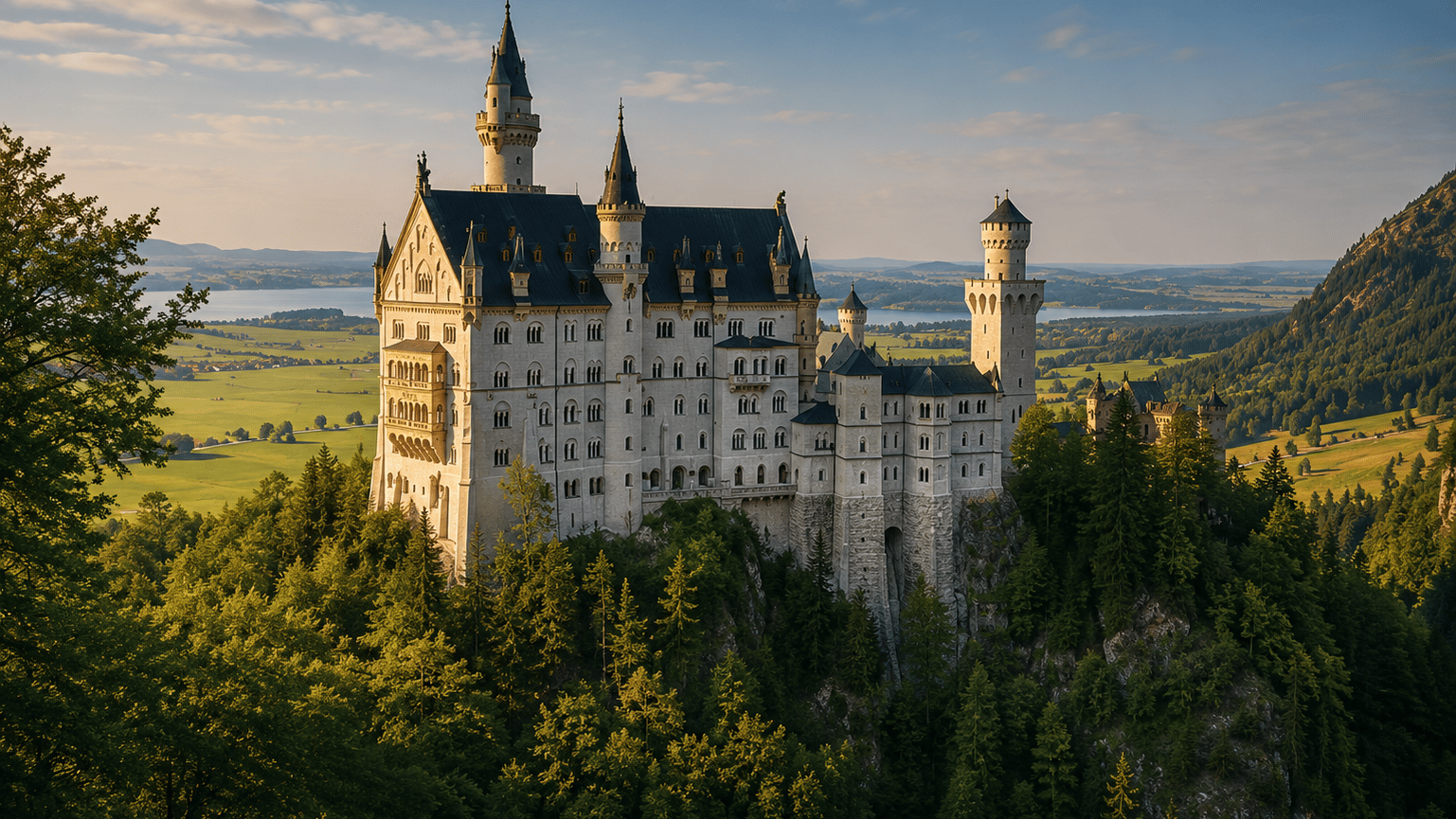
Western Europe · Elevated Stronghold
Neuschwanstein Castle
Germany
Neuschwanstein Castle is strongest on Exposure Control 8/10 — The castle's elevated site and long steep final approach strongly constrain movement; vehicles cannot normally reach the castle, shuttle/carriage routes terminate hundreds of metres away, and visitors pass through timed controlled entry. Multiple pedestrian approaches and the lack of a demonstrated military outer perimeter keep it below the exceptional classes.. Its clearest scored constraint is Resource Security 2/10 — Current café/toilet operation proves some food/drink inventory and water service inside the castle, and historic integrated kitchen/water systems provide useful physical infrastructure. No protected independent potable-water source/storage, food production, fuel reserve or survival-energy pathway is established within the castle boundary once normal support stops, so the position is short-term supplied rather than resource-secure..
Overall
4.7 out of 10Defensibility
5 out of 10Isolation
3 out of 10Sustainability
6 out of 10Ranking context
How this base ranks
Global
#53 of 91 · Top 58.24%
Region · Western Europe
#5 of 9 · Top 55.56%
Base Type · Elevated Stronghold
#8 of 13 · Top 61.54%
Field assessment
At a glance
Bottom Line
For the fixed 20-person Base boundary, the most important endurance constraint is Resource Security 2/10 — Current café/toilet operation proves some food/drink inventory and water service inside the castle, and historic integrated kitchen/water systems provide useful physical infrastructure. No protected independent potable-water source/storage, food production, fuel reserve or survival-energy pathway is established within the castle boundary once normal support stops, so the position is short-term supplied rather than resource-secure..
Biggest Trade-off
The central trade-off is the catalogue's strongest evidenced dimension, Exposure Control at 8/10, against its weakest evidenced dimension, Resource Security at 2/10.
Most Likely Failure
The evaluation leaves this material failure condition unresolved: Current toilets/café and historic running-water infrastructure establish water use inside the castle, but current independent potable source, storage, treatment and outage continuity are not established. R2 credits the real supplied position without asserting independence.
Score rationale
Why it scores this way
Defensibility · 5/10
The mountain castle has a real gateway/courtyard/tower complex, robust masonry and steep vehicle-restricted approaches that materially strengthen the occupied building. It was not designed as an operational military fortress, and current gate resistance, breach compartments and fallback positions are not documented strongly enough for a high-fortification score.
Advantages
- Positive credit is limited to what supports the Defensibility score of 5/10; the component rationale is: The mountain castle has a real gateway/courtyard/tower complex, robust masonry and steep vehicle-restricted approaches that materially strengthen the occupied building. It was not designed as an operational military fortress, and current gate resistance, breach compartments and fallback positions are not documented strongly enough for a high-fortification score.
Limitations
- Do not infer additional Defensibility capability outside the fixed Base boundary or beyond the recorded evidence.
Isolation · 3/10
The castle is locally separated above Hohenschwangau by a steep final ascent, but it sits in the heavily visited Schwangau/Füssen region with normal motorway, train and bus access to the village below. Final approach difficulty is credited under Exposure/Defence rather than mistaken for regional remoteness.
Advantages
- Positive credit is limited to what supports the Isolation score of 3/10; the component rationale is: The castle is locally separated above Hohenschwangau by a steep final ascent, but it sits in the heavily visited Schwangau/Füssen region with normal motorway, train and bus access to the village below. Final approach difficulty is credited under Exposure/Defence rather than mistaken for regional remoteness.
Limitations
- Do not infer additional Isolation capability outside the fixed Base boundary or beyond the recorded evidence.
Sustainability · 6/10
A very large weatherproof staffed building with current toilets, café/support area, lift/emergency systems and extensive rooms provides credible shelter and daily-life space for twenty. Historic integrated kitchen/water/heating/sanitation fabric adds practical starting value. Current overnight residential operation, independent utilities and long-duration hygiene/cooking continuity are not established, limiting the score.
Advantages
- Positive credit is limited to what supports the Sustainability score of 6/10; the component rationale is: A very large weatherproof staffed building with current toilets, café/support area, lift/emergency systems and extensive rooms provides credible shelter and daily-life space for twenty. Historic integrated kitchen/water/heating/sanitation fabric adds practical starting value. Current overnight residential operation, independent utilities and long-duration hygiene/cooking continuity are not established, limiting the score.
Limitations
- Do not infer additional Sustainability capability outside the fixed Base boundary or beyond the recorded evidence.
Survival horizons
How survival changes over time
First 7 days: current defence/contact profile
First 7 Days
This horizon does not invent future upgrades or resupply. It carries the current evaluated conditions forward and keeps unknown future capability uncredited.
Positive factors
- The stronger current condition in this horizon is Exposure Control 8/10 — The castle's elevated site and long steep final approach strongly constrain movement; vehicles cannot normally reach the castle, shuttle/carriage routes terminate hundreds of metres away, and visitors pass through timed controlled entry. Multiple pedestrian approaches and the lack of a demonstrated military outer perimeter keep it below the exceptional classes..
Risks
- The weaker current condition in this horizon is Defensibility 5/10 — The mountain castle has a real gateway/courtyard/tower complex, robust masonry and steep vehicle-restricted approaches that materially strengthen the occupied building. It was not designed as an operational military fortress, and current gate resistance, breach compartments and fallback positions are not documented strongly enough for a high-fortification score.; no better future state is assumed.
First 100 days: current habitat/capacity profile
First 100 Days
This horizon does not invent future upgrades or resupply. It carries the current evaluated conditions forward and keeps unknown future capability uncredited.
Positive factors
- The stronger current condition in this horizon is Population Capacity 7/10 — The castle processes thousands of visitors daily in season and contains extensive rooms/courtyards/support circulation, proving ample physical space and sanitation throughput relative to twenty people. It was designed primarily for a royal household and is not currently residential accommodation, so long-duration sleeping/support capacity is kept below settlement-scale classes..
Risks
- The weaker current condition in this horizon is Sustainability 6/10 — A very large weatherproof staffed building with current toilets, café/support area, lift/emergency systems and extensive rooms provides credible shelter and daily-life space for twenty. Historic integrated kitchen/water/heating/sanitation fabric adds practical starting value. Current overnight residential operation, independent utilities and long-duration hygiene/cooking continuity are not established, limiting the score.; no better future state is assumed.
Long term: current resource/maintenance profile
Long Term
This horizon does not invent future upgrades or resupply. It carries the current evaluated conditions forward and keeps unknown future capability uncredited.
Positive factors
- The stronger current condition in this horizon is Maintenance Resilience 4/10 — The masonry/brick shell retains substantial passive shelter value, but official management explicitly requires continuous foundation monitoring, rock-face securing and façade renovation. Current lifts, toilets, café and utility systems add specialist dependencies. The castle remains usable after some system loss, but maintaining full functionality is demanding..
Risks
- The weaker current condition in this horizon is Resource Security 2/10 — Current café/toilet operation proves some food/drink inventory and water service inside the castle, and historic integrated kitchen/water systems provide useful physical infrastructure. No protected independent potable-water source/storage, food production, fuel reserve or survival-energy pathway is established within the castle boundary once normal support stops, so the position is short-term supplied rather than resource-secure.; no better future state is assumed.
Tactical assessment
Practical Reality
Reality Check
Scores apply only to the defined Base and exactly 20 capable adults. Unknown, excluded or external assets are not credited as hidden capability.
Best Use
Within the evaluated boundary, treat Exposure Control as the primary operational strength; do not promote that score into capabilities the evidence does not establish.
Key Risk
Resource Security is the key evidenced long-duration risk: Current café/toilet operation proves some food/drink inventory and water service inside the castle, and historic integrated kitchen/water systems provide useful physical infrastructure. No protected independent potable-water source/storage, food production, fuel reserve or survival-energy pathway is established within the castle boundary once normal support stops, so the position is short-term supplied rather than resource-secure.
Strengths
- One of the strongest scored dimensions is Exposure Control 8/10 — The castle's elevated site and long steep final approach strongly constrain movement; vehicles cannot normally reach the castle, shuttle/carriage routes terminate hundreds of metres away, and visitors pass through timed controlled entry. Multiple pedestrian approaches and the lack of a demonstrated military outer perimeter keep it below the exceptional classes..
- One of the strongest scored dimensions is Population Capacity 7/10 — The castle processes thousands of visitors daily in season and contains extensive rooms/courtyards/support circulation, proving ample physical space and sanitation throughput relative to twenty people. It was designed primarily for a royal household and is not currently residential accommodation, so long-duration sleeping/support capacity is kept below settlement-scale classes..
- One of the strongest scored dimensions is Sustainability 6/10 — A very large weatherproof staffed building with current toilets, café/support area, lift/emergency systems and extensive rooms provides credible shelter and daily-life space for twenty. Historic integrated kitchen/water/heating/sanitation fabric adds practical starting value. Current overnight residential operation, independent utilities and long-duration hygiene/cooking continuity are not established, limiting the score..
Weaknesses
- One of the weakest scored dimensions is Resource Security 2/10 — Current café/toilet operation proves some food/drink inventory and water service inside the castle, and historic integrated kitchen/water systems provide useful physical infrastructure. No protected independent potable-water source/storage, food production, fuel reserve or survival-energy pathway is established within the castle boundary once normal support stops, so the position is short-term supplied rather than resource-secure..
- One of the weakest scored dimensions is Isolation 3/10 — The castle is locally separated above Hohenschwangau by a steep final ascent, but it sits in the heavily visited Schwangau/Füssen region with normal motorway, train and bus access to the village below. Final approach difficulty is credited under Exposure/Defence rather than mistaken for regional remoteness..
- One of the weakest scored dimensions is Maintenance Resilience 4/10 — The masonry/brick shell retains substantial passive shelter value, but official management explicitly requires continuous foundation monitoring, rock-face securing and façade renovation. Current lifts, toilets, café and utility systems add specialist dependencies. The castle remains usable after some system loss, but maintaining full functionality is demanding..
Assumptions / constraints
- Only assets inside the recorded Core Base and immediate operating boundary are credited; excluded surroundings and unproven future access remain outside the score.
Decision context
Rivals / Alternatives
Similar rival
Rocamadour
France · Elevated Stronghold
Rocamadour keeps the same elevated stronghold strategy, with only 0.0 points between the overall scores and closely matched defensibility pressure.
Overall 4.7/10
Strongest alternative
Mont Saint-Michel
France · Fortified Structure
Mont Saint-Michel scores 6.3 overall versus 4.7, adding a stronger defensibility profile while staying relevant as a Western Europe option.
Overall 6.3/10
Wildcard rival
Amundsen-Scott South Pole Station
Antarctica · Institutional Compound
Amundsen-Scott South Pole Station changes the strategy: it is a institutional compound with a isolation edge, while Neuschwanstein Castle holds more of the defensibility advantage.
Overall 7.7/10