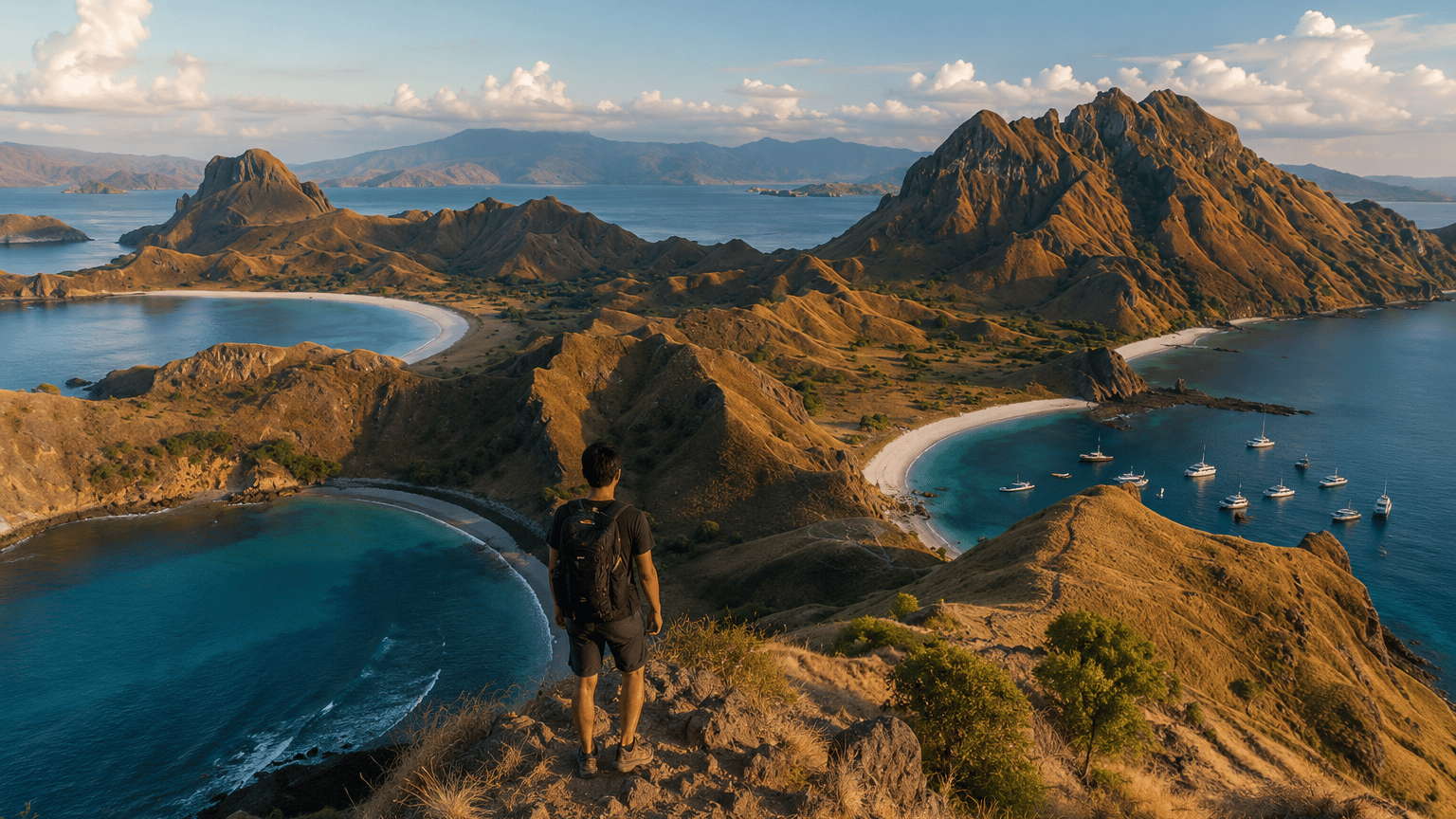
Southeast Asia · Isolated Landmass
Komodo Island
Indonesia
Komodo Island is strongest on Population Capacity 7/10 — A continuing village with hundreds of homes and current educational/community infrastructure provides clear accommodation and service headroom above twenty people, while water scarcity is the main limiting throughput factor.. Its clearest scored constraint is Defensibility 1/10 — The canonical Base is the whole island rather than a ranger compound. Komodo has a long accessible coastline and an inhabited public village, with no island-wide hardened boundary that twenty people could continuously defend..
Overall
4 out of 10Defensibility
1 out of 10Isolation
6 out of 10Sustainability
5 out of 10Ranking context
How this base ranks
Global
#71 of 91 · Top 78.02%
Region · Southeast Asia
#6 of 8 · Top 75%
Base Type · Isolated Landmass
#14 of 19 · Top 73.68%
Field assessment
At a glance
Bottom Line
For the fixed 20-person Base boundary, the most important endurance constraint is Maintenance Resilience 3/10 — Fishing and ordinary village shelter retain passive value, but dry-season water already requires engineered intervention and installed electricity is diesel-based with fuel transported by sea. Pumps/channels, engines and remote replacement logistics make essential services technically brittle..
Biggest Trade-off
The central trade-off is the catalogue's strongest evidenced dimension, Population Capacity at 7/10, against its weakest evidenced dimension, Defensibility at 1/10.
Most Likely Failure
The evaluation leaves this material failure condition unresolved: A current clean-water network is positively evidenced, but source yield, treatment/potability and full dry-season independence are not established. Resource Security 3 credits the real improvement while preserving the long-documented seasonal constraint for package adjudication.
Score rationale
Why it scores this way
Defensibility · 1/10
The canonical Base is the whole island rather than a ranger compound. Komodo has a long accessible coastline and an inhabited public village, with no island-wide hardened boundary that twenty people could continuously defend.
Advantages
- Positive credit is limited to what supports the Defensibility score of 1/10; the component rationale is: The canonical Base is the whole island rather than a ranger compound. Komodo has a long accessible coastline and an inhabited public village, with no island-wide hardened boundary that twenty people could continuously defend.
Limitations
- Do not infer additional Defensibility capability outside the fixed Base boundary or beyond the recorded evidence.
Isolation · 6/10
Ocean separation inside the national park provides meaningful distance from major population centres, while a permanent village, routine tourist/marine access and nearby Flores/Sumbawa communities keep Komodo below the stronger remote-island classes.
Advantages
- Positive credit is limited to what supports the Isolation score of 6/10; the component rationale is: Ocean separation inside the national park provides meaningful distance from major population centres, while a permanent village, routine tourist/marine access and nearby Flores/Sumbawa communities keep Komodo below the stronger remote-island classes.
Limitations
- Do not infer additional Isolation capability outside the fixed Base boundary or beyond the recorded evidence.
Sustainability · 5/10
An established village with hundreds of homes historically, current schools/community facilities, electricity, clean-water distribution and fishing supports credible prolonged habitation for twenty. Chronic dry-season freshwater scarcity and diesel/fuel dependence impose substantial compromise.
Advantages
- Positive credit is limited to what supports the Sustainability score of 5/10; the component rationale is: An established village with hundreds of homes historically, current schools/community facilities, electricity, clean-water distribution and fishing supports credible prolonged habitation for twenty. Chronic dry-season freshwater scarcity and diesel/fuel dependence impose substantial compromise.
Limitations
- Do not infer additional Sustainability capability outside the fixed Base boundary or beyond the recorded evidence.
Survival horizons
How survival changes over time
First 7 days: current defence/contact profile
First 7 Days
This horizon does not invent future upgrades or resupply. It carries the current evaluated conditions forward and keeps unknown future capability uncredited.
Positive factors
- The stronger current condition in this horizon is Exposure Control 6/10 — Sea separation creates substantial regional warning and forces most outside arrivals into boats/landing points. The island's broad coastline, local resident population and tourism/marine movement prevent a tighter few-route score..
Risks
- The weaker current condition in this horizon is Defensibility 1/10 — The canonical Base is the whole island rather than a ranger compound. Komodo has a long accessible coastline and an inhabited public village, with no island-wide hardened boundary that twenty people could continuously defend.; no better future state is assumed.
First 100 days: current habitat/capacity profile
First 100 Days
This horizon does not invent future upgrades or resupply. It carries the current evaluated conditions forward and keeps unknown future capability uncredited.
Positive factors
- The stronger current condition in this horizon is Population Capacity 7/10 — A continuing village with hundreds of homes and current educational/community infrastructure provides clear accommodation and service headroom above twenty people, while water scarcity is the main limiting throughput factor..
Risks
- The weaker current condition in this horizon is Sustainability 5/10 — An established village with hundreds of homes historically, current schools/community facilities, electricity, clean-water distribution and fishing supports credible prolonged habitation for twenty. Chronic dry-season freshwater scarcity and diesel/fuel dependence impose substantial compromise.; no better future state is assumed.
Long term: current resource/maintenance profile
Long Term
This horizon does not invent future upgrades or resupply. It carries the current evaluated conditions forward and keeps unknown future capability uncredited.
Positive factors
- The stronger current condition in this horizon is Maintenance Resilience 3/10 — Fishing and ordinary village shelter retain passive value, but dry-season water already requires engineered intervention and installed electricity is diesel-based with fuel transported by sea. Pumps/channels, engines and remote replacement logistics make essential services technically brittle..
Risks
- The weaker current condition in this horizon is Maintenance Resilience 3/10 — Fishing and ordinary village shelter retain passive value, but dry-season water already requires engineered intervention and installed electricity is diesel-based with fuel transported by sea. Pumps/channels, engines and remote replacement logistics make essential services technically brittle.; no better future state is assumed.
Tactical assessment
Practical Reality
Reality Check
Scores apply only to the defined Base and exactly 20 capable adults. Unknown, excluded or external assets are not credited as hidden capability.
Best Use
Within the evaluated boundary, treat Population Capacity as the primary operational strength; do not promote that score into capabilities the evidence does not establish.
Key Risk
Maintenance Resilience is the key evidenced long-duration risk: Fishing and ordinary village shelter retain passive value, but dry-season water already requires engineered intervention and installed electricity is diesel-based with fuel transported by sea. Pumps/channels, engines and remote replacement logistics make essential services technically brittle.
Strengths
- One of the strongest scored dimensions is Population Capacity 7/10 — A continuing village with hundreds of homes and current educational/community infrastructure provides clear accommodation and service headroom above twenty people, while water scarcity is the main limiting throughput factor..
- One of the strongest scored dimensions is Isolation 6/10 — Ocean separation inside the national park provides meaningful distance from major population centres, while a permanent village, routine tourist/marine access and nearby Flores/Sumbawa communities keep Komodo below the stronger remote-island classes..
- One of the strongest scored dimensions is Exposure Control 6/10 — Sea separation creates substantial regional warning and forces most outside arrivals into boats/landing points. The island's broad coastline, local resident population and tourism/marine movement prevent a tighter few-route score..
Weaknesses
- One of the weakest scored dimensions is Defensibility 1/10 — The canonical Base is the whole island rather than a ranger compound. Komodo has a long accessible coastline and an inhabited public village, with no island-wide hardened boundary that twenty people could continuously defend..
- One of the weakest scored dimensions is Maintenance Resilience 3/10 — Fishing and ordinary village shelter retain passive value, but dry-season water already requires engineered intervention and installed electricity is diesel-based with fuel transported by sea. Pumps/channels, engines and remote replacement logistics make essential services technically brittle..
- One of the weakest scored dimensions is Resource Security 3/10 — Current clean-water distribution, fishing and village stocks provide useful starting resources, but authoritative evidence documents severe seasonal freshwater scarcity and installed electricity depends on imported diesel. Food diversity and durable potable-water continuity remain major dependencies..
Assumptions / constraints
- Only assets inside the recorded Core Base and immediate operating boundary are credited; excluded surroundings and unproven future access remain outside the score.
Decision context
Rivals / Alternatives
Similar rival
Palawan
Philippines · Isolated Landmass
Palawan keeps the same isolated landmass strategy, with only 0.0 points between the overall scores and closely matched sustainability pressure.
Overall 4/10
Strongest alternative
Heligoland
Germany · Isolated Landmass
Heligoland scores 6.3 overall versus 4.0, adding a stronger sustainability profile while staying relevant as another isolated landmass.
Overall 6.3/10
Wildcard rival
Amundsen-Scott South Pole Station
Antarctica · Institutional Compound
Amundsen-Scott South Pole Station changes the strategy: it is a institutional compound with a sustainability edge, while Komodo Island has no headline-pillar edge in return.
Overall 7.7/10