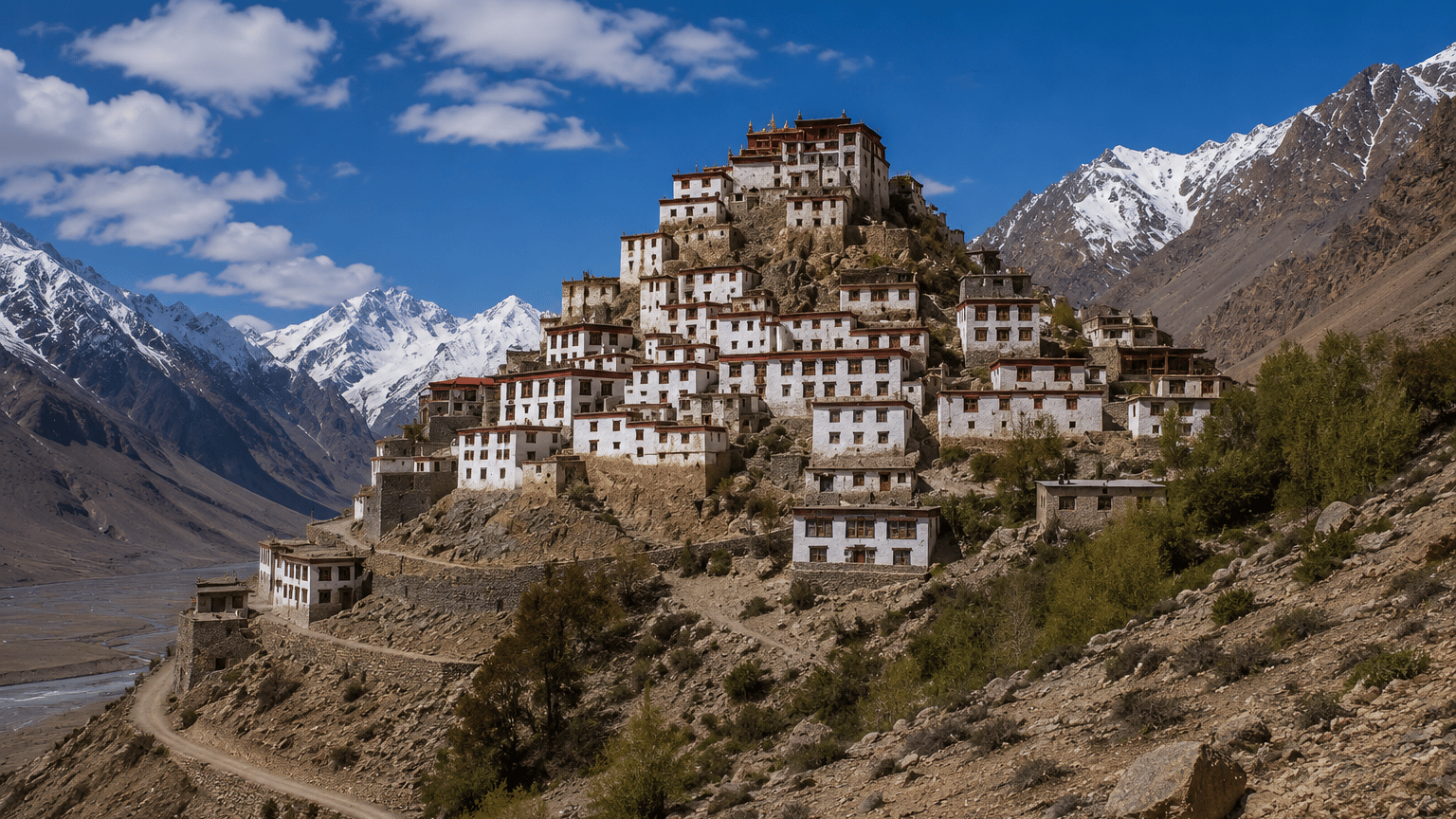
South Asia · Remote Settlement
Kibber Village
India
Kibber Village is strongest on Isolation 8/10 — Very high altitude, difficult road access and documented roughly six-month seasonal isolation create unusually strong geographic separation. A motorable road and summer state-bus connection to Kaza prevent the extreme 9-10 classes.. Its clearest scored constraint is Defensibility 2/10 — Kibber is a compact but ordinary inhabited village, not a fortified compound. Individual homes and high terrain provide secureable positions, but no continuous hardened perimeter or breach-resistant gate system is established and twenty survivors cannot treat the surrounding sanctuary as defended territory. Remoteness is not double-counted as defence..
Overall
5.3 out of 10Defensibility
2 out of 10Isolation
8 out of 10Sustainability
6 out of 10Ranking context
How this base ranks
Global
#30 of 91 · Top 32.97%
Region · South Asia
#2 of 8 · Top 25%
Base Type · Remote Settlement
#5 of 17 · Top 29.41%
Field assessment
At a glance
Bottom Line
For the fixed 20-person Base boundary, the most important endurance constraint is Resource Security 3/10 — Kibber has cultivated local fields in a wider Spiti system producing barley and other crops, current public food-distribution access and electricity-service infrastructure. These are useful starting resources, but the fixed Base lacks a specifically evidenced protected potable-water source/storage/treatment pathway, winter replenishment is difficult, and durable independent energy/fuel continuity is not established. The profile therefore fits useful starting resources with major dependencies..
Biggest Trade-off
The central trade-off is the catalogue's strongest evidenced dimension, Isolation at 8/10, against its weakest evidenced dimension, Defensibility at 2/10.
Most Likely Failure
The evaluation leaves this material failure condition unresolved: Regional gravity-fed agricultural water and a functioning inhabited village are evidenced, but no current protected potable-water source, treatment/storage capacity or interruption tolerance is established specifically inside the Kibber Base. Resource Security 3 therefore preserves this limitation for package adjudication.
Score rationale
Why it scores this way
Defensibility · 2/10
Kibber is a compact but ordinary inhabited village, not a fortified compound. Individual homes and high terrain provide secureable positions, but no continuous hardened perimeter or breach-resistant gate system is established and twenty survivors cannot treat the surrounding sanctuary as defended territory. Remoteness is not double-counted as defence.
Advantages
- Positive credit is limited to what supports the Defensibility score of 2/10; the component rationale is: Kibber is a compact but ordinary inhabited village, not a fortified compound. Individual homes and high terrain provide secureable positions, but no continuous hardened perimeter or breach-resistant gate system is established and twenty survivors cannot treat the surrounding sanctuary as defended territory. Remoteness is not double-counted as defence.
Limitations
- Do not infer additional Defensibility capability outside the fixed Base boundary or beyond the recorded evidence.
Isolation · 8/10
Very high altitude, difficult road access and documented roughly six-month seasonal isolation create unusually strong geographic separation. A motorable road and summer state-bus connection to Kaza prevent the extreme 9-10 classes.
Advantages
- Positive credit is limited to what supports the Isolation score of 8/10; the component rationale is: Very high altitude, difficult road access and documented roughly six-month seasonal isolation create unusually strong geographic separation. A motorable road and summer state-bus connection to Kaza prevent the extreme 9-10 classes.
Limitations
- Do not infer additional Isolation capability outside the fixed Base boundary or beyond the recorded evidence.
Sustainability · 6/10
Kibber is a functioning high-altitude residential village with established homes, cultivated fields, local health/postal services and electricity-service infrastructure, so twenty people have a solid existing community habitat. Severe winter conditions, limited medical depth and uncertain utility/water fallback keep it below the strong long-term-habitat classes.
Advantages
- Positive credit is limited to what supports the Sustainability score of 6/10; the component rationale is: Kibber is a functioning high-altitude residential village with established homes, cultivated fields, local health/postal services and electricity-service infrastructure, so twenty people have a solid existing community habitat. Severe winter conditions, limited medical depth and uncertain utility/water fallback keep it below the strong long-term-habitat classes.
Limitations
- Do not infer additional Sustainability capability outside the fixed Base boundary or beyond the recorded evidence.
Survival horizons
How survival changes over time
First 7 days: current defence/contact profile
First 7 Days
This horizon does not invent future upgrades or resupply. It carries the current evaluated conditions forward and keeps unknown future capability uncredited.
Positive factors
- The stronger current condition in this horizon is Exposure Control 5/10 — The high plateau/mountain setting and final motorable road from Kaza provide useful warning and shape ordinary access, particularly during severe winter isolation. The village remains open to surrounding foot/trekking terrain and has no documented controlled perimeter, so this is a manageable mixed environment rather than a strong funnel..
Risks
- The weaker current condition in this horizon is Defensibility 2/10 — Kibber is a compact but ordinary inhabited village, not a fortified compound. Individual homes and high terrain provide secureable positions, but no continuous hardened perimeter or breach-resistant gate system is established and twenty survivors cannot treat the surrounding sanctuary as defended territory. Remoteness is not double-counted as defence.; no better future state is assumed.
First 100 days: current habitat/capacity profile
First 100 Days
This horizon does not invent future upgrades or resupply. It carries the current evaluated conditions forward and keeps unknown future capability uncredited.
Positive factors
- The stronger current condition in this horizon is Population Capacity 7/10 — A living village with many households, current dispensary/postal services, agricultural land and active public-distribution coverage has strong functional headroom beyond twenty people. Extreme altitude and service constraints prevent treating nominal village-area population as exceptional large-community capacity..
Risks
- The weaker current condition in this horizon is Sustainability 6/10 — Kibber is a functioning high-altitude residential village with established homes, cultivated fields, local health/postal services and electricity-service infrastructure, so twenty people have a solid existing community habitat. Severe winter conditions, limited medical depth and uncertain utility/water fallback keep it below the strong long-term-habitat classes.; no better future state is assumed.
Long term: current resource/maintenance profile
Long Term
This horizon does not invent future upgrades or resupply. It carries the current evaluated conditions forward and keeps unknown future capability uncredited.
Positive factors
- The stronger current condition in this horizon is Maintenance Resilience 4/10 — Ordinary village buildings and local agriculture remain useful without complex machinery, but electricity, road access, health services and irrigated production depend on maintained infrastructure in an environment that is cut off for long periods. Gravity-fed regional irrigation offers some low-tech resilience, while winter access and power-system improvement needs keep the overall profile mixed..
Risks
- The weaker current condition in this horizon is Resource Security 3/10 — Kibber has cultivated local fields in a wider Spiti system producing barley and other crops, current public food-distribution access and electricity-service infrastructure. These are useful starting resources, but the fixed Base lacks a specifically evidenced protected potable-water source/storage/treatment pathway, winter replenishment is difficult, and durable independent energy/fuel continuity is not established. The profile therefore fits useful starting resources with major dependencies.; no better future state is assumed.
Tactical assessment
Practical Reality
Reality Check
Scores apply only to the defined Base and exactly 20 capable adults. Unknown, excluded or external assets are not credited as hidden capability.
Best Use
Within the evaluated boundary, treat Isolation as the primary operational strength; do not promote that score into capabilities the evidence does not establish.
Key Risk
Resource Security is the key evidenced long-duration risk: Kibber has cultivated local fields in a wider Spiti system producing barley and other crops, current public food-distribution access and electricity-service infrastructure. These are useful starting resources, but the fixed Base lacks a specifically evidenced protected potable-water source/storage/treatment pathway, winter replenishment is difficult, and durable independent energy/fuel continuity is not established. The profile therefore fits useful starting resources with major dependencies.
Strengths
- One of the strongest scored dimensions is Isolation 8/10 — Very high altitude, difficult road access and documented roughly six-month seasonal isolation create unusually strong geographic separation. A motorable road and summer state-bus connection to Kaza prevent the extreme 9-10 classes..
- One of the strongest scored dimensions is Population Capacity 7/10 — A living village with many households, current dispensary/postal services, agricultural land and active public-distribution coverage has strong functional headroom beyond twenty people. Extreme altitude and service constraints prevent treating nominal village-area population as exceptional large-community capacity..
- One of the strongest scored dimensions is Sustainability 6/10 — Kibber is a functioning high-altitude residential village with established homes, cultivated fields, local health/postal services and electricity-service infrastructure, so twenty people have a solid existing community habitat. Severe winter conditions, limited medical depth and uncertain utility/water fallback keep it below the strong long-term-habitat classes..
Weaknesses
- One of the weakest scored dimensions is Defensibility 2/10 — Kibber is a compact but ordinary inhabited village, not a fortified compound. Individual homes and high terrain provide secureable positions, but no continuous hardened perimeter or breach-resistant gate system is established and twenty survivors cannot treat the surrounding sanctuary as defended territory. Remoteness is not double-counted as defence..
- One of the weakest scored dimensions is Resource Security 3/10 — Kibber has cultivated local fields in a wider Spiti system producing barley and other crops, current public food-distribution access and electricity-service infrastructure. These are useful starting resources, but the fixed Base lacks a specifically evidenced protected potable-water source/storage/treatment pathway, winter replenishment is difficult, and durable independent energy/fuel continuity is not established. The profile therefore fits useful starting resources with major dependencies..
- One of the weakest scored dimensions is Maintenance Resilience 4/10 — Ordinary village buildings and local agriculture remain useful without complex machinery, but electricity, road access, health services and irrigated production depend on maintained infrastructure in an environment that is cut off for long periods. Gravity-fed regional irrigation offers some low-tech resilience, while winter access and power-system improvement needs keep the overall profile mixed..
Assumptions / constraints
- Only assets inside the recorded Core Base and immediate operating boundary are credited; excluded surroundings and unproven future access remain outside the score.
Decision context
Rivals / Alternatives
Similar rival
Utqiagvik
United States · Remote Settlement
Utqiagvik keeps the same remote settlement strategy, with only 0.0 points between the overall scores and closely matched defensibility pressure.
Overall 5.3/10
Strongest alternative
Amundsen-Scott South Pole Station
Antarctica · Institutional Compound
Amundsen-Scott South Pole Station scores 7.7 overall versus 5.3, adding a stronger sustainability profile while staying relevant as a comparable survival plan.
Overall 7.7/10
Wildcard rival
San Felipe Fortress
Colombia · Fortified Structure
San Felipe Fortress changes the strategy: it is a fortified structure with a defensibility edge, while Kibber Village holds more of the isolation advantage.
Overall 3.7/10