South America · Fortified Structure
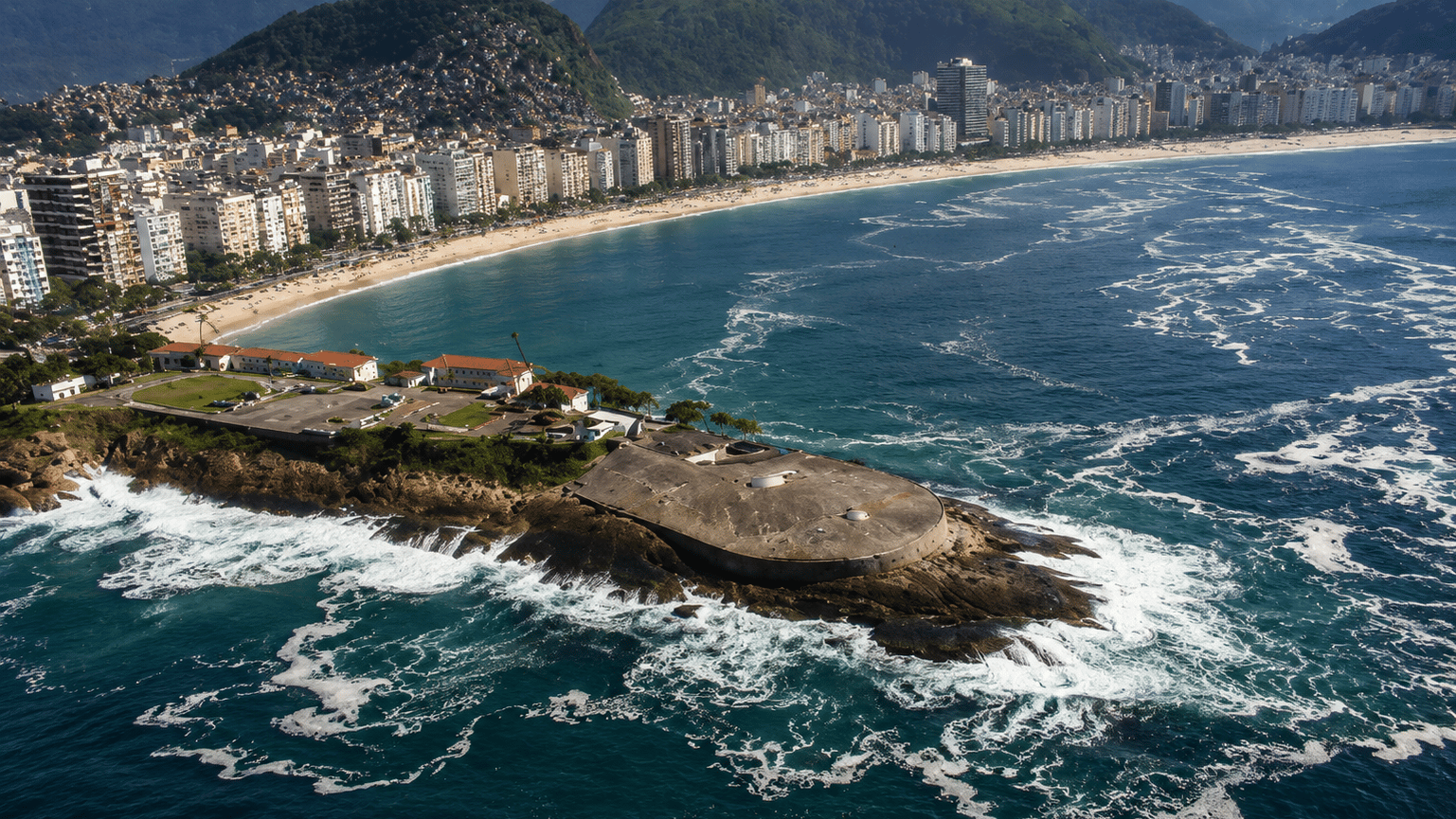
Fort Copacabana
Brazil
Fort Copacabana is strongest on Defensibility 8/10 — The fort is a purpose-built rock-protected military position on a promontory with a controlled gate and substantial hardened structure. Its current museum use does not erase the passive defensive envelope, but it lacks the fully documented compartmentalised/failure-tolerant geometry needed for a 9-10 score under the walker model.. Its clearest scored constraint is Isolation 1/10 — The fort is physically in Copacabana, one of metropolitan Rio de Janeiro's dense urban neighbourhoods. Sea and rock reduce local approach routes but belong to Exposure Control/Defensibility; they do not remove the Base from an enormous surrounding population source..
Overall
4.7 out of 10Defensibility
8 out of 10Isolation
1 out of 10Sustainability
5 out of 10Ranking context
How this base ranks
Global
#49 of 91 · Top 53.85%
Region · South America
#5 of 8 · Top 62.5%
Base Type · Fortified Structure
#12 of 18 · Top 66.67%
Field assessment
At a glance
Bottom Line
For the fixed 20-person Base boundary, the most important endurance constraint is Resource Security 3/10 — The surviving fortification contains purpose-built water-cistern, food-store/kitchen and diesel-plant infrastructure and the current site has active food-service use. Those are significant starting resources, but the evidence does not establish that the cistern currently holds potable water, that the historic diesel plant remains usable, that durable food stores exist, or that any of those resources can be replenished after Rio's municipal/commercial systems fail. The evidence therefore supports the useful-starting-resources/major-dependencies anchor rather than a stronger supply class..
Biggest Trade-off
The central trade-off is the catalogue's strongest evidenced dimension, Defensibility at 8/10, against its weakest evidenced dimension, Isolation at 1/10.
Most Likely Failure
The evaluation leaves this material failure condition unresolved: A purpose-built water cistern is explicitly documented in the surviving fortification, but current water content, potable quality, treatment, usable volume and replenishment are not established. Resource Security 3 credits the evidenced starting infrastructure while retaining this uncertainty for explicit package adjudication.
Score rationale
Why it scores this way
Defensibility · 8/10
The fort is a purpose-built rock-protected military position on a promontory with a controlled gate and substantial hardened structure. Its current museum use does not erase the passive defensive envelope, but it lacks the fully documented compartmentalised/failure-tolerant geometry needed for a 9-10 score under the walker model.
Advantages
- Positive credit is limited to what supports the Defensibility score of 8/10; the component rationale is: The fort is a purpose-built rock-protected military position on a promontory with a controlled gate and substantial hardened structure. Its current museum use does not erase the passive defensive envelope, but it lacks the fully documented compartmentalised/failure-tolerant geometry needed for a 9-10 score under the walker model.
Limitations
- Do not infer additional Defensibility capability outside the fixed Base boundary or beyond the recorded evidence.
Isolation · 1/10
The fort is physically in Copacabana, one of metropolitan Rio de Janeiro's dense urban neighbourhoods. Sea and rock reduce local approach routes but belong to Exposure Control/Defensibility; they do not remove the Base from an enormous surrounding population source.
Advantages
- Positive credit is limited to what supports the Isolation score of 1/10; the component rationale is: The fort is physically in Copacabana, one of metropolitan Rio de Janeiro's dense urban neighbourhoods. Sea and rock reduce local approach routes but belong to Exposure Control/Defensibility; they do not remove the Base from an enormous surrounding population source.
Limitations
- Do not infer additional Isolation capability outside the fixed Base boundary or beyond the recorded evidence.
Sustainability · 5/10
The maintained fort contains extensive internal casemate space, guard accommodation/bathroom heritage, a kitchen/infirmary/food-store layout, current museum halls and food-service spaces, making a credible twenty-person shelter/living envelope with adaptation. It is a museum rather than a residential complex and autonomous modern utilities are not established, preventing a stronger habitat score.
Advantages
- Positive credit is limited to what supports the Sustainability score of 5/10; the component rationale is: The maintained fort contains extensive internal casemate space, guard accommodation/bathroom heritage, a kitchen/infirmary/food-store layout, current museum halls and food-service spaces, making a credible twenty-person shelter/living envelope with adaptation. It is a museum rather than a residential complex and autonomous modern utilities are not established, preventing a stronger habitat score.
Limitations
- Do not infer additional Sustainability capability outside the fixed Base boundary or beyond the recorded evidence.
Survival horizons
How survival changes over time
First 7 days: current defence/contact profile
First 7 Days
This horizon does not invent future upgrades or resupply. It carries the current evaluated conditions forward and keeps unknown future capability uncredited.
Positive factors
- The stronger current condition in this horizon is Defensibility 8/10 — The fort is a purpose-built rock-protected military position on a promontory with a controlled gate and substantial hardened structure. Its current museum use does not erase the passive defensive envelope, but it lacks the fully documented compartmentalised/failure-tolerant geometry needed for a 9-10 score under the walker model..
Risks
- The weaker current condition in this horizon is Defensibility 8/10 — The fort is a purpose-built rock-protected military position on a promontory with a controlled gate and substantial hardened structure. Its current museum use does not erase the passive defensive envelope, but it lacks the fully documented compartmentalised/failure-tolerant geometry needed for a 9-10 score under the walker model.; no better future state is assumed.
First 100 days: current habitat/capacity profile
First 100 Days
This horizon does not invent future upgrades or resupply. It carries the current evaluated conditions forward and keeps unknown future capability uncredited.
Positive factors
- The stronger current condition in this horizon is Sustainability 5/10 — The maintained fort contains extensive internal casemate space, guard accommodation/bathroom heritage, a kitchen/infirmary/food-store layout, current museum halls and food-service spaces, making a credible twenty-person shelter/living envelope with adaptation. It is a museum rather than a residential complex and autonomous modern utilities are not established, preventing a stronger habitat score..
Risks
- The weaker current condition in this horizon is Sustainability 5/10 — The maintained fort contains extensive internal casemate space, guard accommodation/bathroom heritage, a kitchen/infirmary/food-store layout, current museum halls and food-service spaces, making a credible twenty-person shelter/living envelope with adaptation. It is a museum rather than a residential complex and autonomous modern utilities are not established, preventing a stronger habitat score.; no better future state is assumed.
Long term: current resource/maintenance profile
Long Term
This horizon does not invent future upgrades or resupply. It carries the current evaluated conditions forward and keeps unknown future capability uncredited.
Positive factors
- The stronger current condition in this horizon is Maintenance Resilience 6/10 — The core shelter and defensive value come from passive rock, masonry and fortification rather than powered weapons or complex life-support. Historic internal utility/support spaces survive within the fort and current museum operation shows continued maintainability, though modern water, sanitation and electrical services would still degrade without city support..
Risks
- The weaker current condition in this horizon is Resource Security 3/10 — The surviving fortification contains purpose-built water-cistern, food-store/kitchen and diesel-plant infrastructure and the current site has active food-service use. Those are significant starting resources, but the evidence does not establish that the cistern currently holds potable water, that the historic diesel plant remains usable, that durable food stores exist, or that any of those resources can be replenished after Rio's municipal/commercial systems fail. The evidence therefore supports the useful-starting-resources/major-dependencies anchor rather than a stronger supply class.; no better future state is assumed.
Tactical assessment
Practical Reality
Reality Check
Scores apply only to the defined Base and exactly 20 capable adults. Unknown, excluded or external assets are not credited as hidden capability.
Best Use
Within the evaluated boundary, treat Defensibility as the primary operational strength; do not promote that score into capabilities the evidence does not establish.
Key Risk
Resource Security is the key evidenced long-duration risk: The surviving fortification contains purpose-built water-cistern, food-store/kitchen and diesel-plant infrastructure and the current site has active food-service use. Those are significant starting resources, but the evidence does not establish that the cistern currently holds potable water, that the historic diesel plant remains usable, that durable food stores exist, or that any of those resources can be replenished after Rio's municipal/commercial systems fail. The evidence therefore supports the useful-starting-resources/major-dependencies anchor rather than a stronger supply class.
Strengths
- One of the strongest scored dimensions is Defensibility 8/10 — The fort is a purpose-built rock-protected military position on a promontory with a controlled gate and substantial hardened structure. Its current museum use does not erase the passive defensive envelope, but it lacks the fully documented compartmentalised/failure-tolerant geometry needed for a 9-10 score under the walker model..
- One of the strongest scored dimensions is Exposure Control 8/10 — The rocky promontory, surrounding water and controlled fort entrance strongly constrain ordinary land approaches and provide excellent observation. The fort remains directly attached to dense Copacabana and receives high visitor traffic, so it is not an almost approach-proof 9-10 site..
- One of the strongest scored dimensions is Maintenance Resilience 6/10 — The core shelter and defensive value come from passive rock, masonry and fortification rather than powered weapons or complex life-support. Historic internal utility/support spaces survive within the fort and current museum operation shows continued maintainability, though modern water, sanitation and electrical services would still degrade without city support..
Weaknesses
- One of the weakest scored dimensions is Isolation 1/10 — The fort is physically in Copacabana, one of metropolitan Rio de Janeiro's dense urban neighbourhoods. Sea and rock reduce local approach routes but belong to Exposure Control/Defensibility; they do not remove the Base from an enormous surrounding population source..
- One of the weakest scored dimensions is Resource Security 3/10 — The surviving fortification contains purpose-built water-cistern, food-store/kitchen and diesel-plant infrastructure and the current site has active food-service use. Those are significant starting resources, but the evidence does not establish that the cistern currently holds potable water, that the historic diesel plant remains usable, that durable food stores exist, or that any of those resources can be replenished after Rio's municipal/commercial systems fail. The evidence therefore supports the useful-starting-resources/major-dependencies anchor rather than a stronger supply class..
- One of the weakest scored dimensions is Sustainability 5/10 — The maintained fort contains extensive internal casemate space, guard accommodation/bathroom heritage, a kitchen/infirmary/food-store layout, current museum halls and food-service spaces, making a credible twenty-person shelter/living envelope with adaptation. It is a museum rather than a residential complex and autonomous modern utilities are not established, preventing a stronger habitat score..
Assumptions / constraints
- Only assets inside the recorded Core Base and immediate operating boundary are credited; excluded surroundings and unproven future access remain outside the score.
Decision context
Rivals / Alternatives
Similar rival
San Felipe Fortress
Colombia · Fortified Structure
San Felipe Fortress keeps the same fortified structure strategy, with only 1.0 points between the overall scores and closely matched defensibility pressure.
Overall 3.7/10
Strongest alternative
Fort George
United Kingdom · Fortified Structure
Fort George scores 6.7 overall versus 4.7, adding a stronger isolation profile while staying relevant as another fortified structure.
Overall 6.7/10
Wildcard rival
Amundsen-Scott South Pole Station
Antarctica · Institutional Compound
Amundsen-Scott South Pole Station changes the strategy: it is a institutional compound with a isolation edge, while Fort Copacabana holds more of the defensibility advantage.
Overall 7.7/10