UK & Ireland · Landmark Structure
Fastnet Lighthouse
Ireland
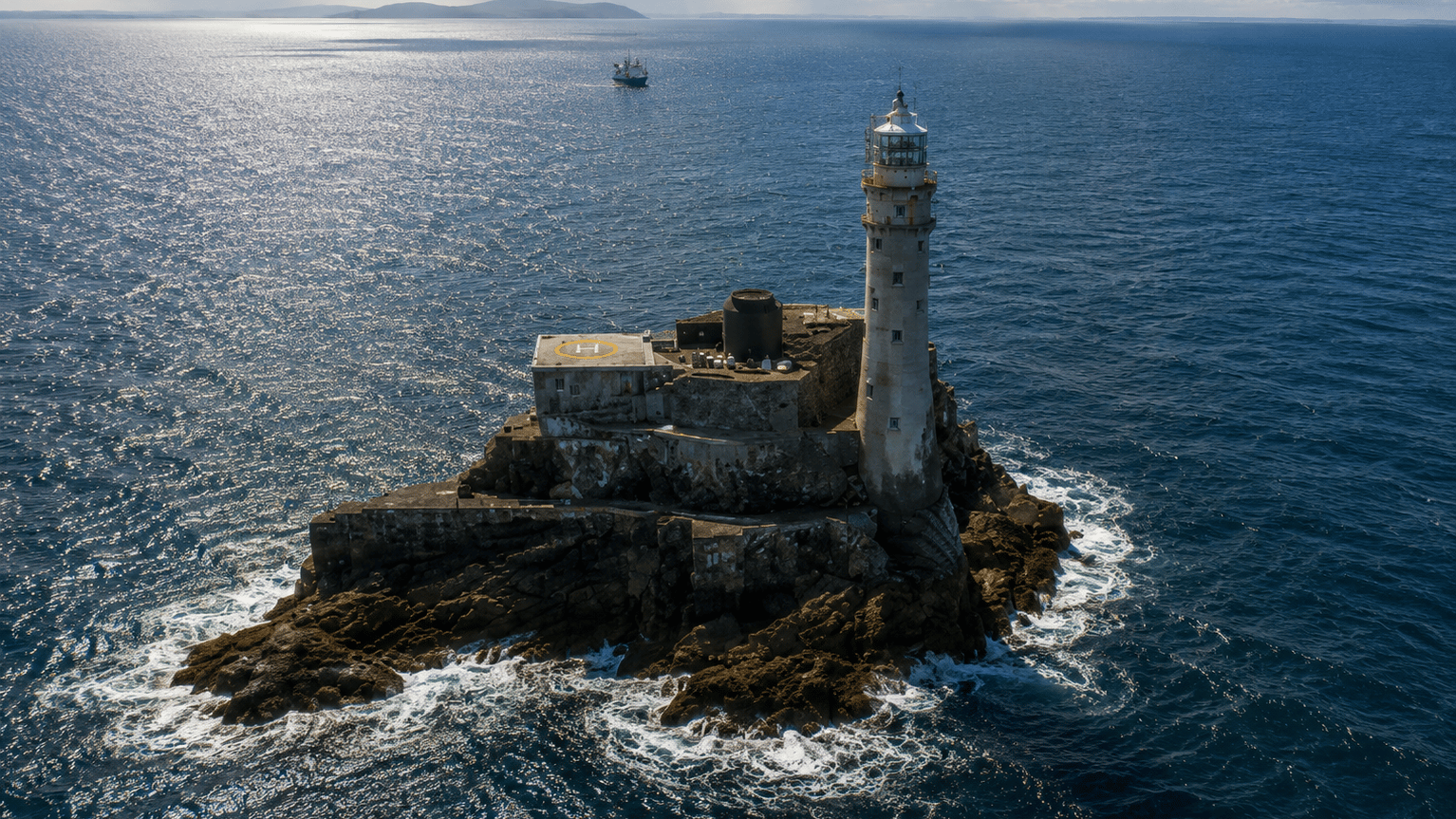
Fastnet Lighthouse is strongest on Isolation 9/10 — Fastnet sits several kilometres beyond an already offshore island and has no ordinary land connection, creating extreme separation from population pressure. It stops short of 10 because it remains a maintained navigational site within reachable coastal waters rather than the highest conceivable geographic separation.. Its clearest scored constraint is Population Capacity 2/10 — The Base is a single narrow lighthouse tower on a small rock. Retained bedrooms, bathroom and welfare space support maintenance teams, but twenty people would be severely constrained in sleeping, sanitation, storage, circulation and operational separation even before long-term supplies are considered..
Overall
6.3 out of 10Defensibility
7 out of 10Isolation
9 out of 10Sustainability
3 out of 10Ranking context
How this base ranks
Global
#5 of 91 · Top 5.49%
Region · UK & Ireland
#2 of 11 · Top 18.18%
Base Type · Landmark Structure
#1 of 3 · Top 33.33%
Field assessment
At a glance
Bottom Line
For the fixed 20-person Base boundary, the most important endurance constraint is Population Capacity 2/10 — The Base is a single narrow lighthouse tower on a small rock. Retained bedrooms, bathroom and welfare space support maintenance teams, but twenty people would be severely constrained in sleeping, sanitation, storage, circulation and operational separation even before long-term supplies are considered..
Biggest Trade-off
The central trade-off is the catalogue's strongest evidenced dimension, Isolation at 9/10, against its weakest evidenced dimension, Population Capacity at 2/10.
Most Likely Failure
The evaluation leaves this material failure condition unresolved: The retained water tank is a real current resource, but its current potable quality, usable volume, source/replenishment and treatment remain unresolved. Resource Security 3 therefore credits the evidenced starting assets while retaining this uncertainty for explicit adjudication rather than silently treating it as either safe water or no water.
Score rationale
Why it scores this way
Defensibility · 7/10
A massive dovetailed granite tower on a tiny rock has an exceptionally robust passive shell and extremely restricted physical entry. It is still a narrow lighthouse rather than a purpose-designed defended compound with meaningful internal fallback areas, so it does not receive bunker-class 8-10 credit.
Advantages
- Positive credit is limited to what supports the Defensibility score of 7/10; the component rationale is: A massive dovetailed granite tower on a tiny rock has an exceptionally robust passive shell and extremely restricted physical entry. It is still a narrow lighthouse rather than a purpose-designed defended compound with meaningful internal fallback areas, so it does not receive bunker-class 8-10 credit.
Limitations
- Do not infer additional Defensibility capability outside the fixed Base boundary or beyond the recorded evidence.
Isolation · 9/10
Fastnet sits several kilometres beyond an already offshore island and has no ordinary land connection, creating extreme separation from population pressure. It stops short of 10 because it remains a maintained navigational site within reachable coastal waters rather than the highest conceivable geographic separation.
Advantages
- Positive credit is limited to what supports the Isolation score of 9/10; the component rationale is: Fastnet sits several kilometres beyond an already offshore island and has no ordinary land connection, creating extreme separation from population pressure. It stops short of 10 because it remains a maintained navigational site within reachable coastal waters rather than the highest conceivable geographic separation.
Limitations
- Do not infer additional Isolation capability outside the fixed Base boundary or beyond the recorded evidence.
Sustainability · 3/10
The current tower retains bedrooms, a bathroom and welfare space, and Irish Lights teams can occupy Fastnet continuously for up to three weeks during major works. That proves sustained human habitation is operationally possible, but the narrow lighthouse remains a severely constrained environment for twenty people with limited sleeping, hygiene and functional separation.
Advantages
- Positive credit is limited to what supports the Sustainability score of 3/10; the component rationale is: The current tower retains bedrooms, a bathroom and welfare space, and Irish Lights teams can occupy Fastnet continuously for up to three weeks during major works. That proves sustained human habitation is operationally possible, but the narrow lighthouse remains a severely constrained environment for twenty people with limited sleeping, hygiene and functional separation.
Limitations
- Do not infer additional Sustainability capability outside the fixed Base boundary or beyond the recorded evidence.
Survival horizons
How survival changes over time
First 7 days: current defence/contact profile
First 7 Days
This horizon does not invent future upgrades or resupply. It carries the current evaluated conditions forward and keeps unknown future capability uncredited.
Positive factors
- The stronger current condition in this horizon is Exposure Control 9/10 — The occupied tower is reached only across open water onto a tiny rock, so meaningful approaches are extremely limited, exposed and predictable. The score remains below 10 because access/landing is demonstrably possible for maintenance teams and the rock is not literally unreachable..
Risks
- The weaker current condition in this horizon is Defensibility 7/10 — A massive dovetailed granite tower on a tiny rock has an exceptionally robust passive shell and extremely restricted physical entry. It is still a narrow lighthouse rather than a purpose-designed defended compound with meaningful internal fallback areas, so it does not receive bunker-class 8-10 credit.; no better future state is assumed.
First 100 days: current habitat/capacity profile
First 100 Days
This horizon does not invent future upgrades or resupply. It carries the current evaluated conditions forward and keeps unknown future capability uncredited.
Positive factors
- The stronger current condition in this horizon is Sustainability 3/10 — The current tower retains bedrooms, a bathroom and welfare space, and Irish Lights teams can occupy Fastnet continuously for up to three weeks during major works. That proves sustained human habitation is operationally possible, but the narrow lighthouse remains a severely constrained environment for twenty people with limited sleeping, hygiene and functional separation..
Risks
- The weaker current condition in this horizon is Population Capacity 2/10 — The Base is a single narrow lighthouse tower on a small rock. Retained bedrooms, bathroom and welfare space support maintenance teams, but twenty people would be severely constrained in sleeping, sanitation, storage, circulation and operational separation even before long-term supplies are considered.; no better future state is assumed.
Long term: current resource/maintenance profile
Long Term
This horizon does not invent future upgrades or resupply. It carries the current evaluated conditions forward and keeps unknown future capability uncredited.
Positive factors
- The stronger current condition in this horizon is Maintenance Resilience 4/10 — The granite shell itself is exceptionally passive and durable, but current operation depends on specialised navigation/electrical equipment plus vessel/helicopter/coastal maintenance support. Survival-critical residential systems are no longer routinely exercised by resident keepers, so long-duration fallback is only partly evidenced..
Risks
- The weaker current condition in this horizon is Resource Security 3/10 — The current tower retains a water tank plus three diesel generators and associated fuel storage, and current maintenance teams can live on the rock for multi-week works. Those are significant starting resources, but no authoritative evidence establishes current potable-water quality/volume/replenishment, durable food stores or a long-duration replacement pathway once Irish Lights vessel/helicopter support stops. This fits useful starting resources with major dependencies rather than a stronger supply class.; no better future state is assumed.
Tactical assessment
Practical Reality
Reality Check
Scores apply only to the defined Base and exactly 20 capable adults. Unknown, excluded or external assets are not credited as hidden capability.
Best Use
Within the evaluated boundary, treat Isolation as the primary operational strength; do not promote that score into capabilities the evidence does not establish.
Key Risk
Population Capacity is the key evidenced long-duration risk: The Base is a single narrow lighthouse tower on a small rock. Retained bedrooms, bathroom and welfare space support maintenance teams, but twenty people would be severely constrained in sleeping, sanitation, storage, circulation and operational separation even before long-term supplies are considered.
Strengths
- One of the strongest scored dimensions is Isolation 9/10 — Fastnet sits several kilometres beyond an already offshore island and has no ordinary land connection, creating extreme separation from population pressure. It stops short of 10 because it remains a maintained navigational site within reachable coastal waters rather than the highest conceivable geographic separation..
- One of the strongest scored dimensions is Exposure Control 9/10 — The occupied tower is reached only across open water onto a tiny rock, so meaningful approaches are extremely limited, exposed and predictable. The score remains below 10 because access/landing is demonstrably possible for maintenance teams and the rock is not literally unreachable..
- One of the strongest scored dimensions is Defensibility 7/10 — A massive dovetailed granite tower on a tiny rock has an exceptionally robust passive shell and extremely restricted physical entry. It is still a narrow lighthouse rather than a purpose-designed defended compound with meaningful internal fallback areas, so it does not receive bunker-class 8-10 credit..
Weaknesses
- One of the weakest scored dimensions is Population Capacity 2/10 — The Base is a single narrow lighthouse tower on a small rock. Retained bedrooms, bathroom and welfare space support maintenance teams, but twenty people would be severely constrained in sleeping, sanitation, storage, circulation and operational separation even before long-term supplies are considered..
- One of the weakest scored dimensions is Sustainability 3/10 — The current tower retains bedrooms, a bathroom and welfare space, and Irish Lights teams can occupy Fastnet continuously for up to three weeks during major works. That proves sustained human habitation is operationally possible, but the narrow lighthouse remains a severely constrained environment for twenty people with limited sleeping, hygiene and functional separation..
- One of the weakest scored dimensions is Resource Security 3/10 — The current tower retains a water tank plus three diesel generators and associated fuel storage, and current maintenance teams can live on the rock for multi-week works. Those are significant starting resources, but no authoritative evidence establishes current potable-water quality/volume/replenishment, durable food stores or a long-duration replacement pathway once Irish Lights vessel/helicopter support stops. This fits useful starting resources with major dependencies rather than a stronger supply class..
Assumptions / constraints
- Only assets inside the recorded Core Base and immediate operating boundary are credited; excluded surroundings and unproven future access remain outside the score.
Decision context
Rivals / Alternatives
Similar rival
Fort Jefferson
United States · Fortified Structure
Fort Jefferson keeps a close survival profile, with only 0.3 points between the overall scores and closely matched defensibility pressure.
Overall 6.7/10
Strongest alternative
Amundsen-Scott South Pole Station
Antarctica · Institutional Compound
Amundsen-Scott South Pole Station scores 7.7 overall versus 6.3, adding a stronger sustainability profile while staying relevant as a comparable survival plan.
Overall 7.7/10
Wildcard rival
Okinawa
Japan · Isolated Landmass
Okinawa changes the strategy: it is a isolated landmass with a sustainability edge, while Fastnet Lighthouse holds more of the isolation advantage.
Overall 3.7/10