Africa · Fortified Structure
Fasil Ghebbi
Ethiopia
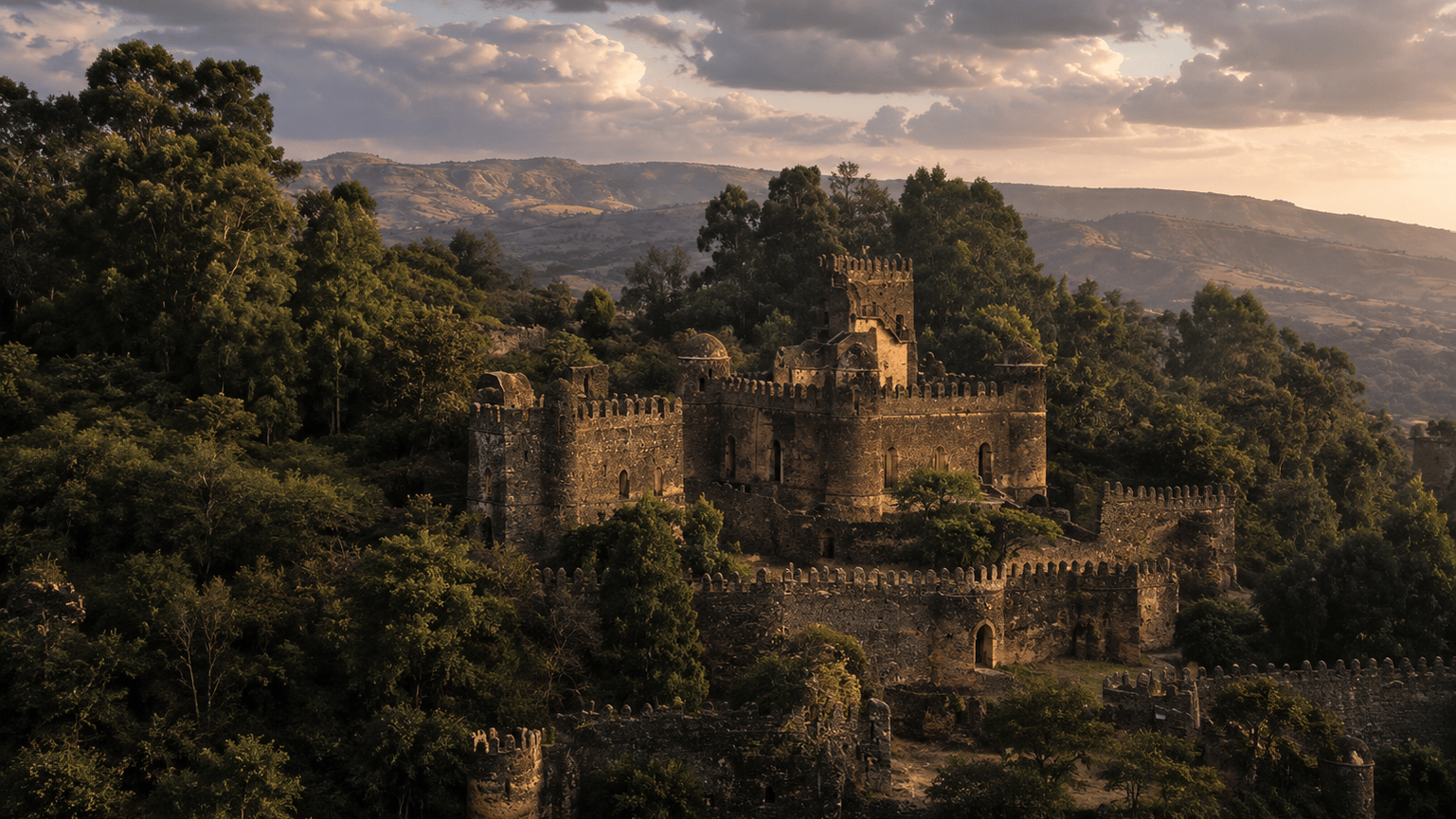
Fasil Ghebbi is strongest on Defensibility 7/10 — A long fortified wall, major stone buildings, towers and battlements create a strong structural position with internal depth. Twelve entrances and the large perimeter impose a meaningful twenty-person defense burden.. Its clearest scored constraint is Resource Security 1/10 — No protected current potable-water source/storage/treatment, durable food production/stocks or survival-critical energy pathway is established inside the enclosure after Gondar systems fail..
Overall
3.7 out of 10Defensibility
7 out of 10Isolation
2 out of 10Sustainability
2 out of 10Ranking context
How this base ranks
Global
#75 of 91 · Top 82.42%
Region · Africa
#6 of 11 · Top 54.55%
Base Type · Fortified Structure
#17 of 18 · Top 94.44%
Field assessment
At a glance
Bottom Line
For the fixed 20-person Base boundary, the most important endurance constraint is Resource Security 1/10 — No protected current potable-water source/storage/treatment, durable food production/stocks or survival-critical energy pathway is established inside the enclosure after Gondar systems fail..
Biggest Trade-off
The central trade-off is the catalogue's strongest evidenced dimension, Defensibility at 7/10, against its weakest evidenced dimension, Resource Security at 1/10.
Most Likely Failure
The evaluation leaves this material failure condition unresolved: No current protected potable-water pathway for the defined enclosure is established.
Score rationale
Why it scores this way
Defensibility · 7/10
A long fortified wall, major stone buildings, towers and battlements create a strong structural position with internal depth. Twelve entrances and the large perimeter impose a meaningful twenty-person defense burden.
Advantages
- Positive credit is limited to what supports the Defensibility score of 7/10; the component rationale is: A long fortified wall, major stone buildings, towers and battlements create a strong structural position with internal depth. Twelve entrances and the large perimeter impose a meaningful twenty-person defense burden.
Limitations
- Do not infer additional Defensibility capability outside the fixed Base boundary or beyond the recorded evidence.
Isolation · 2/10
The compound is inside modern Gondar rather than geographically remote; its walls provide local separation but not separation from a major surrounding urban population.
Advantages
- Positive credit is limited to what supports the Isolation score of 2/10; the component rationale is: The compound is inside modern Gondar rather than geographically remote; its walls provide local separation but not separation from a major surrounding urban population.
Limitations
- Do not infer additional Isolation capability outside the fixed Base boundary or beyond the recorded evidence.
Sustainability · 2/10
Large historic buildings offer weatherproof shelter potential, but present long-duration sleeping, sanitation, food-preparation and medical support for twenty are not established and conservation needs are material.
Advantages
- Positive credit is limited to what supports the Sustainability score of 2/10; the component rationale is: Large historic buildings offer weatherproof shelter potential, but present long-duration sleeping, sanitation, food-preparation and medical support for twenty are not established and conservation needs are material.
Limitations
- Do not infer additional Sustainability capability outside the fixed Base boundary or beyond the recorded evidence.
Survival horizons
How survival changes over time
First 7 days: current defence/contact profile
First 7 Days
This horizon does not invent future upgrades or resupply. It carries the current evaluated conditions forward and keeps unknown future capability uncredited.
Positive factors
- The stronger current condition in this horizon is Defensibility 7/10 — A long fortified wall, major stone buildings, towers and battlements create a strong structural position with internal depth. Twelve entrances and the large perimeter impose a meaningful twenty-person defense burden..
Risks
- The weaker current condition in this horizon is Exposure Control 6/10 — A continuous enclosure and defined gates make contact geometry monitorable, but the 900-metre perimeter and twelve entrances create significant watch burden for twenty people.; no better future state is assumed.
First 100 days: current habitat/capacity profile
First 100 Days
This horizon does not invent future upgrades or resupply. It carries the current evaluated conditions forward and keeps unknown future capability uncredited.
Positive factors
- The stronger current condition in this horizon is Population Capacity 5/10 — Multiple major palace/building complexes provide ample raw space for twenty, while current sanitation and residential support infrastructure are too uncertain for strong additional headroom..
Risks
- The weaker current condition in this horizon is Sustainability 2/10 — Large historic buildings offer weatherproof shelter potential, but present long-duration sleeping, sanitation, food-preparation and medical support for twenty are not established and conservation needs are material.; no better future state is assumed.
Long term: current resource/maintenance profile
Long Term
This horizon does not invent future upgrades or resupply. It carries the current evaluated conditions forward and keeps unknown future capability uncredited.
Positive factors
- The stronger current condition in this horizon is Maintenance Resilience 4/10 — Core masonry retains passive defensive value, but UNESCO documents serious historic repair damage and continuing specialist restoration needs, so safe usable fabric degrades materially without maintenance..
Risks
- The weaker current condition in this horizon is Resource Security 1/10 — No protected current potable-water source/storage/treatment, durable food production/stocks or survival-critical energy pathway is established inside the enclosure after Gondar systems fail.; no better future state is assumed.
Tactical assessment
Practical Reality
Reality Check
Scores apply only to the defined Base and exactly 20 capable adults. Unknown, excluded or external assets are not credited as hidden capability.
Best Use
Within the evaluated boundary, treat Defensibility as the primary operational strength; do not promote that score into capabilities the evidence does not establish.
Key Risk
Resource Security is the key evidenced long-duration risk: No protected current potable-water source/storage/treatment, durable food production/stocks or survival-critical energy pathway is established inside the enclosure after Gondar systems fail.
Strengths
- One of the strongest scored dimensions is Defensibility 7/10 — A long fortified wall, major stone buildings, towers and battlements create a strong structural position with internal depth. Twelve entrances and the large perimeter impose a meaningful twenty-person defense burden..
- One of the strongest scored dimensions is Exposure Control 6/10 — A continuous enclosure and defined gates make contact geometry monitorable, but the 900-metre perimeter and twelve entrances create significant watch burden for twenty people..
- One of the strongest scored dimensions is Population Capacity 5/10 — Multiple major palace/building complexes provide ample raw space for twenty, while current sanitation and residential support infrastructure are too uncertain for strong additional headroom..
Weaknesses
- One of the weakest scored dimensions is Resource Security 1/10 — No protected current potable-water source/storage/treatment, durable food production/stocks or survival-critical energy pathway is established inside the enclosure after Gondar systems fail..
- One of the weakest scored dimensions is Isolation 2/10 — The compound is inside modern Gondar rather than geographically remote; its walls provide local separation but not separation from a major surrounding urban population..
- One of the weakest scored dimensions is Sustainability 2/10 — Large historic buildings offer weatherproof shelter potential, but present long-duration sleeping, sanitation, food-preparation and medical support for twenty are not established and conservation needs are material..
Assumptions / constraints
- Only assets inside the recorded Core Base and immediate operating boundary are credited; excluded surroundings and unproven future access remain outside the score.
Decision context
Rivals / Alternatives
Similar rival
Elmina Castle
Ghana · Fortified Structure
Elmina Castle keeps the same fortified structure strategy, with only 0.7 points between the overall scores and closely matched sustainability pressure.
Overall 4.3/10
Strongest alternative
Fort George
United Kingdom · Fortified Structure
Fort George scores 6.7 overall versus 3.7, adding a stronger sustainability profile while staying relevant as another fortified structure.
Overall 6.7/10
Wildcard rival
Amundsen-Scott South Pole Station
Antarctica · Institutional Compound
Amundsen-Scott South Pole Station changes the strategy: it is a institutional compound with a isolation edge, while Fasil Ghebbi holds more of the defensibility advantage.
Overall 7.7/10