UK & Ireland · Isolated Landmass
St Kilda
United Kingdom
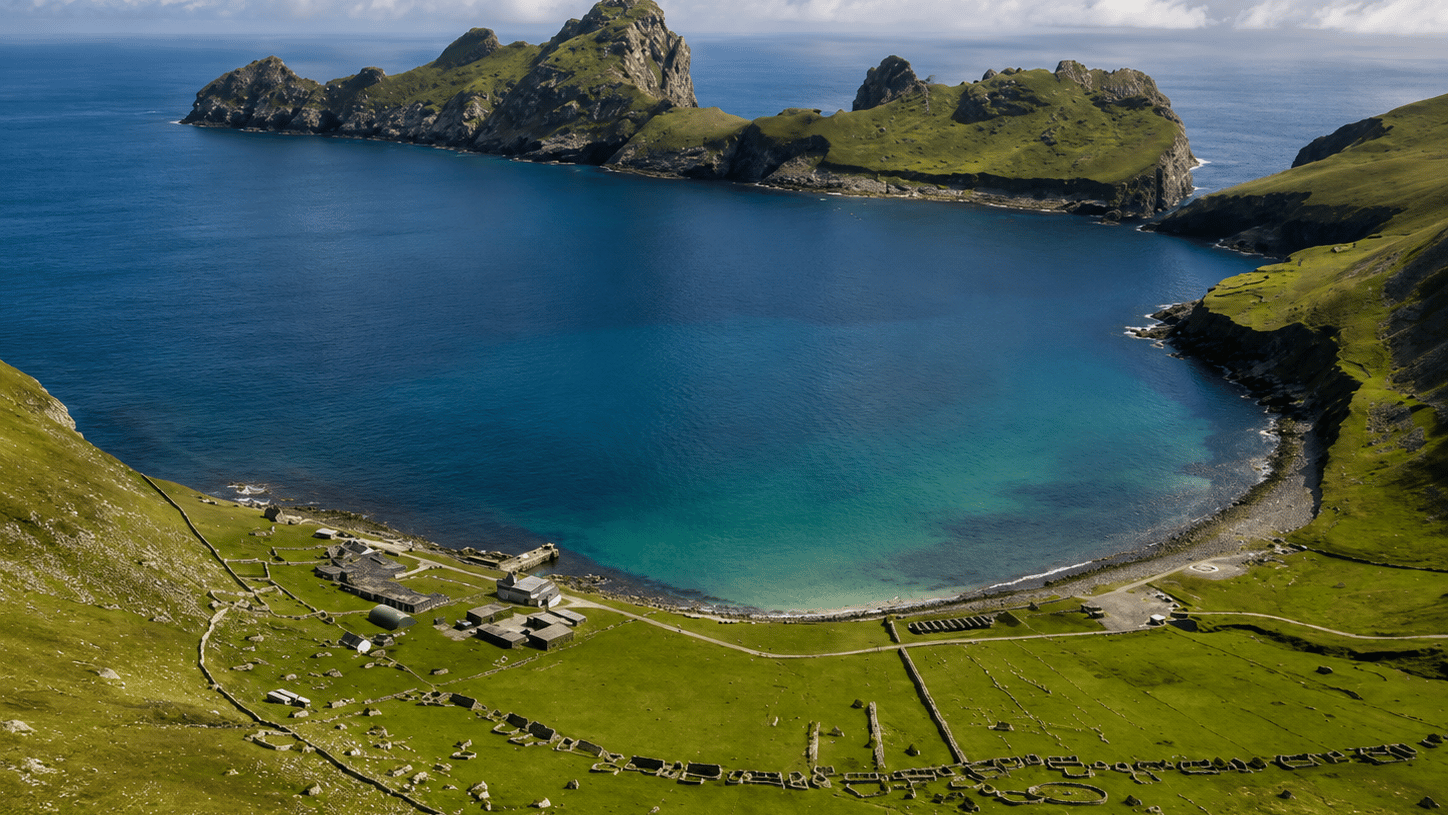
St Kilda is strongest on Isolation 10/10 — Several hours of exposed sea travel, weather-dependent landing, no road/air connection to outside populations and only a tiny current on-island occupational population place Village Bay/Hirta at the highest credible geographic-separation anchor.. Its clearest scored constraint is Defensibility 3/10 — Village Bay has concentrated occupied infrastructure and a small pier, but the settlement itself is not surrounded by a hardened defensive perimeter and non-public MOD security is not counted. Buildings and steep terrain offer local fallback, not fortress-grade direct defence..
Overall
6 out of 10Defensibility
3 out of 10Isolation
10 out of 10Sustainability
5 out of 10Ranking context
How this base ranks
Global
#17 of 91 · Top 18.68%
Region · UK & Ireland
#5 of 11 · Top 45.45%
Base Type · Isolated Landmass
#3 of 19 · Top 15.79%
Field assessment
At a glance
Bottom Line
For the fixed 20-person Base boundary, the most important endurance constraint is Resource Security 3/10 — A current drinking-water supply, sanitation and substantial passive storage structures give a useful starting position. NTS explicitly says there are no shops/cafés and visitors must bring all food and cooking supplies; fuel/energy and specialist parts are also externally dependent. Non-public MOD stores are not counted..
Biggest Trade-off
The central trade-off is the catalogue's strongest evidenced dimension, Isolation at 10/10, against its weakest evidenced dimension, Defensibility at 3/10.
Most Likely Failure
The clearest evidenced failure pressure is Resource Security: A current drinking-water supply, sanitation and substantial passive storage structures give a useful starting position. NTS explicitly says there are no shops/cafés and visitors must bring all food and cooking supplies; fuel/energy and specialist parts are also externally dependent. Non-public MOD stores are not counted.
Score rationale
Why it scores this way
Defensibility · 3/10
Village Bay has concentrated occupied infrastructure and a small pier, but the settlement itself is not surrounded by a hardened defensive perimeter and non-public MOD security is not counted. Buildings and steep terrain offer local fallback, not fortress-grade direct defence.
Advantages
- Positive credit is limited to what supports the Defensibility score of 3/10; the component rationale is: Village Bay has concentrated occupied infrastructure and a small pier, but the settlement itself is not surrounded by a hardened defensive perimeter and non-public MOD security is not counted. Buildings and steep terrain offer local fallback, not fortress-grade direct defence.
Limitations
- Do not infer additional Defensibility capability outside the fixed Base boundary or beyond the recorded evidence.
Isolation · 10/10
Several hours of exposed sea travel, weather-dependent landing, no road/air connection to outside populations and only a tiny current on-island occupational population place Village Bay/Hirta at the highest credible geographic-separation anchor.
Advantages
- Positive credit is limited to what supports the Isolation score of 10/10; the component rationale is: Several hours of exposed sea travel, weather-dependent landing, no road/air connection to outside populations and only a tiny current on-island occupational population place Village Bay/Hirta at the highest credible geographic-separation anchor.
Limitations
- Do not infer additional Isolation capability outside the fixed Base boundary or beyond the recorded evidence.
Sustainability · 5/10
Year-round and seasonal staff occupation proves functioning shelter/support infrastructure, while the campsite independently proves current showers, toilets and drinking water. Severe Atlantic weather, limited public accommodation and complete visitor food provisioning prevent a stronger long-duration habitat score.
Advantages
- Positive credit is limited to what supports the Sustainability score of 5/10; the component rationale is: Year-round and seasonal staff occupation proves functioning shelter/support infrastructure, while the campsite independently proves current showers, toilets and drinking water. Severe Atlantic weather, limited public accommodation and complete visitor food provisioning prevent a stronger long-duration habitat score.
Limitations
- Do not infer additional Sustainability capability outside the fixed Base boundary or beyond the recorded evidence.
Survival horizons
How survival changes over time
First 7 days: current defence/contact profile
First 7 Days
This horizon does not invent future upgrades or resupply. It carries the current evaluated conditions forward and keeps unknown future capability uncredited.
Positive factors
- The stronger current condition in this horizon is Exposure Control 9/10 — Practical outside arrival is extraordinarily constrained: visitors approach by sea, transfer to an open tender and land at the small Village Bay pier, with weather frequently capable of preventing arrival. Local slopes/buildings still require watch once a threat is ashore, keeping this below an absolute 10..
Risks
- The weaker current condition in this horizon is Defensibility 3/10 — Village Bay has concentrated occupied infrastructure and a small pier, but the settlement itself is not surrounded by a hardened defensive perimeter and non-public MOD security is not counted. Buildings and steep terrain offer local fallback, not fortress-grade direct defence.; no better future state is assumed.
First 100 days: current habitat/capacity profile
First 100 Days
This horizon does not invent future upgrades or resupply. It carries the current evaluated conditions forward and keeps unknown future capability uncredited.
Positive factors
- The stronger current condition in this horizon is Sustainability 5/10 — Year-round and seasonal staff occupation proves functioning shelter/support infrastructure, while the campsite independently proves current showers, toilets and drinking water. Severe Atlantic weather, limited public accommodation and complete visitor food provisioning prevent a stronger long-duration habitat score..
Risks
- The weaker current condition in this horizon is Sustainability 5/10 — Year-round and seasonal staff occupation proves functioning shelter/support infrastructure, while the campsite independently proves current showers, toilets and drinking water. Severe Atlantic weather, limited public accommodation and complete visitor food provisioning prevent a stronger long-duration habitat score.; no better future state is assumed.
Long term: current resource/maintenance profile
Long Term
This horizon does not invent future upgrades or resupply. It carries the current evaluated conditions forward and keeps unknown future capability uncredited.
Positive factors
- The stronger current condition in this horizon is Maintenance Resilience 4/10 — Dry-stone storage/building fabric and simple campsite sanitation retain passive value, and active conservation expertise is demonstrated. Harsh weather, difficult replacement logistics and unknown/non-public power/technical fallback for occupied systems make sustained maintenance materially difficult without external support..
Risks
- The weaker current condition in this horizon is Resource Security 3/10 — A current drinking-water supply, sanitation and substantial passive storage structures give a useful starting position. NTS explicitly says there are no shops/cafés and visitors must bring all food and cooking supplies; fuel/energy and specialist parts are also externally dependent. Non-public MOD stores are not counted.; no better future state is assumed.
Tactical assessment
Practical Reality
Reality Check
Scores apply only to the defined Base and exactly 20 capable adults. Unknown, excluded or external assets are not credited as hidden capability.
Best Use
Within the evaluated boundary, treat Isolation as the primary operational strength; do not promote that score into capabilities the evidence does not establish.
Key Risk
Resource Security is the key evidenced long-duration risk: A current drinking-water supply, sanitation and substantial passive storage structures give a useful starting position. NTS explicitly says there are no shops/cafés and visitors must bring all food and cooking supplies; fuel/energy and specialist parts are also externally dependent. Non-public MOD stores are not counted.
Strengths
- One of the strongest scored dimensions is Isolation 10/10 — Several hours of exposed sea travel, weather-dependent landing, no road/air connection to outside populations and only a tiny current on-island occupational population place Village Bay/Hirta at the highest credible geographic-separation anchor..
- One of the strongest scored dimensions is Exposure Control 9/10 — Practical outside arrival is extraordinarily constrained: visitors approach by sea, transfer to an open tender and land at the small Village Bay pier, with weather frequently capable of preventing arrival. Local slopes/buildings still require watch once a threat is ashore, keeping this below an absolute 10..
- One of the strongest scored dimensions is Sustainability 5/10 — Year-round and seasonal staff occupation proves functioning shelter/support infrastructure, while the campsite independently proves current showers, toilets and drinking water. Severe Atlantic weather, limited public accommodation and complete visitor food provisioning prevent a stronger long-duration habitat score..
Weaknesses
- One of the weakest scored dimensions is Defensibility 3/10 — Village Bay has concentrated occupied infrastructure and a small pier, but the settlement itself is not surrounded by a hardened defensive perimeter and non-public MOD security is not counted. Buildings and steep terrain offer local fallback, not fortress-grade direct defence..
- One of the weakest scored dimensions is Resource Security 3/10 — A current drinking-water supply, sanitation and substantial passive storage structures give a useful starting position. NTS explicitly says there are no shops/cafés and visitors must bring all food and cooking supplies; fuel/energy and specialist parts are also externally dependent. Non-public MOD stores are not counted..
- One of the weakest scored dimensions is Maintenance Resilience 4/10 — Dry-stone storage/building fabric and simple campsite sanitation retain passive value, and active conservation expertise is demonstrated. Harsh weather, difficult replacement logistics and unknown/non-public power/technical fallback for occupied systems make sustained maintenance materially difficult without external support..
Assumptions / constraints
- Only assets inside the recorded Core Base and immediate operating boundary are credited; excluded surroundings and unproven future access remain outside the score.
Decision context
Rivals / Alternatives
Similar rival
Lindisfarne
United Kingdom · Isolated Landmass
Lindisfarne keeps the same isolated landmass strategy, with only 0.0 points between the overall scores and closely matched defensibility pressure.
Overall 6/10
Strongest alternative
Amundsen-Scott South Pole Station
Antarctica · Institutional Compound
Amundsen-Scott South Pole Station scores 7.7 overall versus 6.0, adding a stronger sustainability profile while staying relevant as a comparable survival plan.
Overall 7.7/10
Wildcard rival
San Felipe Fortress
Colombia · Fortified Structure
San Felipe Fortress changes the strategy: it is a fortified structure with a defensibility edge, while St Kilda holds more of the isolation advantage.
Overall 3.7/10