South Asia · Elevated Stronghold
Kumbhalgarh Fort
India
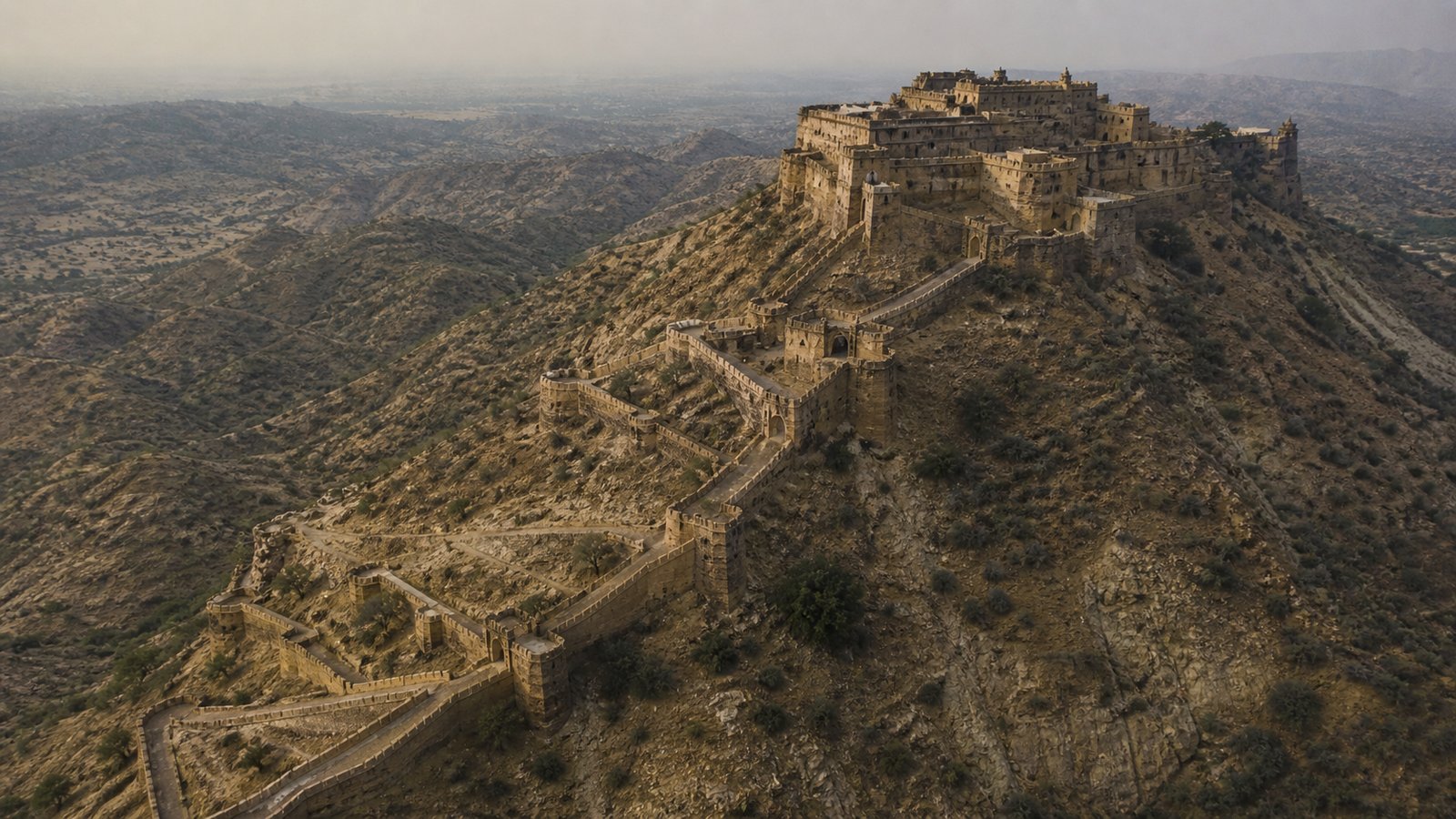
Kumbhalgarh Fort is strongest on Exposure Control 8/10 — Elevated terrain, long fortified walls, gates and wide views provide excellent warning and constrained formal entries, although the huge perimeter creates watch burden and prevents complete control by twenty occupants.. Its clearest scored constraint is Resource Security 3/10 — Historic and current water-harvesting fabric is a real resource advantage, but Rajasthan Tourism itself records drinking-water scarcity as historically decisive and current protected potable quality, food production and energy continuity are not established inside the fort..
Overall
5 out of 10Defensibility
6 out of 10Isolation
5 out of 10Sustainability
4 out of 10Ranking context
How this base ranks
Global
#37 of 91 · Top 40.66%
Region · South Asia
#3 of 8 · Top 37.5%
Base Type · Elevated Stronghold
#3 of 13 · Top 23.08%
Field assessment
At a glance
Bottom Line
For the fixed 20-person Base boundary, the most important endurance constraint is Resource Security 3/10 — Historic and current water-harvesting fabric is a real resource advantage, but Rajasthan Tourism itself records drinking-water scarcity as historically decisive and current protected potable quality, food production and energy continuity are not established inside the fort..
Biggest Trade-off
The central trade-off is the catalogue's strongest evidenced dimension, Exposure Control at 8/10, against its weakest evidenced dimension, Resource Security at 3/10.
Most Likely Failure
The evaluation leaves this material failure condition unresolved: Water-harvesting infrastructure is documented, but current protected potable-water quality, storage and treatment sufficient for twenty-person long-duration occupation are not established.
Score rationale
Why it scores this way
Defensibility · 6/10
Massive walls, gates, bastions and hilltop terrain provide formidable passive defence, but the 268-hectare property and many kilometres of perimeter are far too large for twenty people to actively hold comprehensively.
Advantages
- Positive credit is limited to what supports the Defensibility score of 6/10; the component rationale is: Massive walls, gates, bastions and hilltop terrain provide formidable passive defence, but the 268-hectare property and many kilometres of perimeter are far too large for twenty people to actively hold comprehensively.
Limitations
- Do not infer additional Defensibility capability outside the fixed Base boundary or beyond the recorded evidence.
Isolation · 5/10
The Aravalli wilderness setting and distance from Udaipur provide meaningful regional separation, while normal road access and established tourism keep the fort well below extreme isolation.
Advantages
- Positive credit is limited to what supports the Isolation score of 5/10; the component rationale is: The Aravalli wilderness setting and distance from Udaipur provide meaningful regional separation, while normal road access and established tourism keep the fort well below extreme isolation.
Limitations
- Do not infer additional Isolation capability outside the fixed Base boundary or beyond the recorded evidence.
Sustainability · 4/10
The enormous enclosed property contains substantial stone buildings, palaces and temples that provide shelter and functional space, but it is a heritage fort rather than a current residential settlement and modern long-duration sanitation and sleeping support are not established.
Advantages
- Positive credit is limited to what supports the Sustainability score of 4/10; the component rationale is: The enormous enclosed property contains substantial stone buildings, palaces and temples that provide shelter and functional space, but it is a heritage fort rather than a current residential settlement and modern long-duration sanitation and sleeping support are not established.
Limitations
- Do not infer additional Sustainability capability outside the fixed Base boundary or beyond the recorded evidence.
Survival horizons
How survival changes over time
First 7 days: current defence/contact profile
First 7 Days
This horizon does not invent future upgrades or resupply. It carries the current evaluated conditions forward and keeps unknown future capability uncredited.
Positive factors
- The stronger current condition in this horizon is Exposure Control 8/10 — Elevated terrain, long fortified walls, gates and wide views provide excellent warning and constrained formal entries, although the huge perimeter creates watch burden and prevents complete control by twenty occupants..
Risks
- The weaker current condition in this horizon is Defensibility 6/10 — Massive walls, gates, bastions and hilltop terrain provide formidable passive defence, but the 268-hectare property and many kilometres of perimeter are far too large for twenty people to actively hold comprehensively.; no better future state is assumed.
First 100 days: current habitat/capacity profile
First 100 Days
This horizon does not invent future upgrades or resupply. It carries the current evaluated conditions forward and keeps unknown future capability uncredited.
Positive factors
- The stronger current condition in this horizon is Population Capacity 7/10 — The fort's 268 hectares and extensive internal buildings physically exceed the space needs of twenty people by a wide margin. Current residential fit-out and sanitation, rather than raw space, are the limiting factors..
Risks
- The weaker current condition in this horizon is Sustainability 4/10 — The enormous enclosed property contains substantial stone buildings, palaces and temples that provide shelter and functional space, but it is a heritage fort rather than a current residential settlement and modern long-duration sanitation and sleeping support are not established.; no better future state is assumed.
Long term: current resource/maintenance profile
Long Term
This horizon does not invent future upgrades or resupply. It carries the current evaluated conditions forward and keeps unknown future capability uncredited.
Positive factors
- The stronger current condition in this horizon is Maintenance Resilience 5/10 — Stone walls and historic water-harvesting structures retain substantial passive value without modern power, but the enormous heritage fabric requires ongoing conservation and there is no evidence that all survival-critical water and sanitation systems operate independently today..
Risks
- The weaker current condition in this horizon is Resource Security 3/10 — Historic and current water-harvesting fabric is a real resource advantage, but Rajasthan Tourism itself records drinking-water scarcity as historically decisive and current protected potable quality, food production and energy continuity are not established inside the fort.; no better future state is assumed.
Tactical assessment
Practical Reality
Reality Check
Scores apply only to the defined Base and exactly 20 capable adults. Unknown, excluded or external assets are not credited as hidden capability.
Best Use
Within the evaluated boundary, treat Exposure Control as the primary operational strength; do not promote that score into capabilities the evidence does not establish.
Key Risk
Resource Security is the key evidenced long-duration risk: Historic and current water-harvesting fabric is a real resource advantage, but Rajasthan Tourism itself records drinking-water scarcity as historically decisive and current protected potable quality, food production and energy continuity are not established inside the fort.
Strengths
- One of the strongest scored dimensions is Exposure Control 8/10 — Elevated terrain, long fortified walls, gates and wide views provide excellent warning and constrained formal entries, although the huge perimeter creates watch burden and prevents complete control by twenty occupants..
- One of the strongest scored dimensions is Population Capacity 7/10 — The fort's 268 hectares and extensive internal buildings physically exceed the space needs of twenty people by a wide margin. Current residential fit-out and sanitation, rather than raw space, are the limiting factors..
- One of the strongest scored dimensions is Defensibility 6/10 — Massive walls, gates, bastions and hilltop terrain provide formidable passive defence, but the 268-hectare property and many kilometres of perimeter are far too large for twenty people to actively hold comprehensively..
Weaknesses
- One of the weakest scored dimensions is Resource Security 3/10 — Historic and current water-harvesting fabric is a real resource advantage, but Rajasthan Tourism itself records drinking-water scarcity as historically decisive and current protected potable quality, food production and energy continuity are not established inside the fort..
- One of the weakest scored dimensions is Sustainability 4/10 — The enormous enclosed property contains substantial stone buildings, palaces and temples that provide shelter and functional space, but it is a heritage fort rather than a current residential settlement and modern long-duration sanitation and sleeping support are not established..
- One of the weakest scored dimensions is Isolation 5/10 — The Aravalli wilderness setting and distance from Udaipur provide meaningful regional separation, while normal road access and established tourism keep the fort well below extreme isolation..
Assumptions / constraints
- Only assets inside the recorded Core Base and immediate operating boundary are credited; excluded surroundings and unproven future access remain outside the score.
Decision context
Rivals / Alternatives
Similar rival
Tiger’s Nest Monastery
Bhutan · Elevated Stronghold
Tiger’s Nest Monastery keeps the same elevated stronghold strategy, with only 0.3 points between the overall scores and closely matched sustainability pressure.
Overall 4.7/10
Strongest alternative
Amundsen-Scott South Pole Station
Antarctica · Institutional Compound
Amundsen-Scott South Pole Station scores 7.7 overall versus 5.0, adding a stronger sustainability profile while staying relevant as a comparable survival plan.
Overall 7.7/10
Wildcard rival
Okinawa
Japan · Isolated Landmass
Okinawa changes the strategy: it is a isolated landmass with a sustainability edge, while Kumbhalgarh Fort holds more of the defensibility advantage.
Overall 3.7/10