Eastern Europe · Subterranean
Derinkuyu Underground City
Turkey
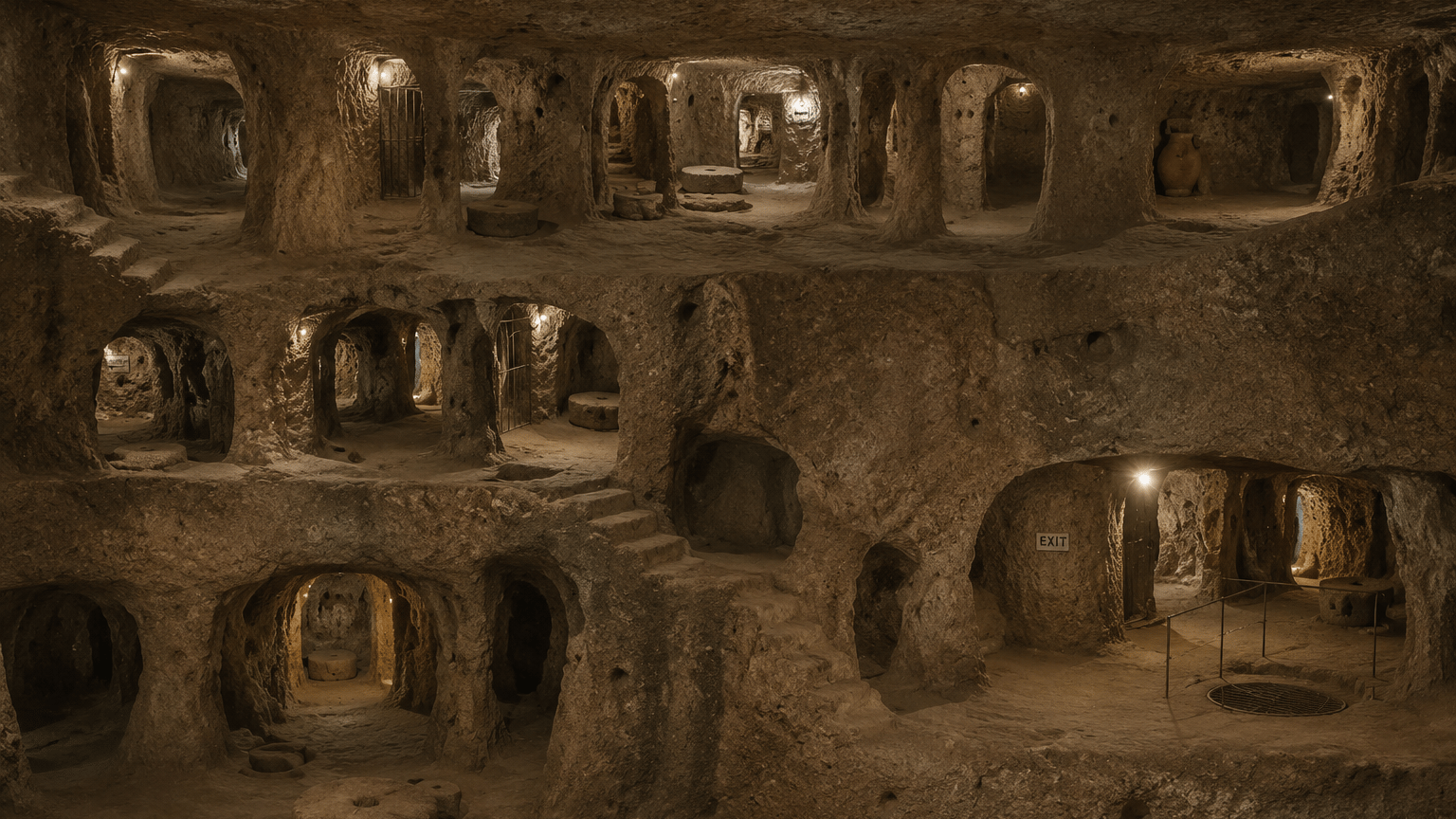
Derinkuyu Underground City is strongest on Exposure Control 8/10 — Deep underground levels, hidden/refuge design, narrow single-person tunnels and closable stone barriers strongly funnel movement and limit mass contact once the complex is occupied. Unknown full entrance geometry and visitor-era modifications keep it below the exceptional anchors.. Its clearest scored constraint is Isolation 2/10 — The underground refuge is hidden/protected locally but sits within modern Derinkuyu on a normal highway only about 30 km from Nevşehir. That direct regional connectivity and nearby town population create large nearby pressure; underground concealment belongs to defence/exposure rather than Isolation..
Overall
4.3 out of 10Defensibility
7 out of 10Isolation
2 out of 10Sustainability
4 out of 10Ranking context
How this base ranks
Global
#59 of 91 · Top 64.84%
Region · Eastern Europe
#8 of 10 · Top 80%
Base Type · Subterranean
#8 of 12 · Top 66.67%
Field assessment
At a glance
Bottom Line
For the fixed 20-person Base boundary, the most important endurance constraint is Resource Security 3/10 — Physical wells, cellars, food-storage/preparation spaces and protected underground volume provide useful starting infrastructure. Current well potability/yield, stored food, working sanitation and survival energy are not established, and surface town supplies remain external. This supports a conservative R3 rather than either invented autonomy or a zero inferred from missing evidence..
Biggest Trade-off
The central trade-off is the catalogue's strongest evidenced dimension, Exposure Control at 8/10, against its weakest evidenced dimension, Isolation at 2/10.
Most Likely Failure
The evaluation leaves this material failure condition unresolved: Historic protected wells are directly evidenced, but current potable quality, yield and treatment are not. R3 credits the physical resource infrastructure without asserting potable independence.
Score rationale
Why it scores this way
Defensibility · 7/10
Rock-cut underground depth, very narrow one-person passages and rolling-stone closures create strong passive defence, compartmentalisation and choke points. Only a fraction is currently accessible and full modern entrance/bypass condition is not mapped, preventing a higher failure-tolerance score.
Advantages
- Positive credit is limited to what supports the Defensibility score of 7/10; the component rationale is: Rock-cut underground depth, very narrow one-person passages and rolling-stone closures create strong passive defence, compartmentalisation and choke points. Only a fraction is currently accessible and full modern entrance/bypass condition is not mapped, preventing a higher failure-tolerance score.
Limitations
- Do not infer additional Defensibility capability outside the fixed Base boundary or beyond the recorded evidence.
Isolation · 2/10
The underground refuge is hidden/protected locally but sits within modern Derinkuyu on a normal highway only about 30 km from Nevşehir. That direct regional connectivity and nearby town population create large nearby pressure; underground concealment belongs to defence/exposure rather than Isolation.
Advantages
- Positive credit is limited to what supports the Isolation score of 2/10; the component rationale is: The underground refuge is hidden/protected locally but sits within modern Derinkuyu on a normal highway only about 30 km from Nevşehir. That direct regional connectivity and nearby town population create large nearby pressure; underground concealment belongs to defence/exposure rather than Isolation.
Limitations
- Do not infer additional Isolation capability outside the fixed Base boundary or beyond the recorded evidence.
Sustainability · 4/10
A currently maintained underground visitor route plus passive ventilation, extensive rooms, historic kitchens/cellars and toilet spaces provide genuine shelter and support potential. Current sleeping arrangements, working sanitation, potable water, cooking and long-duration air/hygiene operation are not established, so present habitat quality remains substantially compromised.
Advantages
- Positive credit is limited to what supports the Sustainability score of 4/10; the component rationale is: A currently maintained underground visitor route plus passive ventilation, extensive rooms, historic kitchens/cellars and toilet spaces provide genuine shelter and support potential. Current sleeping arrangements, working sanitation, potable water, cooking and long-duration air/hygiene operation are not established, so present habitat quality remains substantially compromised.
Limitations
- Do not infer additional Sustainability capability outside the fixed Base boundary or beyond the recorded evidence.
Survival horizons
How survival changes over time
First 7 days: current defence/contact profile
First 7 Days
This horizon does not invent future upgrades or resupply. It carries the current evaluated conditions forward and keeps unknown future capability uncredited.
Positive factors
- The stronger current condition in this horizon is Exposure Control 8/10 — Deep underground levels, hidden/refuge design, narrow single-person tunnels and closable stone barriers strongly funnel movement and limit mass contact once the complex is occupied. Unknown full entrance geometry and visitor-era modifications keep it below the exceptional anchors..
Risks
- The weaker current condition in this horizon is Defensibility 7/10 — Rock-cut underground depth, very narrow one-person passages and rolling-stone closures create strong passive defence, compartmentalisation and choke points. Only a fraction is currently accessible and full modern entrance/bypass condition is not mapped, preventing a higher failure-tolerance score.; no better future state is assumed.
First 100 days: current habitat/capacity profile
First 100 Days
This horizon does not invent future upgrades or resupply. It carries the current evaluated conditions forward and keeps unknown future capability uncredited.
Positive factors
- The stronger current condition in this horizon is Population Capacity 6/10 — The accessible complex contains numerous communal/support spaces and the historic design explicitly accommodated a large community, so physical space for twenty is credible even using only part of the site. Current sleeping/sanitation throughput is not established and ninety percent is not visitor-accessible, preventing a stronger capacity class..
Risks
- The weaker current condition in this horizon is Sustainability 4/10 — A currently maintained underground visitor route plus passive ventilation, extensive rooms, historic kitchens/cellars and toilet spaces provide genuine shelter and support potential. Current sleeping arrangements, working sanitation, potable water, cooking and long-duration air/hygiene operation are not established, so present habitat quality remains substantially compromised.; no better future state is assumed.
Long term: current resource/maintenance profile
Long Term
This horizon does not invent future upgrades or resupply. It carries the current evaluated conditions forward and keeps unknown future capability uncredited.
Positive factors
- The stronger current condition in this horizon is Maintenance Resilience 7/10 — The core shelter, passage, rolling-stone and gravity/passive ventilation architecture is carved directly into rock and has survived for centuries with little dependence on powered machinery. Current public maintenance proves accessible spaces remain usable, although drainage, lighting, modern safety and sanitation would still need upkeep..
Risks
- The weaker current condition in this horizon is Resource Security 3/10 — Physical wells, cellars, food-storage/preparation spaces and protected underground volume provide useful starting infrastructure. Current well potability/yield, stored food, working sanitation and survival energy are not established, and surface town supplies remain external. This supports a conservative R3 rather than either invented autonomy or a zero inferred from missing evidence.; no better future state is assumed.
Tactical assessment
Practical Reality
Reality Check
Scores apply only to the defined Base and exactly 20 capable adults. Unknown, excluded or external assets are not credited as hidden capability.
Best Use
Within the evaluated boundary, treat Exposure Control as the primary operational strength; do not promote that score into capabilities the evidence does not establish.
Key Risk
Resource Security is the key evidenced long-duration risk: Physical wells, cellars, food-storage/preparation spaces and protected underground volume provide useful starting infrastructure. Current well potability/yield, stored food, working sanitation and survival energy are not established, and surface town supplies remain external. This supports a conservative R3 rather than either invented autonomy or a zero inferred from missing evidence.
Strengths
- One of the strongest scored dimensions is Exposure Control 8/10 — Deep underground levels, hidden/refuge design, narrow single-person tunnels and closable stone barriers strongly funnel movement and limit mass contact once the complex is occupied. Unknown full entrance geometry and visitor-era modifications keep it below the exceptional anchors..
- One of the strongest scored dimensions is Defensibility 7/10 — Rock-cut underground depth, very narrow one-person passages and rolling-stone closures create strong passive defence, compartmentalisation and choke points. Only a fraction is currently accessible and full modern entrance/bypass condition is not mapped, preventing a higher failure-tolerance score..
- One of the strongest scored dimensions is Maintenance Resilience 7/10 — The core shelter, passage, rolling-stone and gravity/passive ventilation architecture is carved directly into rock and has survived for centuries with little dependence on powered machinery. Current public maintenance proves accessible spaces remain usable, although drainage, lighting, modern safety and sanitation would still need upkeep..
Weaknesses
- One of the weakest scored dimensions is Isolation 2/10 — The underground refuge is hidden/protected locally but sits within modern Derinkuyu on a normal highway only about 30 km from Nevşehir. That direct regional connectivity and nearby town population create large nearby pressure; underground concealment belongs to defence/exposure rather than Isolation..
- One of the weakest scored dimensions is Resource Security 3/10 — Physical wells, cellars, food-storage/preparation spaces and protected underground volume provide useful starting infrastructure. Current well potability/yield, stored food, working sanitation and survival energy are not established, and surface town supplies remain external. This supports a conservative R3 rather than either invented autonomy or a zero inferred from missing evidence..
- One of the weakest scored dimensions is Sustainability 4/10 — A currently maintained underground visitor route plus passive ventilation, extensive rooms, historic kitchens/cellars and toilet spaces provide genuine shelter and support potential. Current sleeping arrangements, working sanitation, potable water, cooking and long-duration air/hygiene operation are not established, so present habitat quality remains substantially compromised..
Assumptions / constraints
- Only assets inside the recorded Core Base and immediate operating boundary are credited; excluded surroundings and unproven future access remain outside the score.
Decision context
Rivals / Alternatives
Similar rival
Ligatne Bunker
Latvia · Subterranean
Ligatne Bunker keeps the same subterranean strategy, with only 1.3 points between the overall scores and closely matched sustainability pressure.
Overall 5.7/10
Strongest alternative
Olavsvern Naval Base
Norway · Subterranean
Olavsvern Naval Base scores 6.3 overall versus 4.3, adding a stronger sustainability profile while staying relevant as another subterranean.
Overall 6.3/10
Wildcard rival
Amundsen-Scott South Pole Station
Antarctica · Institutional Compound
Amundsen-Scott South Pole Station changes the strategy: it is a institutional compound with a isolation edge, while Derinkuyu Underground City holds more of the defensibility advantage.
Overall 7.7/10