Oceania · Remote Settlement
Coober Pedy Underground Settlement
Australia
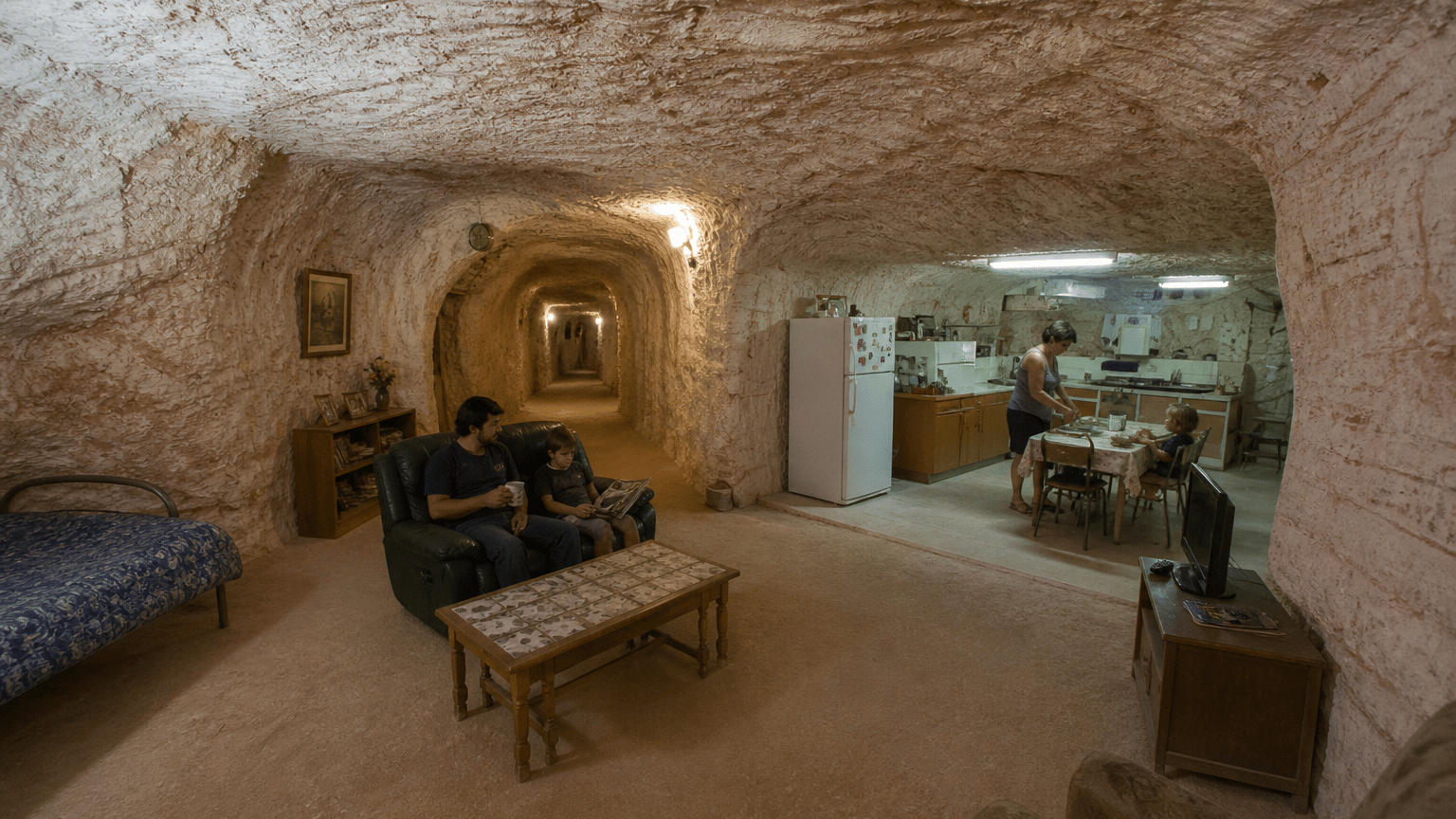
Coober Pedy Underground Settlement is strongest on Population Capacity 9/10 — A functioning town of roughly 2,000 people with housing, health services, education, shops and utility systems has exceptional functional headroom relative to a twenty-person survivor reference group.. Its clearest scored constraint is Defensibility 2/10 — Coober Pedy is a distributed town without a continuous defended perimeter. Individual underground dugouts provide unusually robust secureable shelter, but twenty people cannot defend the whole canonical settlement as one compound and ordinary roads/service areas create many breach points. Remoteness is deliberately excluded from this score..
Overall
5.7 out of 10Defensibility
2 out of 10Isolation
7 out of 10Sustainability
8 out of 10Ranking context
How this base ranks
Global
#21 of 91 · Top 23.08%
Region · Oceania
#1 of 4 · Top 25%
Base Type · Remote Settlement
#2 of 17 · Top 11.76%
Field assessment
At a glance
Bottom Line
For the fixed 20-person Base boundary, the most important endurance constraint is Maintenance Resilience 5/10 — Underground dugouts retain shelter and thermal stability passively, while the town's stand-alone power mixes wind, solar, battery and diesel rather than relying on one generator. Water still requires bore pumping and energy-intensive reverse osmosis, and remote parts/specialist maintenance remain significant dependencies, producing a balanced rather than strongly resilient profile..
Biggest Trade-off
The central trade-off is the catalogue's strongest evidenced dimension, Population Capacity at 9/10, against its weakest evidenced dimension, Defensibility at 2/10.
Most Likely Failure
The clearest evidenced failure pressure is Maintenance Resilience: Underground dugouts retain shelter and thermal stability passively, while the town's stand-alone power mixes wind, solar, battery and diesel rather than relying on one generator. Water still requires bore pumping and energy-intensive reverse osmosis, and remote parts/specialist maintenance remain significant dependencies, producing a balanced rather than strongly resilient profile.
Score rationale
Why it scores this way
Defensibility · 2/10
Coober Pedy is a distributed town without a continuous defended perimeter. Individual underground dugouts provide unusually robust secureable shelter, but twenty people cannot defend the whole canonical settlement as one compound and ordinary roads/service areas create many breach points. Remoteness is deliberately excluded from this score.
Advantages
- Positive credit is limited to what supports the Defensibility score of 2/10; the component rationale is: Coober Pedy is a distributed town without a continuous defended perimeter. Individual underground dugouts provide unusually robust secureable shelter, but twenty people cannot defend the whole canonical settlement as one compound and ordinary roads/service areas create many breach points. Remoteness is deliberately excluded from this score.
Limitations
- Do not infer additional Defensibility capability outside the fixed Base boundary or beyond the recorded evidence.
Isolation · 7/10
Hundreds of kilometres of outback separate Coober Pedy from major cities and regional centres, creating substantial effective separation. The Stuart Highway, scheduled road transport and regional flights keep it below unusually removed or extreme-remoteness classes.
Advantages
- Positive credit is limited to what supports the Isolation score of 7/10; the component rationale is: Hundreds of kilometres of outback separate Coober Pedy from major cities and regional centres, creating substantial effective separation. The Stuart Highway, scheduled road transport and regional flights keep it below unusually removed or extreme-remoteness classes.
Limitations
- Do not infer additional Isolation capability outside the fixed Base boundary or beyond the recorded evidence.
Sustainability · 8/10
A functioning town with extensive underground thermally stable housing, potable water, stand-alone electricity, hospital/health services, schools and ordinary commerce gives twenty people a highly sustainable existing habitat. Desert heat and dependence on technically maintained utilities/logistics prevent an exceptional class.
Advantages
- Positive credit is limited to what supports the Sustainability score of 8/10; the component rationale is: A functioning town with extensive underground thermally stable housing, potable water, stand-alone electricity, hospital/health services, schools and ordinary commerce gives twenty people a highly sustainable existing habitat. Desert heat and dependence on technically maintained utilities/logistics prevent an exceptional class.
Limitations
- Do not infer additional Sustainability capability outside the fixed Base boundary or beyond the recorded evidence.
Survival horizons
How survival changes over time
First 7 days: current defence/contact profile
First 7 Days
This horizon does not invent future upgrades or resupply. It carries the current evaluated conditions forward and keeps unknown future capability uncredited.
Positive factors
- The stronger current condition in this horizon is Exposure Control 5/10 — Long-distance movement is strongly concentrated onto the Stuart Highway and open desert provides useful sightlines, but the town itself is a distributed street/mining settlement with many local approaches and no engineered few-route boundary. This is a manageable mixed environment, not a fortified approach system..
Risks
- The weaker current condition in this horizon is Defensibility 2/10 — Coober Pedy is a distributed town without a continuous defended perimeter. Individual underground dugouts provide unusually robust secureable shelter, but twenty people cannot defend the whole canonical settlement as one compound and ordinary roads/service areas create many breach points. Remoteness is deliberately excluded from this score.; no better future state is assumed.
First 100 days: current habitat/capacity profile
First 100 Days
This horizon does not invent future upgrades or resupply. It carries the current evaluated conditions forward and keeps unknown future capability uncredited.
Positive factors
- The stronger current condition in this horizon is Population Capacity 9/10 — A functioning town of roughly 2,000 people with housing, health services, education, shops and utility systems has exceptional functional headroom relative to a twenty-person survivor reference group..
Risks
- The weaker current condition in this horizon is Sustainability 8/10 — A functioning town with extensive underground thermally stable housing, potable water, stand-alone electricity, hospital/health services, schools and ordinary commerce gives twenty people a highly sustainable existing habitat. Desert heat and dependence on technically maintained utilities/logistics prevent an exceptional class.; no better future state is assumed.
Long term: current resource/maintenance profile
Long Term
This horizon does not invent future upgrades or resupply. It carries the current evaluated conditions forward and keeps unknown future capability uncredited.
Positive factors
- The stronger current condition in this horizon is Resource Security 6/10 — Coober Pedy has local artesian-bore water treated through its own reverse-osmosis plant, stand-alone diversified wind/solar/battery/diesel electricity, wastewater reuse and significant current supermarket/fuel stocks. Water and energy are therefore genuinely local rather than ordinary grid imports. Food, diesel and specialist replacement parts still depend heavily on long-distance supply, preventing a strong-durable 7 class..
Risks
- The weaker current condition in this horizon is Maintenance Resilience 5/10 — Underground dugouts retain shelter and thermal stability passively, while the town's stand-alone power mixes wind, solar, battery and diesel rather than relying on one generator. Water still requires bore pumping and energy-intensive reverse osmosis, and remote parts/specialist maintenance remain significant dependencies, producing a balanced rather than strongly resilient profile.; no better future state is assumed.
Tactical assessment
Practical Reality
Reality Check
Scores apply only to the defined Base and exactly 20 capable adults. Unknown, excluded or external assets are not credited as hidden capability.
Best Use
Within the evaluated boundary, treat Population Capacity as the primary operational strength; do not promote that score into capabilities the evidence does not establish.
Key Risk
Maintenance Resilience is the key evidenced long-duration risk: Underground dugouts retain shelter and thermal stability passively, while the town's stand-alone power mixes wind, solar, battery and diesel rather than relying on one generator. Water still requires bore pumping and energy-intensive reverse osmosis, and remote parts/specialist maintenance remain significant dependencies, producing a balanced rather than strongly resilient profile.
Strengths
- One of the strongest scored dimensions is Population Capacity 9/10 — A functioning town of roughly 2,000 people with housing, health services, education, shops and utility systems has exceptional functional headroom relative to a twenty-person survivor reference group..
- One of the strongest scored dimensions is Sustainability 8/10 — A functioning town with extensive underground thermally stable housing, potable water, stand-alone electricity, hospital/health services, schools and ordinary commerce gives twenty people a highly sustainable existing habitat. Desert heat and dependence on technically maintained utilities/logistics prevent an exceptional class..
- One of the strongest scored dimensions is Isolation 7/10 — Hundreds of kilometres of outback separate Coober Pedy from major cities and regional centres, creating substantial effective separation. The Stuart Highway, scheduled road transport and regional flights keep it below unusually removed or extreme-remoteness classes..
Weaknesses
- One of the weakest scored dimensions is Defensibility 2/10 — Coober Pedy is a distributed town without a continuous defended perimeter. Individual underground dugouts provide unusually robust secureable shelter, but twenty people cannot defend the whole canonical settlement as one compound and ordinary roads/service areas create many breach points. Remoteness is deliberately excluded from this score..
- One of the weakest scored dimensions is Exposure Control 5/10 — Long-distance movement is strongly concentrated onto the Stuart Highway and open desert provides useful sightlines, but the town itself is a distributed street/mining settlement with many local approaches and no engineered few-route boundary. This is a manageable mixed environment, not a fortified approach system..
- One of the weakest scored dimensions is Maintenance Resilience 5/10 — Underground dugouts retain shelter and thermal stability passively, while the town's stand-alone power mixes wind, solar, battery and diesel rather than relying on one generator. Water still requires bore pumping and energy-intensive reverse osmosis, and remote parts/specialist maintenance remain significant dependencies, producing a balanced rather than strongly resilient profile..
Assumptions / constraints
- Only assets inside the recorded Core Base and immediate operating boundary are credited; excluded surroundings and unproven future access remain outside the score.
Decision context
Rivals / Alternatives
Similar rival
Siwa Oasis
Egypt · Remote Settlement
Siwa Oasis keeps the same remote settlement strategy, with only 0.0 points between the overall scores and closely matched defensibility pressure.
Overall 5.7/10
Strongest alternative
Amundsen-Scott South Pole Station
Antarctica · Institutional Compound
Amundsen-Scott South Pole Station scores 7.7 overall versus 5.7, adding a stronger isolation profile while staying relevant as a comparable survival plan.
Overall 7.7/10
Wildcard rival
San Felipe Fortress
Colombia · Fortified Structure
San Felipe Fortress changes the strategy: it is a fortified structure with a defensibility edge, while Coober Pedy Underground Settlement holds more of the isolation advantage.
Overall 3.7/10