North America · Subterranean
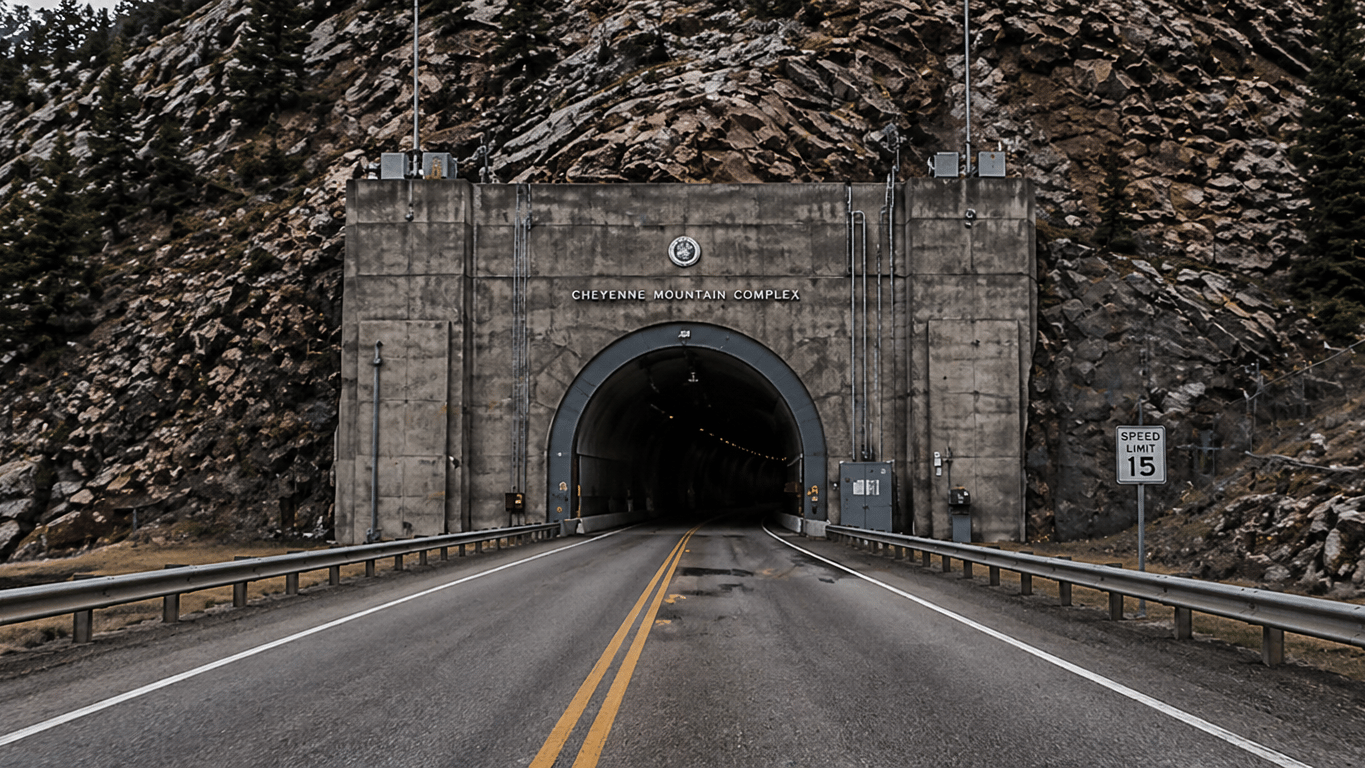
Cheyenne Mountain Complex
United States
Cheyenne Mountain Complex combines extraordinary hardened defence with a much less forgiving long-term operating model: a small survivor group can seal and hold it, but sustaining air, power, water and food without specialist support is the real constraint.
Overall
5.7 out of 10Defensibility
10 out of 10Isolation
2 out of 10Sustainability
5 out of 10Ranking context
How this base ranks
Global
#20 of 91 · Top 21.98%
Region · North America
#4 of 9 · Top 44.44%
Base Type · Subterranean
#3 of 12 · Top 25%
Field assessment
At a glance
Bottom Line
One of the hardest locations in the corpus for walkers to breach, but not a self-sustaining bunker: its survival value falls sharply if engineered life-support systems or finite supplies fail.
Biggest Trade-off
Near-maximum physical defence in exchange for heavy technical dependence and proximity to the Colorado Springs population source.
Most Likely Failure
The complex remains secure from direct pressure while a critical engineered system or finite resource fails inside it.
Score rationale
Why it scores this way
Defensibility · 10/10
Cheyenne sits in the highest credible real-world defensive class because direct access is hardened, constrained and failure-tolerant.
Advantages
- Blast doors, granite mass and hardened internal structures make direct walker breach exceptionally difficult.
Limitations
- The score does not rely on current weapons or military staffing, which are outside the physical Base evaluation.
Isolation · 2/10
Mountain terrain gives local separation, but the complex remains close to Colorado Springs and therefore receives substantial regional pressure.
Advantages
- The mountain setting separates the occupied underground core from ordinary street-level exposure.
Limitations
- Roughly seven miles from downtown Colorado Springs is not genuine geographic remoteness.
Sustainability · 5/10
The site can support people for meaningful periods, but its long-term habitat quality depends on engineered systems and finite resources.
Advantages
- Internal water, enclosed space and backup power create a credible operating habitat for the reference group.
Limitations
- Ventilation, cooling, power and water systems create a specialist-maintenance dependency during sealed operation.
Survival horizons
How survival changes over time
Exceptional immediate shelter
First 7 Days
The hardened boundary, controlled portal and internal infrastructure give the group an unusually strong immediate refuge.
Positive factors
- Direct walker pressure can be kept outside an exceptionally robust occupied boundary.
Risks
- The group must quickly inventory food, fuel and the condition of survival-critical systems rather than assuming the bunker runs itself.
Systems management becomes decisive
First 100 Days
Once the immediate security problem is contained, preserving ventilation, power, water and cooling becomes the central operating challenge.
Positive factors
- Redundant and manually operable features provide some tolerance for early failures.
Risks
- Specialist-system faults or depleted stores can reduce habitability without any perimeter breach.
Secure but technically brittle
Long Term
Long-term survival depends on simplifying or sustaining complex infrastructure and solving food/resource renewal beyond finite stored capacity.
Positive factors
- The physical shell and internal volume remain major enduring assets.
Risks
- No durable internal food-production pathway is established by the current evidence set.
Tactical assessment
Practical Reality
Reality Check
The mountain solves breach far better than it solves independent habitation; hardened command infrastructure is not automatically a self-sufficient settlement.
Best Use
A tightly controlled hardened refuge for a small group that can preserve critical systems and establish a realistic food plan before finite supplies become decisive.
Key Risk
A cascading failure in ventilation, power, cooling or water systems that ordinary survivors cannot repair with available skills and parts.
Strengths
- Massive blast doors, deep granite protection and hardened internal structures provide exceptional direct defence.
- Portal and tunnel geometry concentrate access into unusually few observable routes.
- Internal water reservoirs and backup generation provide a strong starting resource position.
Weaknesses
- Long-duration habitability depends on specialist ventilation, power, cooling and water systems.
- The site is close to a large Colorado Springs population source rather than genuinely remote.
- Current evidence does not establish a durable internal food-production pathway.
Assumptions / constraints
- The evaluation uses the fixed 20-capable-adult reference and does not assume rare specialist engineering expertise.
Decision context
Rivals / Alternatives
Similar rival
Hackenberg Maginot Fortress
France · Subterranean
Hackenberg Maginot Fortress keeps the same subterranean strategy, with only 0.3 points between the overall scores and closely matched sustainability pressure.
Overall 6/10
Strongest alternative
Olavsvern Naval Base
Norway · Subterranean
Olavsvern Naval Base scores 6.3 overall versus 5.7, adding a stronger sustainability profile while staying relevant as another subterranean.
Overall 6.3/10
Wildcard rival
Amundsen-Scott South Pole Station
Antarctica · Institutional Compound
Amundsen-Scott South Pole Station changes the strategy: it is a institutional compound with a isolation edge, while Cheyenne Mountain Complex holds more of the defensibility advantage.
Overall 7.7/10