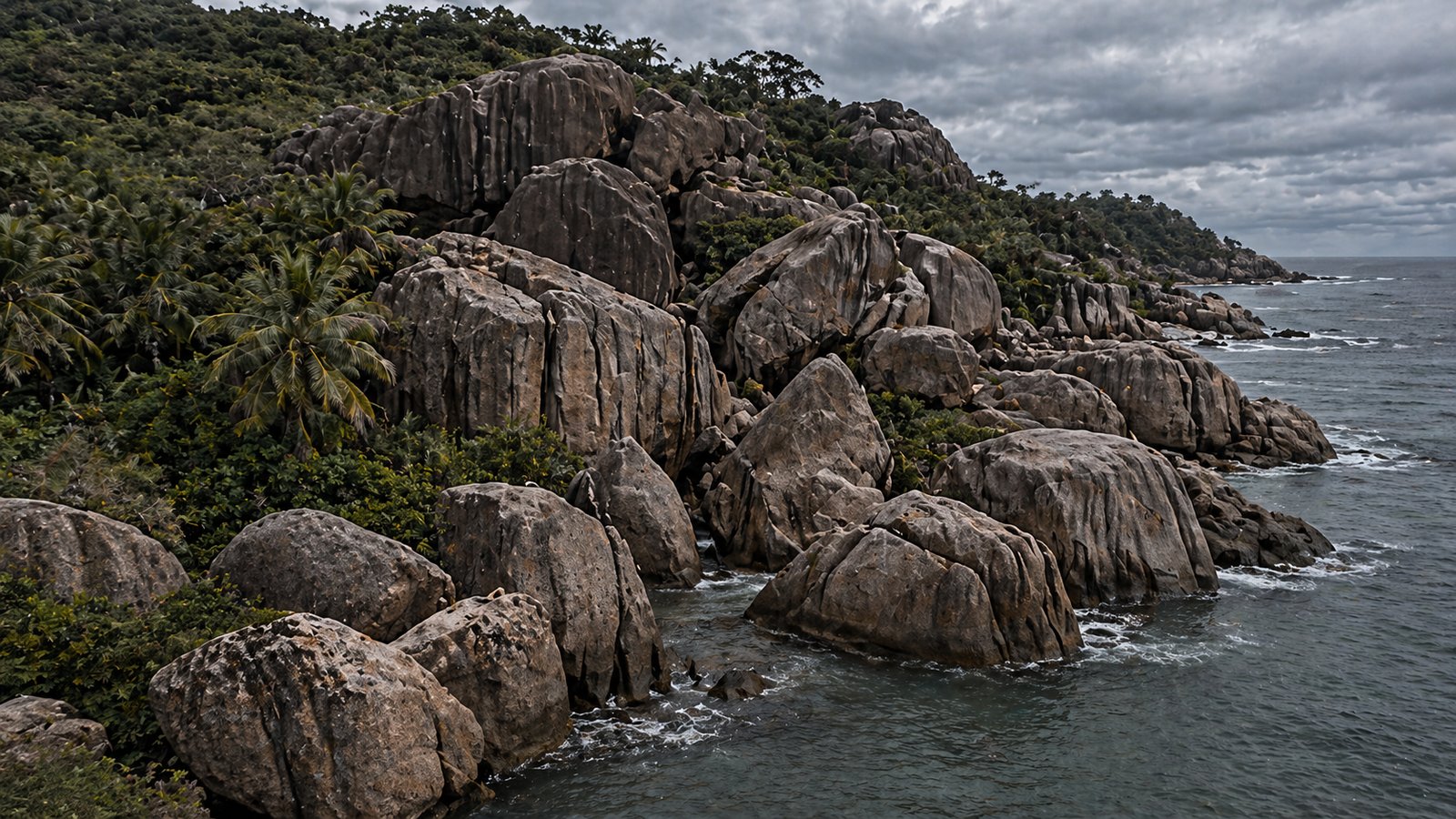
Africa · Isolated Landmass
Seychelles
Seychelles
Seychelles is strongest on Population Capacity 9/10 — The inhabited archipelago already supports more than 120,000 residents with mature housing and public utilities, giving exceptional capacity relative to twenty survivors even though infrastructure is concentrated on the main islands.. Its clearest scored constraint is Defensibility 1/10 — The canonical Base spans 115 islands, multiple inhabited centres, harbours and coastlines. Twenty survivors cannot defend the archipelago as one continuous position, and no preferred island is silently substituted..
Overall
4.7 out of 10Defensibility
1 out of 10Isolation
6 out of 10Sustainability
7 out of 10Ranking context
How this base ranks
Global
#55 of 91 · Top 60.44%
Region · Africa
#2 of 11 · Top 18.18%
Base Type · Isolated Landmass
#9 of 19 · Top 47.37%
Field assessment
At a glance
Bottom Line
For the fixed 20-person Base boundary, the most important endurance constraint is Maintenance Resilience 4/10 — Surface-water catchments, reservoirs and fisheries retain useful passive/local value, but water networks depend on 115 pumping stations and treatment infrastructure while desalination and electricity are energy intensive. With 95.8% fossil generation and substantial food imports, loss of fuel, machinery or parts materially degrades essential systems..
Biggest Trade-off
The central trade-off is the catalogue's strongest evidenced dimension, Population Capacity at 9/10, against its weakest evidenced dimension, Defensibility at 1/10.
Most Likely Failure
The clearest evidenced failure pressure is Maintenance Resilience: Surface-water catchments, reservoirs and fisheries retain useful passive/local value, but water networks depend on 115 pumping stations and treatment infrastructure while desalination and electricity are energy intensive. With 95.8% fossil generation and substantial food imports, loss of fuel, machinery or parts materially degrades essential systems.
Score rationale
Why it scores this way
Defensibility · 1/10
The canonical Base spans 115 islands, multiple inhabited centres, harbours and coastlines. Twenty survivors cannot defend the archipelago as one continuous position, and no preferred island is silently substituted.
Advantages
- Positive credit is limited to what supports the Defensibility score of 1/10; the component rationale is: The canonical Base spans 115 islands, multiple inhabited centres, harbours and coastlines. Twenty survivors cannot defend the archipelago as one continuous position, and no preferred island is silently substituted.
Limitations
- Do not infer additional Defensibility capability outside the fixed Base boundary or beyond the recorded evidence.
Isolation · 6/10
Seychelles is genuinely remote from continental population concentrations in the Indian Ocean, but more than 120,000 residents already live inside the canonical archipelago and normal international/inter-island transport exists. That combination supports materially advantageous, not extreme, effective isolation.
Advantages
- Positive credit is limited to what supports the Isolation score of 6/10; the component rationale is: Seychelles is genuinely remote from continental population concentrations in the Indian Ocean, but more than 120,000 residents already live inside the canonical archipelago and normal international/inter-island transport exists. That combination supports materially advantageous, not extreme, effective isolation.
Limitations
- Do not infer additional Isolation capability outside the fixed Base boundary or beyond the recorded evidence.
Sustainability · 7/10
A functioning island nation with housing, health/services, extensive potable-water systems, sewerage, fisheries and electricity provides strong existing habitat for twenty people. Dry-season water pressure and deep fuel/food import dependence make prolonged degraded-operation less robust than the strongest island societies.
Advantages
- Positive credit is limited to what supports the Sustainability score of 7/10; the component rationale is: A functioning island nation with housing, health/services, extensive potable-water systems, sewerage, fisheries and electricity provides strong existing habitat for twenty people. Dry-season water pressure and deep fuel/food import dependence make prolonged degraded-operation less robust than the strongest island societies.
Limitations
- Do not infer additional Sustainability capability outside the fixed Base boundary or beyond the recorded evidence.
Survival horizons
How survival changes over time
First 7 days: current defence/contact profile
First 7 Days
This horizon does not invent future upgrades or resupply. It carries the current evaluated conditions forward and keeps unknown future capability uncredited.
Positive factors
- The stronger current condition in this horizon is Exposure Control 5/10 — Ocean gaps strongly constrain movement between islands and from continents, but the canonical Base contains 115 islands, numerous shores/landing points and a six-figure resident population concentrated on the main islands. Twenty survivors gain strong regional separation without a simple archipelago-wide approach set..
Risks
- The weaker current condition in this horizon is Defensibility 1/10 — The canonical Base spans 115 islands, multiple inhabited centres, harbours and coastlines. Twenty survivors cannot defend the archipelago as one continuous position, and no preferred island is silently substituted.; no better future state is assumed.
First 100 days: current habitat/capacity profile
First 100 Days
This horizon does not invent future upgrades or resupply. It carries the current evaluated conditions forward and keeps unknown future capability uncredited.
Positive factors
- The stronger current condition in this horizon is Population Capacity 9/10 — The inhabited archipelago already supports more than 120,000 residents with mature housing and public utilities, giving exceptional capacity relative to twenty survivors even though infrastructure is concentrated on the main islands..
Risks
- The weaker current condition in this horizon is Sustainability 7/10 — A functioning island nation with housing, health/services, extensive potable-water systems, sewerage, fisheries and electricity provides strong existing habitat for twenty people. Dry-season water pressure and deep fuel/food import dependence make prolonged degraded-operation less robust than the strongest island societies.; no better future state is assumed.
Long term: current resource/maintenance profile
Long Term
This horizon does not invent future upgrades or resupply. It carries the current evaluated conditions forward and keeps unknown future capability uncredited.
Positive factors
- The stronger current condition in this horizon is Resource Security 5/10 — Seychelles has a diversified potable-water system with reservoirs, rivers, boreholes and desalination plus exceptional marine-fish access. Those strengths are balanced by roughly 70% food-import dependence, tiny agricultural land availability and near-total fossil-fuel dependence for electricity. The result is a genuinely viable mixed resource position, not strong autonomy..
Risks
- The weaker current condition in this horizon is Maintenance Resilience 4/10 — Surface-water catchments, reservoirs and fisheries retain useful passive/local value, but water networks depend on 115 pumping stations and treatment infrastructure while desalination and electricity are energy intensive. With 95.8% fossil generation and substantial food imports, loss of fuel, machinery or parts materially degrades essential systems.; no better future state is assumed.
Tactical assessment
Practical Reality
Reality Check
Scores apply only to the defined Base and exactly 20 capable adults. Unknown, excluded or external assets are not credited as hidden capability.
Best Use
Within the evaluated boundary, treat Population Capacity as the primary operational strength; do not promote that score into capabilities the evidence does not establish.
Key Risk
Maintenance Resilience is the key evidenced long-duration risk: Surface-water catchments, reservoirs and fisheries retain useful passive/local value, but water networks depend on 115 pumping stations and treatment infrastructure while desalination and electricity are energy intensive. With 95.8% fossil generation and substantial food imports, loss of fuel, machinery or parts materially degrades essential systems.
Strengths
- One of the strongest scored dimensions is Population Capacity 9/10 — The inhabited archipelago already supports more than 120,000 residents with mature housing and public utilities, giving exceptional capacity relative to twenty survivors even though infrastructure is concentrated on the main islands..
- One of the strongest scored dimensions is Sustainability 7/10 — A functioning island nation with housing, health/services, extensive potable-water systems, sewerage, fisheries and electricity provides strong existing habitat for twenty people. Dry-season water pressure and deep fuel/food import dependence make prolonged degraded-operation less robust than the strongest island societies..
- One of the strongest scored dimensions is Isolation 6/10 — Seychelles is genuinely remote from continental population concentrations in the Indian Ocean, but more than 120,000 residents already live inside the canonical archipelago and normal international/inter-island transport exists. That combination supports materially advantageous, not extreme, effective isolation..
Weaknesses
- One of the weakest scored dimensions is Defensibility 1/10 — The canonical Base spans 115 islands, multiple inhabited centres, harbours and coastlines. Twenty survivors cannot defend the archipelago as one continuous position, and no preferred island is silently substituted..
- One of the weakest scored dimensions is Maintenance Resilience 4/10 — Surface-water catchments, reservoirs and fisheries retain useful passive/local value, but water networks depend on 115 pumping stations and treatment infrastructure while desalination and electricity are energy intensive. With 95.8% fossil generation and substantial food imports, loss of fuel, machinery or parts materially degrades essential systems..
- One of the weakest scored dimensions is Exposure Control 5/10 — Ocean gaps strongly constrain movement between islands and from continents, but the canonical Base contains 115 islands, numerous shores/landing points and a six-figure resident population concentrated on the main islands. Twenty survivors gain strong regional separation without a simple archipelago-wide approach set..
Assumptions / constraints
- Only assets inside the recorded Core Base and immediate operating boundary are credited; excluded surroundings and unproven future access remain outside the score.
Decision context
Rivals / Alternatives
Similar rival
Île d’Yeu
France · Isolated Landmass
Île d’Yeu keeps the same isolated landmass strategy, with only 0.0 points between the overall scores and closely matched defensibility pressure.
Overall 4.7/10
Strongest alternative
Heligoland
Germany · Isolated Landmass
Heligoland scores 6.3 overall versus 4.7, adding a stronger isolation profile while staying relevant as another isolated landmass.
Overall 6.3/10
Wildcard rival
San Felipe Fortress
Colombia · Fortified Structure
San Felipe Fortress changes the strategy: it is a fortified structure with a defensibility edge, while Seychelles holds more of the isolation advantage.
Overall 3.7/10